

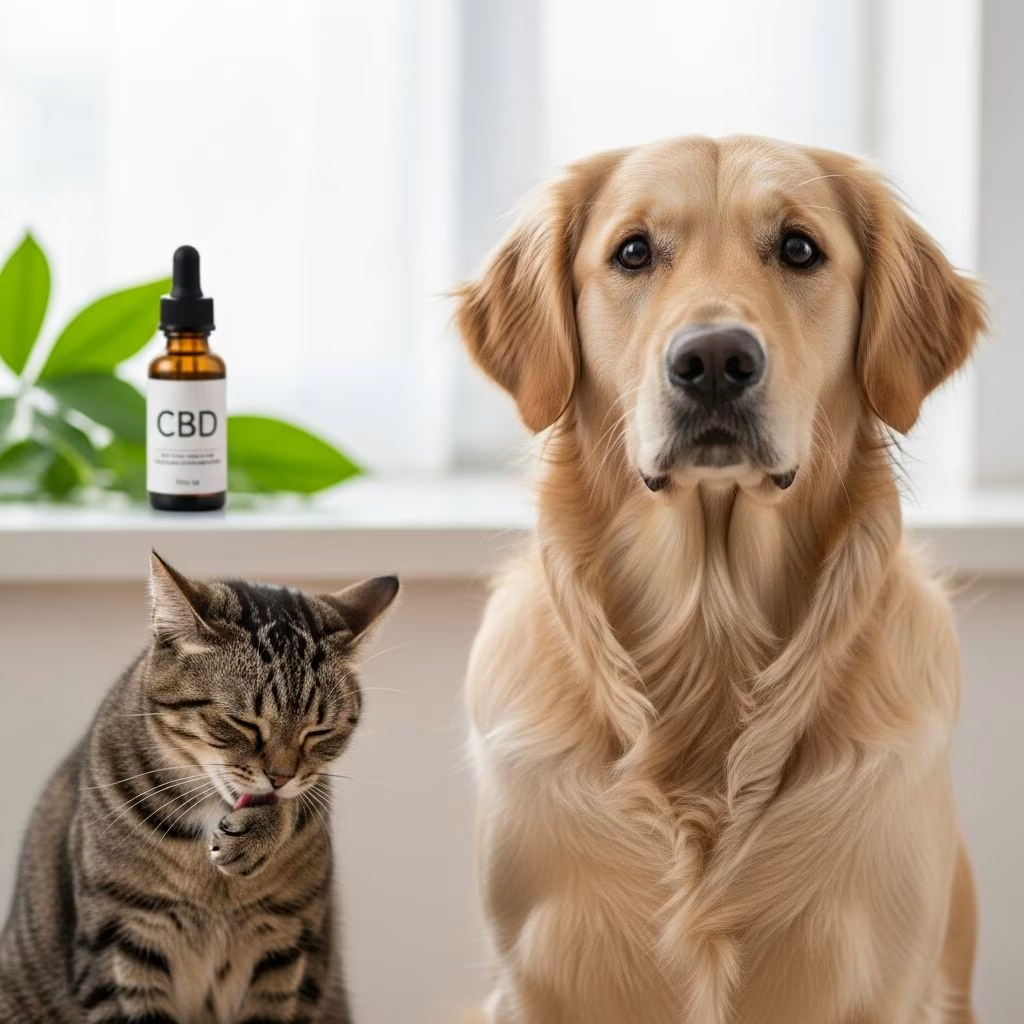
Cannabidiol (CBD), a compound derived from hemp, has gained popularity among pet owners seeking natural remedies for various health issues in dogs and cats. Recent scientific studies indicate that CBD is generally well-tolerated in companion animals at physiological doses, showing good bioavailability and minimal side effects. However, while promising for conditions like osteoarthritis, epilepsy, and anxiety, more research is needed to confirm efficacy and establish standardized guidelines.
Understanding CBD and Its Rise in Pet Care
CBD is one of over 100 cannabinoids found in the cannabis plant, distinct from THC, the psychoactive component that causes a ‘high.’ Hemp-derived CBD products contain less than 0.3% THC, making them non-intoxicating. Pet owners increasingly turn to CBD for its potential anti-inflammatory, analgesic, and anxiolytic properties. Studies confirm that oral CBD achieves effective absorption in dogs and cats, supporting its use in treats, oils, and tinctures.
The surge in pet CBD products stems from anecdotal reports of relief from chronic pain, seizures, and stress. Regulatory bodies like the FDA have not approved CBD for animal use, emphasizing the need for caution due to variable product quality. High-quality, third-party tested products are essential to ensure accurate labeling and purity.
Scientific Evidence on CBD Safety in Dogs and Cats
Multiple peer-reviewed studies affirm CBD’s safety profile in healthy dogs. A 90-day trial dosing beagles at 5 mg/kg body weight per day with CBD, CBD+CBG, or CBD+CBDA reported no serious adverse events, somnolence, or clinically significant changes. Similarly, doses up to 4 mg/kg daily over six months showed no impact on health or wellbeing, with elevated alkaline phosphatase (ALP) levels deemed non-clinically relevant.
In cats, preliminary data mirrors these findings, with good tolerability at physiological doses. Short-term administration (up to 28 days) at doses ranging from 1-12 mg/kg also proved safe, with only mild effects like lethargy at higher levels. Long-term data is emerging, but current evidence suggests low risk for extended use in healthy animals.
| Study Focus | Dose Range | Duration | Key Findings |
|---|---|---|---|
| Healthy Dogs (Broad-spectrum CBD) | 4 mg/kg/day | 6 months | No adverse effects; well-tolerated |
| CBD + CBG/CBDA in Beagles | 5 mg/kg/day | 90 days | No SAE; minor hypersalivation |
| Repeat Dose Trial | 1-12 mg/kg/day | 28 days | Mild effects at high doses |
| Osteoarthritis/Epilepsy | Varied | Short-term | Improved signs; safe profile |
Potential Benefits of CBD for Common Pet Conditions
Research highlights CBD’s promise for specific ailments. In dogs with osteoarthritis, CBD reduced pain and improved mobility, with over 80% showing positive responses in early Cornell studies. For epilepsy, clinical signs improved, though not all dogs benefited equally.
- Anxiety and Stress: Daily 4 mg/kg dosing over 24 weeks significantly lowered cortisol, whining, and lip-licking during car travel, indicating mild anxiolytic effects.
- Pruritus and Skin Issues: Reduced scratching behavior observed in trials.
- Seizures: Some reduction in frequency, pending larger studies.
- Pain Management: Effective for osteoarthritis-associated discomfort.
For cats, evidence is sparser but suggests similar benefits for anxiety and aggression, with calls for targeted research.
Dosing Guidelines and Administration Tips
Safe dosing typically ranges from 2-5 mg/kg body weight daily, divided into one or two administrations. Start low and titrate based on response, monitoring for side effects like diarrhea, vomiting, or sedation. Oils under the tongue offer faster absorption than treats.
Weight-based dosing example:
- Small dog (10 lbs): 4.5-23 mg/day
- Medium dog (50 lbs): 23-113 mg/day
- Large dog (100 lbs): 45-227 mg/day
Consult a veterinarian for personalized advice, especially with concurrent medications, as CBD may affect liver enzymes.
Risks, Side Effects, and Contraindications
While generally safe, CBD can cause mild gastrointestinal upset, dry mouth, or elevated liver enzymes at high doses. THC contamination poses greater risks, including ataxia and neurological symptoms. Dogs are more sensitive to THC than humans.
Pregnant or lactating pets, those with liver disease, or on drugs metabolized by cytochrome P450 should avoid CBD. Product inconsistency remains a concern; FDA tests revealed many lack claimed CBD levels.
Regulatory Landscape and Product Selection
CBD for pets falls in a gray area. The FDA deems it unapproved for animals, and some regions restrict veterinary recommendations. In the EU and UK, CBD products are supplements, not medicines, lacking marketing authorizations.
Choose products with:
- Third-party lab certificates of analysis (COA)
- Hemp-derived, full/broad-spectrum with <0.3% THC
- Veterinarian-formulated options
- Clear labeling of mg CBD per serving
Expert Perspectives from Veterinary Research
Veterinarians urge evidence-based use. While not a ‘miracle cure,’ CBD shows adjunctive potential. Ongoing trials at institutions like the University of Colorado explore efficacy for osteoarthritis and epilepsy. Cornell’s work supports pain relief in arthritic dogs.
Researchers stress the need for standardized extracts, longer trials, and species-specific data. Post-market surveillance like NAERS indicates rare adverse events (1.6-2.8 per million doses).
Frequently Asked Questions (FAQs)
Can CBD make my dog high?
No, reputable hemp CBD has negligible THC, preventing psychoactive effects.
Is CBD legal for pets?
Federal law allows hemp-derived CBD (<0.3% THC), but check state regs; FDA unapproved for animals.
How long does it take for CBD to work in pets?
Effects may appear in 30-60 minutes for acute issues, 1-2 weeks for chronic conditions.
Can cats use CBD safely?
Yes, at adjusted doses, with good tolerability shown in studies.
Should I give CBD with food?
Yes, fatty foods enhance absorption.
Future Directions in Pet CBD Research
Emerging studies focus on pharmacokinetics, interactions, and condition-specific efficacy. Long-term safety in diverse populations, optimal formulations (e.g., nano-emulsified), and combination therapies are priorities. Real-world data from adverse event reporting strengthens the safety case.
Pet owners should view CBD as a complementary tool, not replacement for vet care. Collaborate with professionals to integrate it safely.
References
- Scientific Validation of Cannabidiol for Management of Dog and Cat… — PubMed/NCBI. 2023-02-16. https://pubmed.ncbi.nlm.nih.gov/36790884/
- Safety study of cannabidiol products in healthy dogs — Frontiers in Veterinary Science. 2024. https://www.frontiersin.org/journals/veterinary-science/articles/10.3389/fvets.2024.1349590/full
- CBD Oil for Dogs: Is It Safe and Effective? — Standiford Veterinary. Recent (pre-2026). https://standifordveterinary.com/services/other/blog/cbd-oil-dogs-it-safe-and-effective.html
- CBD for pets: navigating quality assurance, safety standards… — PMC/NCBI. 2024. https://pmc.ncbi.nlm.nih.gov/articles/PMC11755934/
- Daily dosing of cannabidiol (CBD) demonstrates a positive effect… — Journal of Animal Science, Oxford Academic. 2023. https://academic.oup.com/jas/article/doi/10.1093/jas/skad414/7582589
- CBD: What you need to know about its uses and efficacy — Cornell University College of Veterinary Medicine. Recent (pre-2026). https://www.vet.cornell.edu/departments-centers-and-institutes/riney-canine-health-center/canine-health-topics/cbd-what-you-need-know-about-its-uses-and-efficacy



