

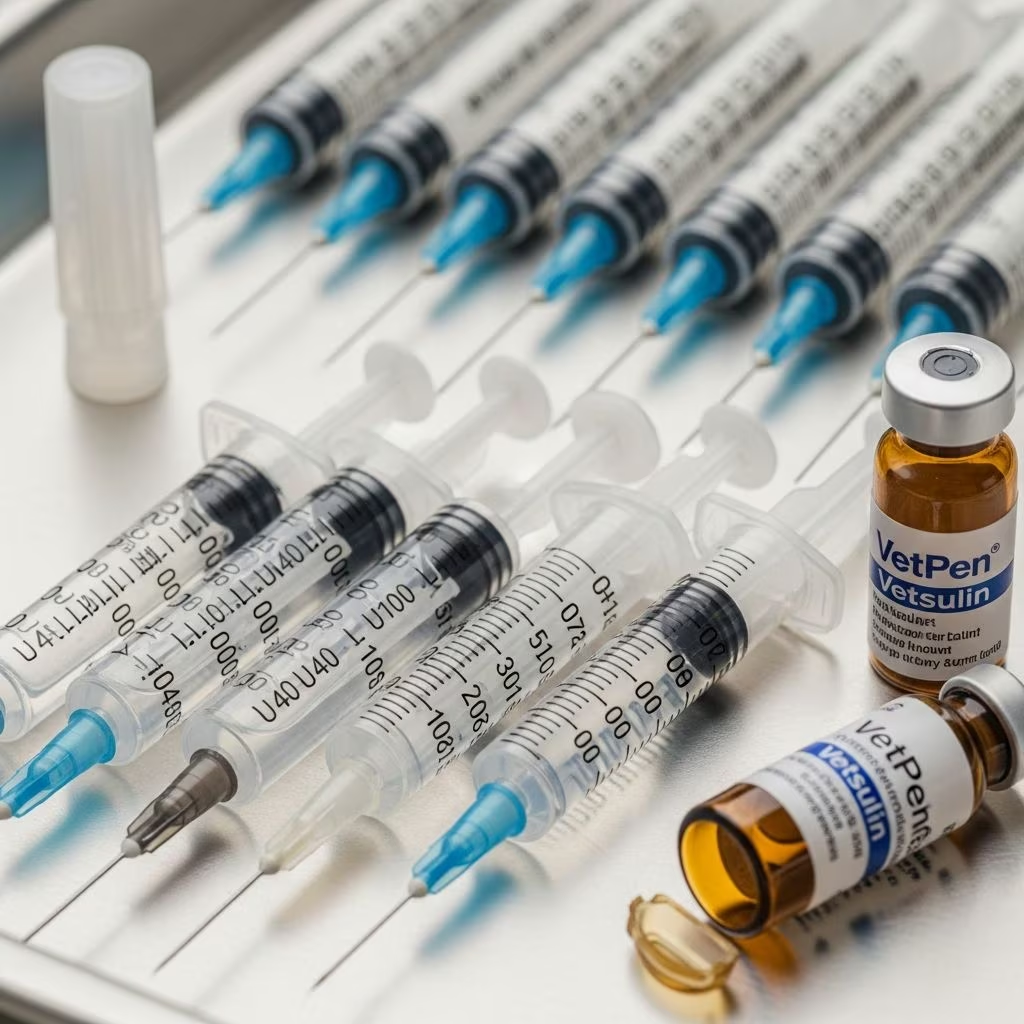
Diabetes management in dogs and cats hinges on precise insulin dosing, where syringe-insulin concentration mismatches can lead to serious health risks. This guide explains how to correctly adjust U-100 and U-40 insulin volumes for safe administration, drawing from veterinary pharmacology principles to empower pet owners.
The Fundamentals of Pet Insulin Concentrations
Insulin solutions are standardized by units per milliliter (U/ml): U-100 contains 100 units per ml, while U-40 has 40 units per ml. Syringes are marked accordingly—U-100 syringes measure finer increments for human insulins often repurposed in pets, whereas U-40 syringes suit veterinary-specific formulations like protamine zinc insulin (PZI) or lente.
Veterinarians select concentrations based on species needs: dogs typically use intermediate-acting U-100 insulins like NPH, while cats favor long-acting options such as glargine (U-100) or rhPZI (U-40). Mismatching without conversion risks overdose (hypoglycemia) or underdose (persistent hyperglycemia), potentially causing seizures, organ damage, or diabetic ketoacidosis.
Why Concentration Matching Prevents Errors
A U-100 syringe with U-40 insulin delivers 2.5 times more units per mark, amplifying doses dangerously. Conversely, a U-40 syringe with U-100 insulin underdelivers by the same factor. The conversion ratio is always 100/40 = 2.5, a fixed mathematical relationship rooted in concentration differences.
- Hypoglycemia risks: Shaking, weakness, collapse—treat immediately with glucose.
- Hyperglycemia risks: Excessive thirst, weight loss, infections—signals need for vet adjustment.
Consistent matching ensures therapeutic levels, with studies showing glargine and PZI achieve glycemic control in 56-72% of cats when dosed correctly.
Mastering U-40 to U-100 Conversions
When switching to a U-100 syringe for U-40 insulin, multiply the prescribed U-40 units by 2.5 to find the equivalent volume.
| Prescribed U-40 Dose (units) | Conversion Factor | U-100 Syringe Volume (units) |
|---|---|---|
| 1 | x 2.5 | 2.5 |
| 2 | x 2.5 | 5 |
| 4 | x 2.5 | 10 |
| 6 | x 2.5 | 15 |
Example: A cat on 3 units U-40 needs 7.5 units on a U-100 syringe—round per vet instructions, often to nearest half-unit if using appropriate syringes.
Mastering U-100 to U-40 Conversions
For U-100 insulin in a U-40 syringe, divide the prescribed dose by 2.5.
| Prescribed U-100 Dose (units) | Conversion Factor | U-40 Syringe Volume (units) |
|---|---|---|
| 5 | / 2.5 | 2 |
| 10 | / 2.5 | 4 |
| 15 | / 2.5 | 6 |
| 20 | / 2.5 | 8 |
Example: A dog prescribed 12.5 units U-100 draws 5 units on a U-40 syringe. Always verify with a calculator and consult your vet before first use.
Practical Steps for Accurate Dosing
- Consult your vet: Confirm prescription, concentration, and any recent bloodwork.
- Gather supplies: Fresh insulin vial, matching syringe (or converted), alcohol swabs, glucose source.
- Prepare insulin: Gently roll (don’t shake) vial; draw air equal to dose, inject into vial, then draw dose.
- Convert if needed: Apply 2.5x multiplier or divider precisely.
- Inject subcutaneously: Pinch skin on flank or scruff, angle needle 45 degrees, inject slowly.
- Feed immediately: Offer meal to counter hypoglycemia risk.
- Log everything: Time, dose, food intake, behavior.
For precision, use insulin pens calibrated in 0.5 or 1-unit increments, available for both species.
Tailored Insulin Strategies for Dogs
Dogs thrive on intermediate insulins like NPH or lente (U-100 or U-40), dosed 0.25-0.5 U/kg twice daily. Their predictable eating aligns with twice-daily injections. Protamine zinc (e.g., Vetsulin, U-40) offers once- or twice-daily options, minimizing Somogyi rebound (hypoglycemia-induced hyperglycemia).
- Monitor via blood glucose curves and fructosamine monthly.
- Watch for exercise-induced lows: Adjust for hikes or play.
- Starting dose: 0.5 U/kg, titrate based on curves.
Tailored Insulin Strategies for Cats
Felines demand long-acting insulins: glargine or detemir (U-100), rhPZI (U-40), at 0.25-0.5 U/kg q12h, often ≤2 units total per cat. Stress hyperglycemia complicates curves; prefer home monitoring or continuous glucose devices. Low-carb diets boost remission rates to 68-72%.
- Twice-daily dosing preferred for sustained control.
- Signs of issues: Hiding, vocalizing unusually.
- Remission possible in newly diagnosed cases with tight control.
Advanced Monitoring Techniques
Beyond conversions, track via:
- Home glucometers: Ear or paw pricks for curves.
- Fructosamine tests: Reflect 1-3 week average glucose.
- Urine strips: Detect glucosuria/ketones.
- Apps/logs: Trend data for vet reviews.
Adjustments occur gradually; never halve doses unilaterally. AAHA guidelines stress glargine for cats due to remission efficacy.
Frequently Asked Questions (FAQs)
Can I mix U-100 and U-40 syringes long-term?
No—stick to matched sets or precise conversions to avoid errors. Consult vet for switches.
What if my pet refuses food after insulin?
Offer syrup; contact vet—skipped meals risk lows.
Are insulin pens better than syringes?
Yes for accuracy, especially small doses in cats.
How often to recheck bloodwork?
Every 2-4 weeks initially, then monthly.
Does diet impact dosing?
Absolutely—low-carb for cats enhances insulin sensitivity.
Emergency Protocols for Complications
Hypoglycemia: Rub honey on gums, seek emergency care if unresponsive.
Hyperglycemia: Vet evaluation for infection, dose tweak.
Store insulin refrigerated; discard if frozen or discolored.
References
- Converting U-100 & U-40 Insulin Syringes for Dogs and Cats — PetPlace. Accessed 2026. https://www.petplace.com/article/drug-library/drug-library/library/how-to-convert-u-100-and-u-40-insulin-and-syringes-for-dogs-and-cats
- Update on insulin treatment for dogs and cats: insulin dosing pens — PMC/NCBI. 2018-07-26. https://pmc.ncbi.nlm.nih.gov/articles/PMC6067590/
- Switching to Another Insulin: What & How — Clinician’s Brief. Accessed 2026. https://www.cliniciansbrief.com/article/switching-another-insulin-what-how
- 2018 AAHA Diabetes Management Guideline for Dogs and Cats: Insulin Therapies — AAHA. 2018. https://www.aaha.org/resources/2018-aaha-diabetes-management-guideline-for-dogs-and-cats/insulin-therapies/
- Understanding Insulin for Diabetic Pets — Tufts VETS. Accessed 2026. https://tuftsvets.org/about/blog/understanding-insulin-for-diabetic-pets.php



