

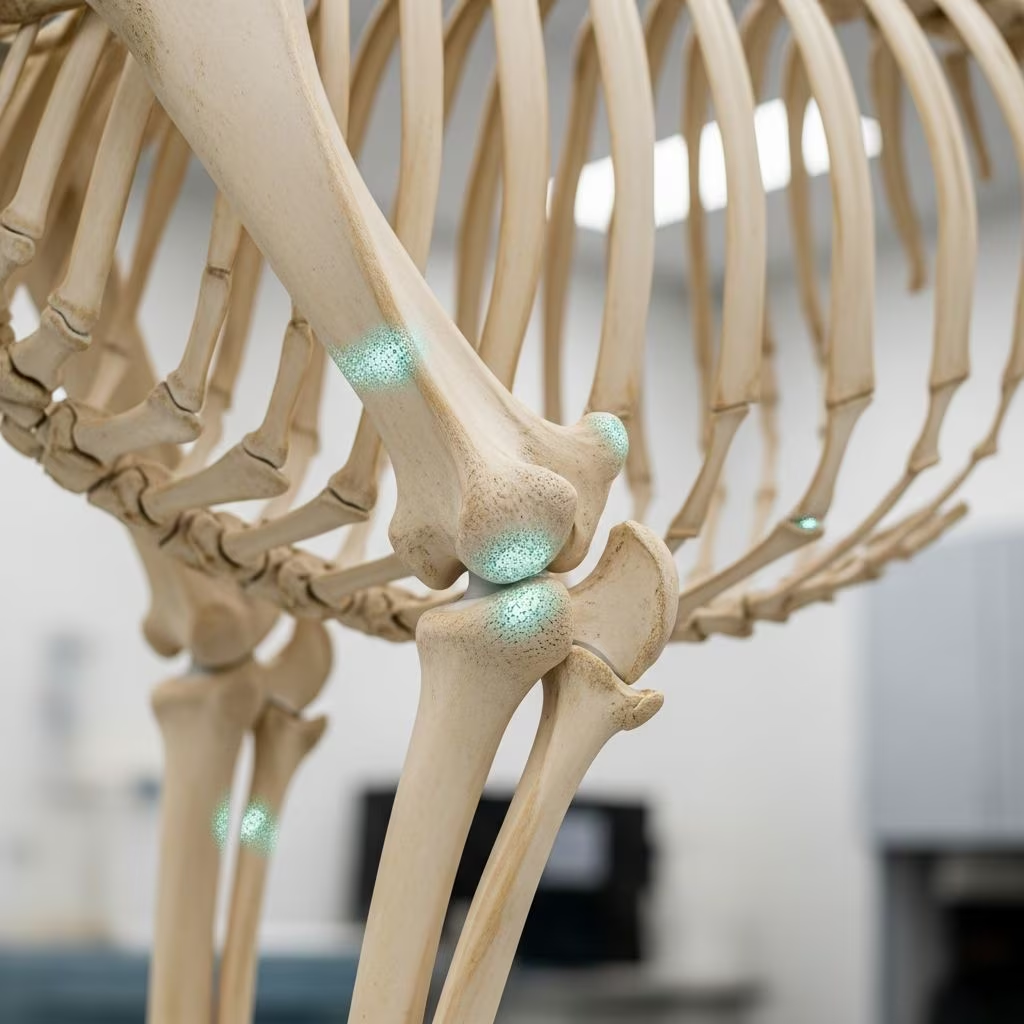
Large animals like cattle, horses, sheep, and pigs can suffer from a variety of congenital and inherited musculoskeletal problems that impact their growth, mobility, and productivity. These conditions often stem from genetic mutations, environmental influences during pregnancy, or nutritional imbalances in early life. Understanding these disorders helps veterinarians and farmers implement targeted breeding programs and early interventions to minimize losses in livestock operations.
Understanding the Origins of Musculoskeletal Anomalies
Musculoskeletal anomalies in large animals arise either congenitally, meaning they are present at birth due to intrauterine development issues, or develop postnatally through a mix of genetic predispositions and external factors. Congenital issues frequently result from genetic defects passed through breeding lines, while developmental orthopedic diseases emerge during rapid growth phases, influenced by overnutrition or mechanical stress on immature bones and joints.
Genetic factors play a dominant role in many cases, with specific enzyme deficiencies or growth factor disruptions leading to abnormal bone formation, muscle development, or joint alignment. For instance, lysosomal storage diseases occur when cells accumulate undegraded materials due to missing enzymes, causing skeletal distortions. Environmental triggers, such as maternal toxin exposure or poor uterine nutrition, can exacerbate these genetic vulnerabilities, resulting in deformities that become evident shortly after birth or during the growth spurt.
Common Limb Deformities and Their Impact
Limb deformities represent some of the most frequently observed musculoskeletal issues in newborn foals, calves, and lambs. These can be categorized into flexural and angular types, each presenting unique challenges to animal health and farm economics.
Flexural Deformities: Contracted Flexor Tendons
Flexural deformities involve excessive flexion or extension of joints, primarily due to imbalances in the length of the flexor tendon unit relative to the bone. In severe cases, known as contracted flexor tendons, foals or calves are born with limbs fixed in a flexed position, making standing difficult. This condition often affects the distal interphalangeal joint, leading to a ‘club foot’ appearance.
Causes include intrauterine malpositioning, rapid fetal growth outpacing tendon development, or hereditary weaknesses in connective tissues. Mild cases may resolve with supportive care like splinting and controlled exercise, but severe instances require surgical tendon lengthening to restore function and prevent secondary joint damage.
Angular Deformities: Valgus and Varus Deviations
Angular limb deformities manifest as lateral (valgus) or medial (varus) deviations, commonly in the carpus, tarsus, or fetlock regions. These arise from asymmetric growth in the physes (growth plates) of long bones or laxity in supporting ligaments. Fast-growing breeds like thoroughbred foals are particularly susceptible due to excessive weight-bearing on immature cuboidal bones.
Diagnosis involves radiographs to assess physeal closure and bone modeling abnormalities. Treatment strategies range from corrective farriery and exercise restriction to periosteal stripping or osteotomies in persistent cases. Early detection during the first few months of life is crucial for favorable outcomes.
| Deformity Type | Common Sites | Affected Species | Treatment Options |
|---|---|---|---|
| Flexural | Fetlock, pastern | Foals, calves | Splints, surgery |
| Angular Valgus | Carpus, hock | Foals, pigs | Farriery, periosteal stripping |
| Angular Varus | Tarsus, stifle | Calves, lambs | Exercise management, bracing |
Skeletal Dysplasias and Dwarfism Syndromes
Skeletal dysplasias encompass a range of disorders characterized by disproportionate or stunted bone growth, often lethal in homozygous forms. In cattle, bulldog chondrodysplasia stands out as a classic example, where affected calves exhibit extremely short limbs, a domed cranium, and abdominal hernias due to defective endochondral ossification.
This condition, linked to mutations in the ACAN gene, follows an incompletely dominant inheritance pattern prevalent in Dexter and certain Holstein lines. Heterozygous carriers may show milder dwarfism, impacting breeding decisions. Similarly, complex vertebral malformations in Holsteins involve hemivertebrae and scoliosis, often accompanied by cardiac anomalies, leading to high perinatal mortality.
Other dysplasias, like Telemark or snorter types in cattle, present with brachycephalic features and respiratory compromise, highlighting the need for genomic screening in seedstock herds.
Muscle Disorders: From Hyperplasia to Myopathies
Muscle-related congenital anomalies vary from hypertrophic conditions to degenerative myopathies, each with distinct genetic bases and clinical presentations.
Double Muscling and Hyperplasia
Double muscling, or muscular hyperplasia, results from myostatin gene mutations that inhibit muscle growth regulation. Breeds like Belgian Blue, Charolais, and Piedmontese exhibit pronounced muscling in the hindquarters and loins, but suffer drawbacks including dystocia, reduced fertility, and weaker respiratory muscles. While economically advantageous for beef production, careful calving assistance is essential.
Myopathies and Glycogen Storage Diseases
Inherited myopathies include diaphragmatic muscle atrophy in Holstein-Friesians, causing bloat and exercise intolerance in adults, and glycogen storage diseases (GSD) where enzyme deficiencies lead to carbohydrate accumulation in muscles. Type II GSD in Brahman cattle manifests as profound weakness and inability to stand, inherited recessively.
Myotonia in goats, dubbed ‘fainting goats,’ involves delayed muscle relaxation due to chloride channel defects, triggered by sudden movements. These animals appear stiff but recover quickly, posing no life threat.
- Myofibrillar hypoplasia: Seen in piglets (splay leg), impairing hindlimb extension.
- Muscle steatosis: Fatty infiltration in slaughter animals, occasionally causing gait issues.
- Malignant hyperthermia: Acute stress response in pigs, leading to fatal hyperthermia.
Lysosomal Storage and Metabolic Disorders
Lysosomal storage diseases disrupt cellular waste clearance, accumulating glycosaminoglycans in bones and joints. GM1 gangliosidosis in cattle and sheep, from beta-galactosidase deficiency, causes dwarfism, vertebral irregularities, and arthritis. These progressive conditions shorten lifespans and require euthanasia in severe cases.
Metabolic myopathies, like phosphorylase deficiency, mimic human McArdle disease, presenting with exercise-induced weakness in horses and ruminants.
Diagnostic Approaches and Management Strategies
Diagnosing these anomalies relies on clinical examination, radiography, ultrasonography, and genetic testing. For limb deformities, serial radiographs track physeal growth; muscle biopsies confirm myopathies via histopathology.
Management emphasizes prevention through pedigree analysis and avoiding carrier matings. Nutritional optimization—balancing energy, minerals like copper and zinc—mitigates developmental risks. Surgical corrections, physical therapy, and orthotics improve quality of life in viable cases.
Breeding Implications and Genetic Selection
Herd health programs integrate genomic selection tools to eliminate deleterious alleles. For double muscling, marker-assisted selection balances yield gains against calving ease. Public databases and breed associations provide allele frequency data, guiding sire choices.
Frequently Asked Questions (FAQs)
What causes contracted tendons in foals?
Primarily intrauterine positioning errors or rapid growth, with genetic factors in some lines.
Is double muscling harmful to cattle?
It boosts meat yield but increases dystocia and reduces fertility.
Can angular deformities be corrected?
Yes, early intervention with farriery and surgery yields high success rates.
How is bulldog syndrome inherited?
Incompletely dominant; heterozygotes viable but dwarfed.
Are lysosomal diseases treatable?
Currently supportive only; gene therapy research ongoing.
References
- Overview of Congenital and Inherited Anomalies of the Musculoskeletal System in Large Animals — Merck Veterinary Manual. 2023. https://www.merckvetmanual.com/musculoskeletal-system/congenital-and-inherited-anomalies-of-the-musculoskeletal-system/overview-of-congenital-and-inherited-anomalies-of-the-musculoskeletal-system-in-large-animals
- Congenital and Inherited Anomalies of the Musculoskeletal System in Cattle — MSD Veterinary Manual. 2023. https://www.msdvetmanual.com/musculoskeletal-system/congenital-and-inherited-anomalies-of-the-musculoskeletal-system/congenital-and-inherited-anomalies-of-the-musculoskeletal-system-in-cattle
- Review of Major Congenital Malformation in Cattle: Its Causes and Consequences — Juniper Publishers (Academic). 2022. https://juniperpublishers.com/jdvs/JDVS.MS.ID.555925.php
- Exploring skeletal disorders in cattle and sheep: a WGS screening identifies novel candidate genes and variants — PMC/NIH (Peer-reviewed). 2023-10-15. https://pmc.ncbi.nlm.nih.gov/articles/PMC12465177/
- Approach to Investigating Congenital Skeletal Abnormalities in Animals — SAGE Journals (Peer-reviewed). 2015-04-15. https://journals.sagepub.com/doi/10.1177/0300985815579999



