

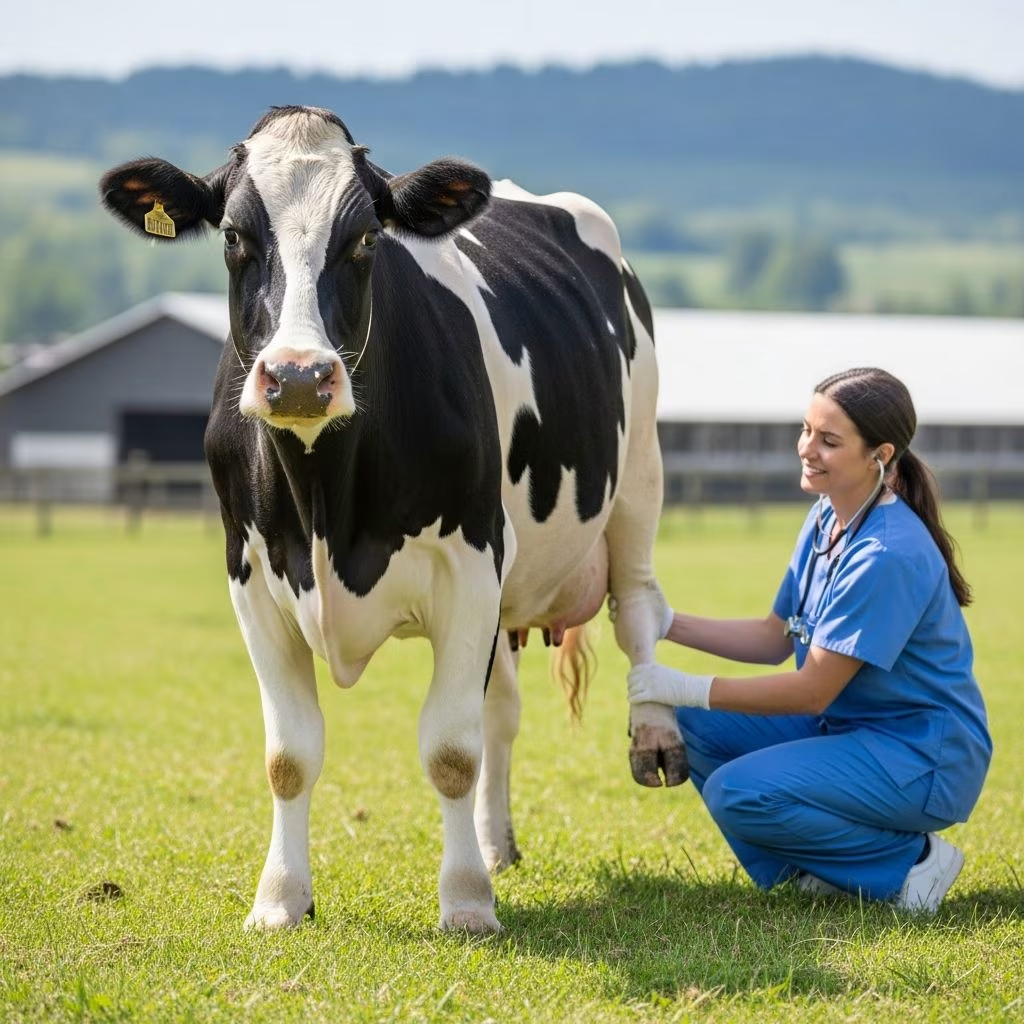
Cattle populations worldwide face various congenital and genetic conditions affecting their musculoskeletal systems, leading to significant economic losses for producers through reduced productivity, dystocia, and high mortality rates. These disorders range from limb contractures and joint fixations to muscle weaknesses and bone malformations, often traceable to recessive genes or environmental teratogens during gestation.
Prevalence and Economic Impact
Among bovine congenital defects, musculoskeletal issues dominate, accounting for over 80% of recorded cases in some surveys. Intestinal atresia and schistosomus reflexus follow, but limb and joint anomalies like ankylosis are frequent, especially when combined with other system involvements. These conditions contribute to stillbirths, neonatal deaths, and culling, with musculoskeletal defects most commonly paired with neurological or digestive problems, indicating multifactorial origins.
Farm-level data reveals that while many operations report no cases over five years, affected herds suffer from deformed calves unable to stand or nurse, exacerbating labor costs and genetic dilution in breeding stock.
Limb Deformities and Flexural Abnormalities
Contracted flexor tendons represent one of the most widespread neonatal issues in calves, manifesting as flexed limbs that hinder standing. This sagittal plane deformity primarily affects foals and calves, with genetic and intrauterine positioning as contributors.
- Forelimb involvement: Medial carpal deviation, bowed radius/ulna, and irregular growth plates.
- Hindlimb features: Medially deviated hocks, bowed tibiae, and muscle atrophy.
Syndactyly, or fused digits, prevails in Holsteins as an autosomal recessive trait, often striking forefeet and causing high-stepping gaits and heat sensitivity. Affected animals navigate slowly, impacting herd mobility.
Arthrogryposis and Related Rigidities
Arthrogryposis multiplex, a lethal recessive defect in Charolais and Angus, produces calves with fixed, twisted joints, kyphoscoliosis, and hypoplastic muscles. Birth weights are low (15-25 kg), yet dystocia is prevalent due to malpositioned limbs from fetal immobility.
| Condition | Breeds Affected | Inheritance | Key Features |
|---|---|---|---|
| Arthrogryposis Multiplex | Charolais, Angus | Autosomal Recessive | Fixed joints, twisted spine, muscle loss, stillbirth |
| Congenital Articular Rigidity | Multiple breeds | Genetic/Teratogenic | Joint stiffness, possible neural atrophy |
Beyond genetics, viral agents like Akabane or bluetongue, and plants such as Lupinus (days 40-70 gestation), induce similar fixations. Charolais show heritable forms, while lupine toxicosis mimics these in exposed herds.
Muscle and Myopathy Disorders
Inherited myopathies span progressive degenerations resembling human muscular dystrophies. Meuse-Rhine-Yssel cattle exhibit fatal diaphragm/intercostal weakness, while Brown Swiss suffer weaver syndrome.
Double muscling, or hyperplasia, marks European beef breeds like Charolais and Piedmontese. Calves appear stocky with small heads, but face dystocia from large birth weights, immature reproduction, and reduced endurance due to mitochondrial deficits.
- Increased calving difficulty and gestation length.
- Hypoplastic genitals delaying maturity.
- Lower stress tolerance and fat deposition.
Glycogen Storage Diseases
GSD types II and V plague specific breeds. Type II (Pompe disease) in Shorthorns/Brahmans causes weakness, cardiomegaly, and death by 9-16 months, with lysosomal glycogen accumulations. Charolais type V features exercise intolerance and elevated CK/AST/LDH from myophosphorylase deficiency.
Corriedale sheep share type II traits, highlighting cross-species patterns in metabolic myopathies.
Bone and Skeletal Dysplasias
Osteopetrosis, or marble bone disease, is a recessive killer in Angus, Hereford, Simmental, and Holsteins. Dense, brittle bones increase risks of pneumonia, urolithiasis, and dystocia, with recent Red Angus reports.
Limber leg in Jerseys stems from a lethal recessive, yielding floppy joints and incomplete musculoskeletal formation. Calves collapse despite normal appearance at birth.
Other Notable Anomalies
Muscular steatosis, fat infiltration in muscles, sporadically hits cattle, sheep, and pigs. Splayleg in pigs (not cattle primary) involves adductor weakness, but analogous floppy limb issues occur in bovines.
GM1 gangliosidosis from beta-galactosidase deficiency causes dwarfism, vertebral irregularities, and cartilage degeneration in cattle/sheep.
Diagnostic Approaches
Veterinary assessment combines clinical signs, pedigree analysis, and histopathology. Radiographs reveal growth plate irregularities, bone density changes, or joint fusions. Serum enzymes (CK, AST, LDH) flag muscle damage in GSD. Necropsy confirms glycogen deposits or atrophy patterns.
- Genetic testing for known recessives (e.g., arthrogryposis markers).
- Teratogen history review (pasture plants, viral outbreaks).
- Ultrasound for prenatal detection in high-risk herds.
Management and Prevention Strategies
Breeding avoidance of carriers via DNA screening is paramount for recessives like syndactyly or osteopetrosis. Cull affected lineages and use sire summaries from breed associations.
For teratogenic causes, vaccinate against bluetongue/Akabane and fence toxic plants. Nutritional balance prevents secondary deformities.
| Risk Factor | Prevention Measure |
|---|---|
| Genetic Recessives | Genomic selection, carrier testing |
| Viral Teratogens | Vaccination programs |
| Plant Toxins | Grazing management |
Supportive care for viable cases includes splints for mild flexures, but most rigidities demand euthanasia.
FAQs
What causes the most common musculoskeletal defects in calves?
Genetic recessives and gestational teratogens like viruses or lupines top the list, with contracted tendons being prevalent.
Can double-muscled cattle be bred successfully?
Yes, with managed matings to counter dystocia and select for moderate muscling, though endurance lags.
How do you test for glycogen storage disease in cattle?
Measure serum enzymes and confirm via muscle biopsy showing glycogen deposits.
Is osteopetrosis curable?
No, it’s lethal; prevention relies on eliminating carrier bulls.
What breeds are prone to syndactyly?
Primarily Holsteins, as a simple recessive.
Research Directions
Ongoing genomic studies map QTLs for deformities, promising marker-assisted selection. IGF regulation links to limb bowing, opening hormonal intervention avenues. Surveillance tracks emerging defects amid breed imports.
References
- Congenital and inherited anomalies of the musculoskeletal system — Auburn University College of Veterinary Medicine. 2007. https://www.vetmed.auburn.edu/wp-content/uploads/2015/01/C-7-Congenital-and-inherieted-anomalies-of-the-musculoskeletal-system-Merk-Veterinary-Manual-for-Pet-Health-2007.pdf
- Skeletal deformities of beef calves — Canadian Cattlemen. N/A. https://www.canadiancattlemen.ca/livestock/beef-cattle/cow-calf/skeletal-deformities-of-beef-calves/
- Overview of Congenital and Inherited Anomalies of the Musculoskeletal System in Large Animals — Merck Veterinary Manual. N/A. https://www.merckvetmanual.com/musculoskeletal-system/congenital-and-inherited-anomalies-of-the-musculoskeletal-system/overview-of-congenital-and-inherited-anomalies-of-the-musculoskeletal-system-in-large-animals
- Bovine congenital defects recorded by veterinary practitioners — Reproduction in Domestic Animals / XLVets. 2023. https://xlvets.ie/wp-content/uploads/2023/11/Reprod-Domestic-Animals-2023-Mee-Bovine-congenital-defects-recorded-by-veterinary-practitioners.pdf
- Review of Major Congenital Malformation in Cattle: Its Causes and Control Strategies — Juniper Publishers (JDVS). N/A. https://juniperpublishers.com/jdvs/JDVS.MS.ID.555925.php
- Congenital defects of the bovine musculoskeletal system and joints — PubMed (Veterinary Research Communications). 1993-04. https://pubmed.ncbi.nlm.nih.gov/8457933/
- Bovine congenital defects recorded by veterinary practitioners — Wiley Online Library (Reproduction in Domestic Animals). 2023. https://onlinelibrary.wiley.com/doi/10.1111/rda.14501



