

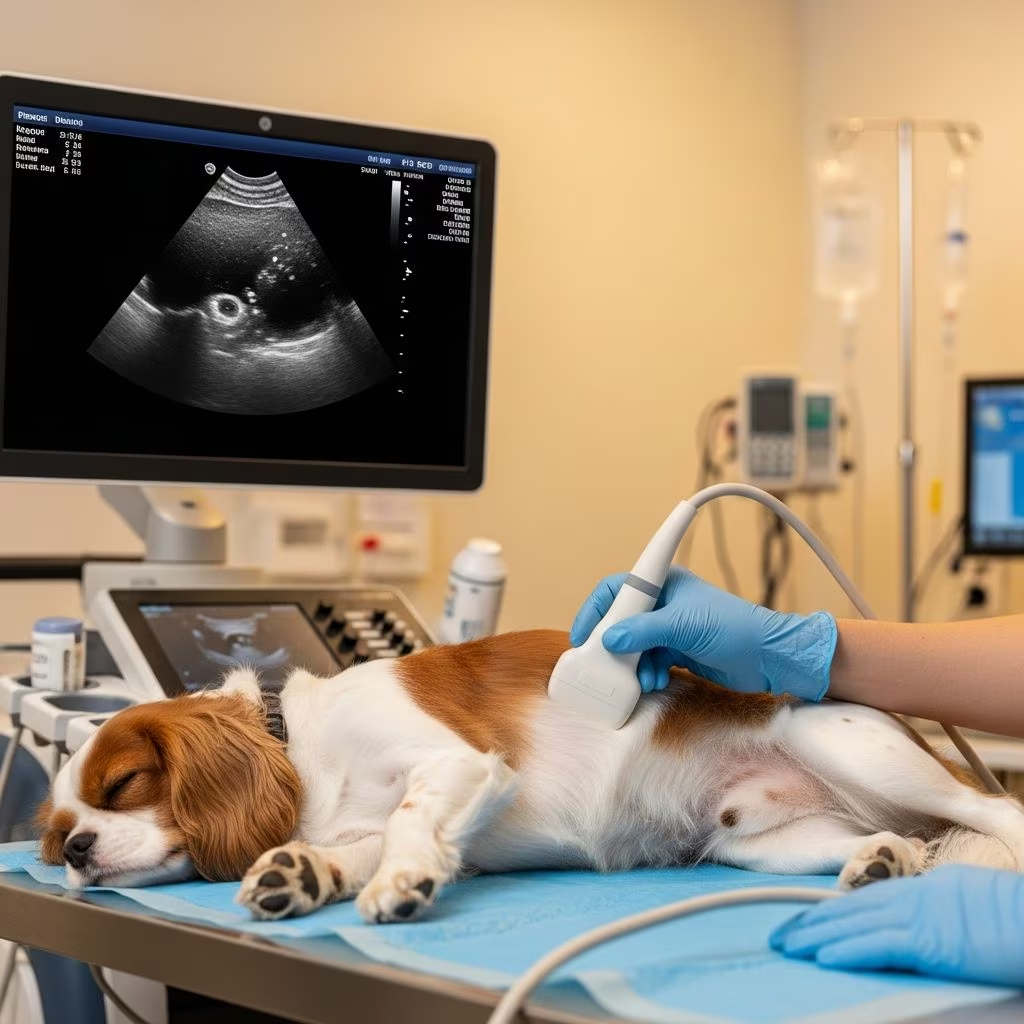
The liver plays a vital role in small animals like dogs and cats, handling detoxification, metabolism, and bile production. When hepatic issues arise, timely and precise imaging becomes crucial for diagnosis. This article delves into various imaging modalities used to assess liver health, highlighting their strengths, applications, and limitations in veterinary care.
Why Imaging Matters for Hepatic Evaluation
Detecting liver abnormalities early can significantly influence treatment success. Common signs prompting imaging include elevated liver enzymes, jaundice, abdominal swelling, or unexplained weight loss. Imaging helps differentiate between diffuse diseases like hepatitis and focal issues such as tumors or cysts. By visualizing liver size, texture, blood flow, and surrounding structures, veterinarians can plan biopsies, surgeries, or medical interventions effectively.
Traditional blood tests provide clues but lack structural detail. Imaging bridges this gap, offering non-invasive or minimally invasive insights into the organ’s condition. Recent advancements have made these tools more accessible, even in general practices.
Foundational Role of Radiography
Radiography, or X-rays, serves as the initial screening tool due to its availability and low cost. It excels at identifying gross changes like hepatomegaly (enlarged liver) or microhepatica (shrunken liver). In dogs, the liver appears as a soft tissue opacity in the cranial abdomen, often silhouetted by the diaphragm, stomach, and kidneys.
Challenges include poor soft tissue contrast, making subtle parenchymal changes hard to spot. Techniques like capnoperitoneography, involving gas introduction into the abdomen, improve visualization of liver borders. Thoracic radiographs are essential in suspected neoplasia to check for lung metastases. While not definitive for liver texture, radiography guides further imaging decisions.
- Strengths: Quick, inexpensive, detects size variations and calcifications.
- Limitations: Overlaps with other organs obscure details; misses early diffuse diseases.
Ultrasonography: The Cornerstone of Liver Assessment
Ultrasound has revolutionized hepatic diagnostics with its real-time, radiation-free imaging of soft tissues. It’s ideal for evaluating parenchyma echogenicity, detecting masses, cysts, or biliary obstructions. Normal liver appears homogeneous and mid-echogenic, comparable to the spleen.
Hepatomegaly shows rounded edges and displaced vessels; hyperechoic patterns suggest lipidosis in cats, while hypoechoic areas may indicate neoplasia or abscesses. Color Doppler assesses portal vein flow, identifying shunts or hypertension. It’s operator-dependent, requiring skilled technicians for optimal results.
Guided procedures like fine-needle aspiration (FNA) or core biopsies enhance accuracy, targeting lesions while avoiding vessels or gallbladder. In obstructive icterus, dilated ducts confirm blockages.
| Ultrasound Finding | Possible Conditions |
|---|---|
| Increased echogenicity | Steatosis, chronic hepatitis |
| Decreased echogenicity | Acute hepatitis, lymphoma |
| Nodular pattern | Cirrhosis, regenerative nodules |
| Mass with mixed echoes | Hemangiosarcoma, adenoma |
Advanced Cross-Sectional Imaging: CT and MRI
Computed Tomography (CT) provides unparalleled detail of the entire liver, including hidden lobes. Multi-phase contrast studies reveal vascular anomalies like portosystemic shunts (PSS), with arterial, portal, and delayed phases differentiating lesion types. Hounsfield units quantify attenuation; hypodense areas signal masses or cysts.
Magnetic Resonance Imaging (MRI) offers superior soft tissue contrast, excelling in subtle parenchymal diseases and biliary evaluation via MR cholangiopancreatography (MRCP). It’s radiation-free but longer and costlier. Both are gold standards for pre-surgical planning in complex cases like shunts or tumors.
CT angiography definitively rules out PSS in large breeds where ultrasound falters. MRI predicts malignancy in masses through enhancement patterns.
- CT Advantages: 3D reconstruction, vascular mapping, metastasis detection.
- MRI Strengths: No radiation, excellent for diffuse fibrosis or early neoplasia.
Emerging Techniques: Scintigraphy and Laparoscopy
Scintigraphy uses technetium-99m-labeled agents to track hepatocyte function and biliary excretion. Absent intestinal uptake indicates extrahepatic obstruction; it’s also sensitive for PSS. Limited by isotope needs and availability.
Laparoscopy provides direct visualization, enabling biopsies from optimal sites. It’s minimally invasive, offering 3D views and hemorrhage monitoring post-biopsy. Useful when percutaneous methods fail, especially in small livers.
Integrating Modalities for Optimal Diagnosis
No single method suffices; a multimodal approach yields best results. Start with radiography and ultrasound for screening, escalate to CT/MRI for confirmation. For instance, ultrasound detects a mass, CT characterizes it, and biopsy confirms histology.
Poor ultrasound-histopathology correlation underscores biopsy’s necessity. Combining Doppler with contrast-enhanced CT refines vascular assessments. In hepatobiliary enzymopathies, serial imaging tracks progression.
Common Pitfalls and Best Practices
Operator skill affects ultrasound quality; standardized protocols mitigate this. Gas or effusion obscures views—fasting and positioning help. Artifacts from ribs challenge radiography. Always correlate imaging with clinical and lab data.
In cats, lipidosis mimics neoplasia; phase-specific CT clarifies. For shunts, negative ultrasound warrants CT. Biopsy risks like bleeding are minimized with guidance.
Future Directions in Veterinary Hepatic Imaging
AI-enhanced ultrasound improves pattern recognition. Portable CT units expand access. Contrast agents tailored for small animals promise better lesion discrimination. These innovations will democratize advanced diagnostics.
Frequently Asked Questions (FAQs)
What is the first imaging step for suspected liver disease?
Radiography for size assessment, followed by ultrasound for detailed parenchyma evaluation.
Can ultrasound alone diagnose liver cancer?
No, it detects masses but requires biopsy for confirmation due to overlap with benign lesions.
Is MRI safe for all small animals?
Yes, no radiation, but sedation is needed for motion-free images.
How does CT help with portosystemic shunts?
Provides definitive 3D vascular mapping, crucial for surgical planning.
What’s the role of Doppler in liver ultrasound?
Evaluates blood flow direction and velocity, detecting shunts or hypertension.
This comprehensive overview equips veterinarians with tools to navigate hepatic diagnostics effectively, improving outcomes for small animal patients.
References
- Diagnostic Imaging of Canine Hepatobiliary Affections: A Review — PMC/NCBI. 2012-04-15. https://pmc.ncbi.nlm.nih.gov/articles/PMC3329710/
- Hepatobiliary Anatomy Review & Diagnostic Imaging — Cape Cod Veterinary Specialists. 2025-03-01. https://capecodvetspecialists.com/wp-content/uploads/2025/03/Liver-CE_N-Wilson.pdf
- 23: Hepatobiliary Imaging — Veterian Key. 2023-01-10. https://veteriankey.com/23-hepatobiliary-imaging/
- Diagnostic approach to liver disease — Vet Times. 2024-05-20. https://www.vettimes.com/news/vets/small-animal-vets/diagnostic-approach-to-liver-disease
- Small Animal Abdominal Ultrasonography, Part 1: Liver & Gallbladder — Today’s Veterinary Practice. 2023-08-12. https://todaysveterinarypractice.com/radiology-imaging/imaging-essentials-small-animal-abdominal-ultrasonography-liver-gallbladder-part-1/



