

Hummingbird Types, Traits, and Where to Spot Them
Hummingbirds represent one of nature’s most extraordinary avian families, captivating birdwatchers and nature enthusiasts worldwide. These diminutive yet remarkable creatures possess unique characteristics that set them apart from all other birds. With their incredible metabolic rates, specialized wing anatomy, and vibrant plumage, hummingbirds have evolved into master pollinators and acrobatic fliers. Understanding the different types of hummingbirds, their distinctive traits, and where to find them can significantly enhance your bird-watching experiences and deepen your appreciation for these fascinating creatures.
Understanding Hummingbird Characteristics
Hummingbirds belong to the family Trochilidae and are among the smallest birds in the world, with most species measuring between 3 to 5 inches in length. What they lack in size, they compensate for with remarkable physical and behavioral adaptations. These birds possess exceptional metabolic capacities that allow them to maintain body temperatures and energy levels required for their rapid, acrobatic flight patterns.
One of the most distinctive features of hummingbirds is their unique wing anatomy. Unlike other birds, hummingbirds can rotate their wings at the shoulder in a figure-eight pattern, enabling them to generate lift on both the upstroke and downstroke. This remarkable ability allows them to hover in place, fly backward, and execute aerial maneuvers that seem to defy gravity. Their wings beat incredibly rapidly—between 50 and 80 times per second depending on the species—creating the characteristic humming sound that gives them their name.
Another fascinating adaptation involves their feeding mechanism. Many hummingbirds don’t actually suck nectar through their beaks; instead, the sweet liquid moves via capillary action along specialized grooves in their tongues. This efficient feeding mechanism allows them to consume up to half their body weight in sugar daily, providing the enormous energy reserves needed for their active lifestyle.
Major Hummingbird Species of North America
North America hosts several spectacular hummingbird species, each with distinctive characteristics and behaviors. Learning to identify these species enhances the bird-watching experience and contributes valuable observations to citizen science initiatives.
Ruby-Throated Hummingbird
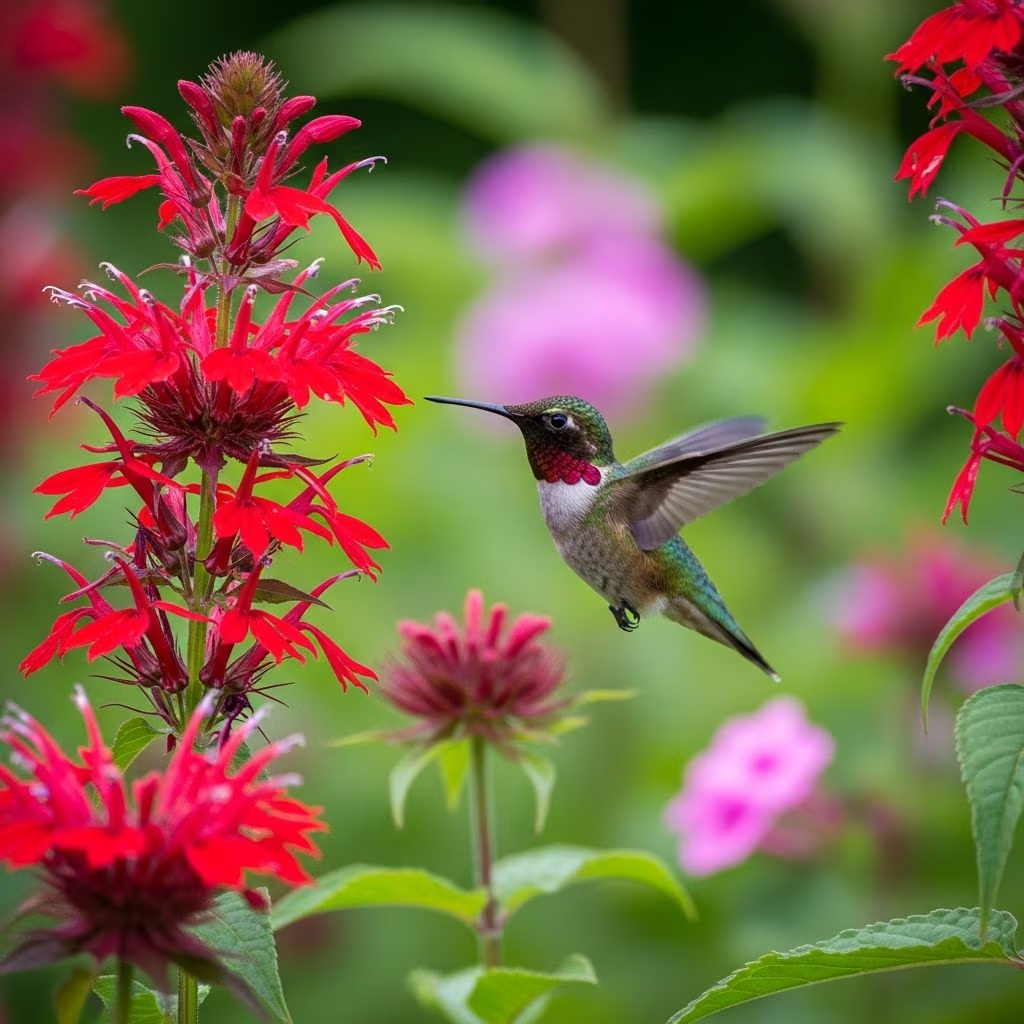
The Ruby-throated Hummingbird stands as the most familiar species to eastern North Americans and is the only hummingbird that regularly breeds in eastern North America. Males display an iridescent ruby-red throat that appears almost black in poor lighting, while females feature white throats occasionally marked with dark spots. These tiny birds, weighing just 3 grams, undertake one of nature’s most remarkable journeys—migrating non-stop across the Gulf of Mexico twice yearly, covering over 500 miles. According to the Cornell Lab of Ornithology, Ruby-throated Hummingbirds can live up to 9 years in the wild, though most individuals live between 3 and 5 years. Their population remains stable, with an estimated 20 to 25 million individuals across their range.
Rufous Hummingbird
Don’t let their diminutive size fool you—Rufous Hummingbirds rank among the feistiest and most aggressive hummingbirds. These orange-red dynamos migrate farther than any other hummingbird species, traveling up to 3,900 miles from Alaska to Mexico. The Rufous Hummingbird possesses the northernmost breeding range of any hummingbird species, extending into southern Alaska. Their breeding range covers a vast area from southern Alaska through the Pacific Northwest, making them a truly remarkable migratory species despite their compact size.
Anna’s Hummingbird
Anna’s Hummingbirds display stunning rose-pink throats and crowns that can appear red or even purple depending on lighting conditions. These birds represent one of the most vocal hummingbird species, producing complex songs rather than just the typical chips and calls characteristic of other species. Research published in the British Ecological Society reveals that Anna’s Hummingbirds have adapted their metabolism to survive cold winter nights by entering torpor, reducing their metabolic rate by up to 95%. This extraordinary adaptation allows them to breed during the winter breeding season, a unique capability among hummingbirds.
Black-Chinned Hummingbird
Black-chinned Hummingbirds rank among the most adaptable of all North American hummingbirds, found in deserts, mountain forests, urban parks, and natural environments. Adult males display vibrant blue throats, white undertail coverts, and black forked tails, while females have grayish throats and undersides with pale markings. These birds are strictly migratory, arriving in spring and departing in fall, spending most winter months in Mexico. Males perform a dramatic courtship dance and engage in territorial defense by diving up to 100 feet above the ground in a U-shaped pattern, creating a loud wing buzz.
Broad-Tailed Hummingbird
Broad-tailed Hummingbirds rank among the noisiest of all hummingbirds, thanks to a loud, metallic trill that males produce with their wings. These birds favor high mountain meadows of western North America, where they skillfully navigate their specialized habitats. Their distinctive vocalizations make them relatively easy to identify even when visual confirmation proves difficult.
Costa’s Hummingbird
Costa’s Hummingbirds inhabit the parched landscapes of the Sonoran and Mojave deserts, where they zip among saguaro and ocotillo cacti. Males flash a brilliant royal purple throat patch that extends off the sides of their neck like little wings, making them visually distinctive against their desert surroundings. Their adaptation to extreme desert conditions showcases the remarkable environmental flexibility of hummingbirds.
Calliope Hummingbird
The Calliope Hummingbird holds the distinction of being the smallest bird in northern North America, measuring just 3.25 inches in length. Male Calliope Hummingbirds display rosy-purple gorget feathers that form streaks against a white background. Adult females feature metallic bronze-green backs, cinnamon-colored sides and flanks, and dull brownish-white throats with dusky streaks. These birds breed in the mountains of central British Columbia and southwestern Alberta, extending south to northern Baja California, with winter ranges in Mexico.
Allen’s Hummingbird
Allen’s Hummingbirds are lookalike cousins to the Rufous Hummingbird, displaying an affinity for the fragrant coastal scrub and chaparral of California and Oregon. Males perform elaborate courtship displays to attract potential mates, though like most hummingbird species, males contribute nothing to nest building, egg incubation, or chick rearing.
Buff-Bellied Hummingbird
Buff-bellied Hummingbirds display bright red bills, coppery tails, and throats that flash brilliant blue-green iridescence. These birds occur along the Gulf Coast of Mexico, barely reaching into South Texas and sometimes stretching northward in winter along the U.S. Gulf Coast. Their unique coloration and distribution make them distinctive among North American hummingbirds.
Specialized Hummingbird Species
Beyond North American species, numerous hummingbirds display extraordinary specializations and adaptations that demonstrate the remarkable diversity within this bird family.
Sword-Billed Hummingbird
The Sword-billed Hummingbird possesses the most extraordinary adaptation within the hummingbird family—a bill that exceeds its body length. This extraordinary adaptation enables the bird to feed from flowers with extremely long corollas, particularly Passiflora mixta, a passion vine found in the Andes. The sword-billed hummingbird relies on flower nectar from these specialized blooms as its primary energy source, representing a perfect example of co-evolution, where both species evolved together over millions of years. Because of their unwieldy bills, Sword-billed Hummingbirds must groom themselves with their feet rather than their bills, unlike other hummingbird species. They’re found from Venezuela to Bolivia at elevations between 2,500 and 10,500 feet.
Violet Sabrewing
The Violet Sabrewing ranks among the largest hummingbirds in Central America and arguably one of the most beautiful. Males display deep violet-blue plumage with distinctive curved, white-tipped tail feathers that give them their “sabrewing” name. Their size and coloration make them iconic representatives of Central American hummingbird diversity.
Marvelous Spatuletail
Endemic to Peru’s remote Río Utcubamba valley, the Marvelous Spatuletail may be the most extraordinarily adorned of all hummingbird species. Males possess just four tail feathers—two normal ones and two incredibly long outer feathers that end in large violet-blue discs or “spatules.” This remarkable tail structure represents one of nature’s most unusual anatomical specializations.
Long-Tailed Sylph
The Long-tailed Sylph, found in cloud forests from Venezuela to Bolivia, showcases sexual dimorphism taken to an extreme. Males sport brilliant emerald-green backs, sapphire-blue crowns, and extraordinarily long, deeply forked tails that can measure up to 7 inches. Their dramatic tail length and vibrant coloration make them unmistakable within their range.
Physical Traits and Visual Identification
Male hummingbirds display the widest diversity of plumage color among all birds, particularly in blues, greens, and purples. These vibrant colors result from microscopic structure in feathers that creates iridescence, causing colors to shift dramatically depending on viewing angle and light conditions.
Sexual dimorphisms in bill size and shape characterize many hummingbird clades, with females generally possessing longer, more curved bills favored for accessing nectar from tall flowers. For males and females of the same size, females tend to have larger bills overall. These differences reflect evolutionary adaptations that reduce direct competition between sexes for feeding resources.
Most hummingbird species measure between 3 and 5 inches, with the notable exception of the Giant Hummingbird, which can reach significantly larger proportions. Larger hummingbirds exhibit distinct morphological features and adaptations, including longer bills and unique visual capabilities.
Where to Spot Hummingbirds
Successfully observing hummingbirds requires understanding their preferred habitats and seasonal distributions. Different species favor distinct environments, from desert scrublands to mountain meadows to coastal chaparral.
Breeding Ranges and Habitats
Ruby-throated Hummingbirds breed throughout eastern North America, making backyard feeders excellent observation points during breeding season. Rufous Hummingbirds breed from southern Alaska through the Pacific Northwest, representing the northernmost breeding range of any hummingbird species. Black-chinned Hummingbirds inhabit deserts, mountain forests, and urban parks across the western United States. Broad-tailed Hummingbirds favor high mountain meadows of western North America. Costa’s Hummingbirds inhabit the Sonoran and Mojave deserts.
Widespread Species Distribution
Certain hummingbird species achieve remarkable geographic ranges across Central and South America. The White-necked Jacobin represents one of the most widespread hummingbird species in Central and South America, ranging from Mexico to Brazil. The Rufous-tailed Hummingbird spreads widely from Mexico to Ecuador, demonstrating considerable adaptability. The Blue-crowned Woodnymph occurs commonly from Mexico to Peru. The Green-crowned Brilliant inhabits Central American mountains.
Observation Tips
Successful hummingbird observation begins with setting up feeders with appropriate nectar solutions and maintaining them in clean condition. Early morning hours typically offer the best viewing opportunities when hummingbirds are most active. Position feeders near flowering plants that naturally attract these birds. Listen for the distinctive humming sound and high-pitched chirps that help locate birds even when visual confirmation proves momentarily difficult. Patient observation near feeders and flowering plants yields consistent sightings throughout breeding season.
Hummingbird Behavior and Adaptation
Hummingbirds display remarkable behavioral patterns that reflect their unique ecological roles and evolutionary history. Many species exhibit intense territorial behavior, with males defending feeding territories with aggressive displays and aerial combat. Social structures vary significantly among species; some birds, like the White-necked Jacobin, often feed in groups rather than defending individual territories.
Different species succeed in their environments by remaining highly adaptable, utilizing various food sources, and tolerating human-modified environments. Abundant species like the Rufous-tailed Hummingbird, Blue-crowned Woodnymph, Green-crowned Brilliant, and Steely-vented Hummingbird share common traits of adaptability and resource flexibility.
Hummingbird Classification and Evolution
The hummingbird family comprises nine major clades: the topazes and jacobins, the hermits, the mangoes, the coquettes, the brilliants, the giant hummingbird (Patagona gigas), the mountaingems, the bees, and the emeralds. The topazes and jacobins combined show the oldest split with the rest of the hummingbirds. The hummingbird family contains the third-greatest number of species of any bird family after the tyrant flycatchers and the tanagers. The coquettes (Lesbiini clade) display very little size dimorphism, with males and females being similar in size, contrasting sharply with other hummingbird groups.
Frequently Asked Questions
Q: How fast do hummingbirds’ hearts beat?
A: Hummingbirds possess incredibly rapid heart rates, often exceeding 250 beats per minute during active flight and hovering. This exceptional cardiovascular adaptation supports their high metabolic demands and enables their incredible aerial capabilities.
Q: How much nectar does a hummingbird consume daily?
A: Hummingirds consume approximately half their body weight in sugar daily, visiting hundreds of flowers to meet their energy requirements. This extraordinary consumption rate fuels their rapid wing beats and constant activity levels.
Q: How far do Rufous Hummingbirds migrate?
A: Rufous Hummingirds migrate farther than any other hummingbird species, traveling up to 3,900 miles annually from breeding grounds in Alaska and the Pacific Northwest to wintering areas in Mexico.
Q: Which hummingbird species is the smallest?
A: The Calliope Hummingbird ranks as the smallest bird in northern North America, measuring just 3.25 inches in length. Globally, the Bee Hummingbird of Cuba is even smaller at approximately 2 inches.
Q: How do hummingbirds survive cold nights?
A: Some hummingbirds, particularly Anna’s Hummingbirds, enter a state called torpor during cold nights, reducing their metabolic rate by up to 95%. This remarkable adaptation allows them to conserve energy and survive freezing temperatures.
Q: Can hummingirds fly backward?
A: Yes, hummingirds can fly backward due to their unique wing anatomy that enables figure-eight wing movements generating lift on both upstrokes and downstrokes. This capability distinguishes them from virtually all other bird species.
References
- 12 Fascinating Hummingbird Species You Need to Know — Wildlife Nomads. Accessed November 28, 2025. https://www.wildlifenomads.com/blog/species-of-hummingbirds/
- 9 Hummingbird Species to Look Out for This Summer — All About Birds, Cornell Lab of Ornithology. Accessed November 28, 2025. https://www.allaboutbirds.org/news/summertime-in-the-united-states-of-hummingbirds/
- Hummingbird — Wikipedia. Accessed November 28, 2025. https://en.wikipedia.org/wiki/Hummingbird
- Hummingbirds of North America — U.S. Fish & Wildlife Service. Accessed November 28, 2025. https://www.fws.gov/story/hummingbirds-north-america
- Hummingbirds in Your Backyard — Georgia Wildlife Resources Division. Accessed November 28, 2025. https://georgiawildlife.com/hummingbirds-your-backyard
- Hummingbird Species — Hummingbird Central. Accessed November 28, 2025. https://www.hummingbirdcentral.com/hummingbird-species.htm



