

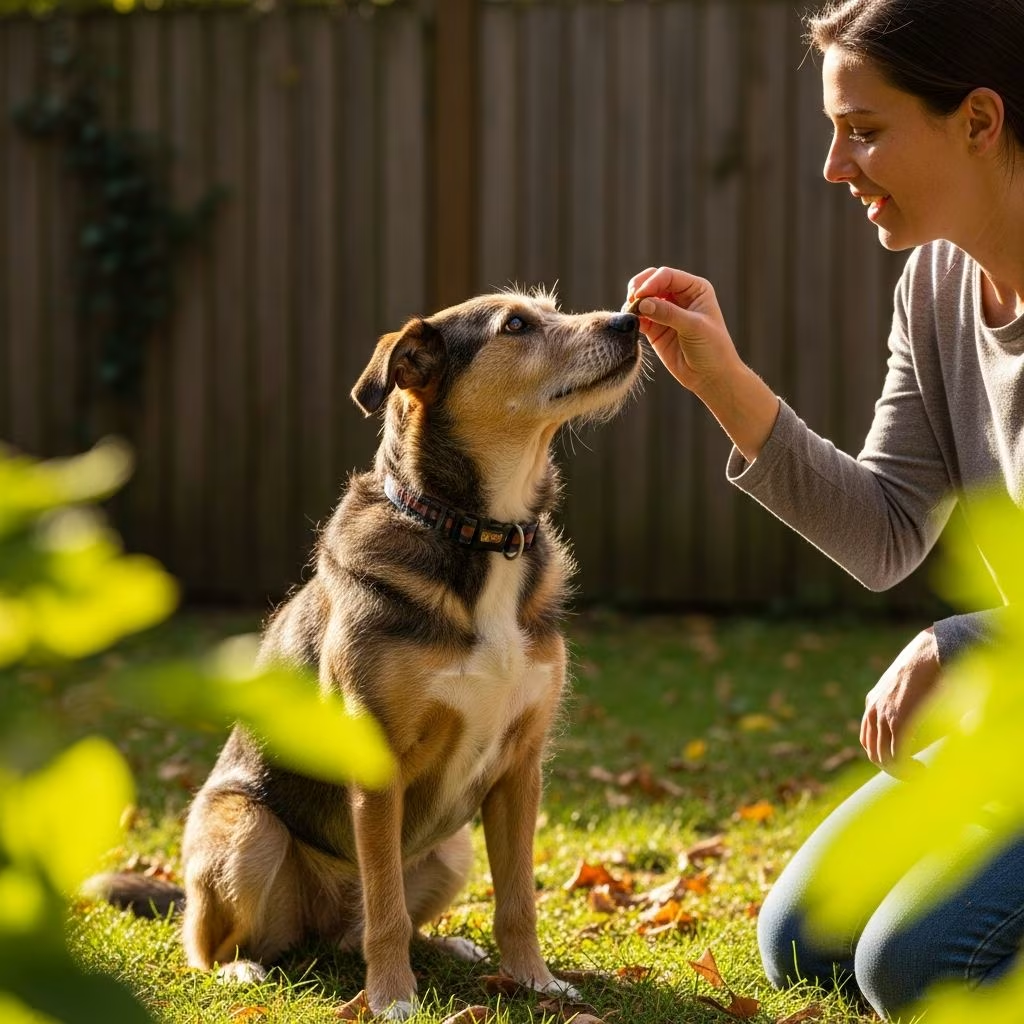
Bringing home a rescue dog is incredibly rewarding, but it can also feel overwhelming at first. Many rescue dogs come with unknown histories, inconsistent training, and big feelings about their new environment. With a thoughtful plan, patience, and compassionate training, you can help your new companion settle in and thrive.
This guide walks you through the core pillars of rescue dog training: building a bond, house‑training and crate‑training, teaching basic cues like sit and stay, creating routines and boundaries, and knowing when to consider an obedience class.
Start With Bonding, Not Perfection
When your rescue dog first arrives home, your top priority is not perfect obedience—it is safety, trust, and emotional security. In the early days and weeks, your dog is adjusting to a completely new world, with new smells, people, rules, and routines.
Why the bond matters first
- Trust reduces fear and stress. Research on shelter and rescue dogs shows that entering a new home can elevate cortisol (stress hormone) and anxiety-related behaviors, especially in the first weeks.
- A secure relationship improves learning. Dogs that feel safe with their caregivers are more able to focus, explore, and form positive associations with new experiences.
- Attachment predicts behavior. Studies of dog–human attachment indicate that dogs who form secure bonds often show fewer behavior problems and better resilience in challenging situations.
Before you worry about advanced skills, focus on predictable care, gentle handling, and calm, positive interactions.
Practical ways to build trust
- Keep the first few days quiet—limit visitors and outings.
- Offer high‑value treats by hand, but never force contact; let the dog approach you.
- Use a soft voice and slow movements; avoid hovering, grabbing, or crowding.
- Follow a consistent feeding, walking, and rest schedule.
- Allow a safe retreat area (bed or crate) where your dog is never disturbed.
You can introduce simple cues like sit or come early on, but always keep sessions short and upbeat, and never punish mistakes.
House‑Training a Rescue Dog
Even if your rescue dog was previously house‑trained, the stress and novelty of a new environment can lead to accidents. Start as if your dog has never been house‑trained to set clear expectations.
Set up for success from day one
- Prepare before arrival. Decide where your dog will sleep, play, and go to the bathroom outside.
- Limit freedom indoors. Use baby gates or closed doors to keep your dog in easily supervised areas.
- Take them out frequently. Many trainers recommend bathroom breaks:
- First thing in the morning
- After meals and drinks
- After play or excitement
- Before bed
- Every 1–3 hours during the day, depending on age and history
Teach where and when to go
Each time you take your dog to the designated potty spot:
- Walk them calmly to the same area.
- Use a consistent cue such as “go potty.”
- Remain quiet and neutral while they sniff and eliminate.
- As soon as they finish, praise warmly and give a small treat.
This creates a strong association between eliminating outdoors and receiving good things.
Handling indoor accidents
- Interrupt gently if you catch them in the act (a soft “oops, outside”) and guide them outdoors.
- Do not yell, rub their nose in it, or punish—these methods are associated with fear and can increase anxiety and problem behaviors.
- Clean thoroughly with an enzymatic cleaner to remove odor and discourage repeat marking.
- Review your schedule: if accidents continue, take your dog out more frequently and supervise more closely.
Crate‑Training Your Rescue Dog
A crate, when introduced properly, can become a cozy and secure den-like space for your dog. Animal welfare organizations and veterinary behaviorists support crate use when it is humane, time‑limited, and reward‑based.
Benefits of crate‑training
- Supports house‑training by limiting unsupervised time.
- Provides a safe place to rest and decompress.
- Makes travel and vet stays less stressful.
- Helps prevent destructive behavior when you cannot supervise.
Step‑by‑step crate introduction
Keep the crate in a quiet area of your home where the family spends time. Make it comfortable with a soft bed or blanket and safe chew toys.
- Create positive associations.
Leave the crate door open. Toss treats just inside the doorway so your dog can step in to retrieve them. Gradually toss treats further inside so more of their body enters the crate. Praise calmly for any voluntary approach. - Work toward full body entry.
Once your dog is comfortable stepping all the way in, offer a small \”treat party\”—several treats scattered inside—each time they fully enter. - Close the door briefly.
When your dog goes in willingly and seems relaxed, gently close the door for 2–3 minutes while you sit nearby. Feed treats through the door or drop them in the crate, then open the door before your dog becomes worried. - Gradually increase duration.
Over several sessions, slowly lengthen crate time. If your dog barks or scratches, wait briefly for a moment of quiet before opening the door. Avoid letting them out while actively protesting, or they may learn that noise makes the door open. - Practice short absences.
Once your dog is calm with you in the room, start stepping out for very short periods. Return calmly, wait until they are settled, then let them out and reward. This teaches that you always come back and that calm behavior opens the door.
Crate‑training guidelines
- Never use the crate as punishment or a place to \”banish\” your dog.
- Ensure your dog is getting enough exercise, affection, and enrichment outside of crate time.
- Healthy adult dogs should not be crated excessively; long‑term confinement without breaks is linked to stress and welfare concerns.
- If your dog panics (heavy drooling, escape attempts, self‑injury), seek professional help—this may be more than a simple training issue.
Teaching Basic Cues to Your Rescue Dog
Once your dog is settling in and you have a rough routine, you can focus more on basic cues. These skills keep your dog safer, improve manners, and deepen communication.
| Basic Cue | Main Purpose | Everyday Use |
|---|---|---|
| Stay | Impulse control and safety | Prevent door dashing, hold position at curbs, wait politely |
| Sit | Foundation behavior and manners | Greet people calmly, wait for food, focus on handler |
| Recall (Come) | Return to handler on cue | Off‑leash safety, yard freedom, emergency management |
How to teach “Stay”
The stay cue helps your dog practice self‑control and can prevent dangerous situations, such as running into the street or rushing out the front door.
- Ask your dog to sit or lie down.
- Say “stay” once, then hold your hand out like a stop sign.
- Count 1–2 seconds, then reward if your dog has not moved.
- Gradually increase the duration by a second or two at a time.
- Next, add distance: take a small step back, return, then reward.
- Finally, add gentle distractions, such as moving your arms or turning your body.
Always increase only one difficulty at a time—duration, distance, or distraction—to keep your dog successful.
How to teach “Sit”
The cue sit is one of the easiest and most useful behaviors to teach, and it is the foundation for many other skills.
- Hold a treat near your dog’s nose.
- Slowly move the treat up and back over the head. As the nose follows the treat, the rear will naturally lower.
- As soon as your dog’s bottom touches the ground, say “yes” or click (if you use a clicker) and give the treat.
- Repeat several times until your dog begins to sit quickly.
- Add the word “sit” just before you lure, then gradually phase out the treat lure, rewarding only after the sit is complete.
Use “sit” before meals, before going out the door, and when greeting people. This channels excitement into a polite behavior instead of jumping.
Establish a Firm Routine and Clear Boundaries
Dogs, especially those from chaotic backgrounds, often relax when life becomes predictable. A routine and clear, kind boundaries reduce confusion and help your dog understand what is expected.
Building a daily routine
- Feed at the same times each day.
- Offer regular walks or yard time for exercise and bathroom breaks.
- Schedule short training sessions (3–10 minutes) one to three times daily.
- Provide predictable rest periods so your dog can decompress.
- Keep bedtime and wake‑up times as consistent as possible.
Predictability is particularly helpful for dogs with anxiety or a history of unstable environments, as consistency can reduce arousal and stress.
Teaching boundaries with positive reinforcement
Boundaries are not about punishment; they are about teaching your dog which behaviors “work” to get what they want.
- Threshold manners: Teach your dog to wait at doors until released. Ask for a sit or stand, open the door a crack, and close it if your dog rushes. Reward calm waiting, then release with a cue like “okay.”
- Furniture rules: Decide whether your dog is allowed on couches or beds. If not, reward them generously for lying on their own bed. If yes, you can still teach “off” and “up” so access is by invitation.
- Polite greetings: If your dog jumps, calmly step away and ignore. Reward and give attention only when all four paws are on the floor or when they sit.
By consistently rewarding the behaviors you like first, you reduce the chance for problem behaviors to become habits.
Consider an Obedience Class
Working with a qualified trainer through a positive‑reinforcement obedience class is one of the most effective ways to support your rescue dog. Modern training organizations and veterinary behavior groups recommend reward‑based methods as both effective and better for welfare than punishment‑heavy approaches.
Why classes help both you and your dog
- You learn how to communicate clearly and read your dog’s body language.
- Your dog practices basic cues around distractions in a structured environment.
- Trainers can spot and address issues early, before they escalate.
- Classes provide safe, managed exposure to other dogs and people.
Choosing the right class
- Look for terms like “positive reinforcement,” “force‑free,” or “reward‑based.”
- Avoid programs that rely on fear, pain, or intimidation (e.g., shock collars, leash jerks as the primary method).
- Ask about class size—smaller groups often allow more individual coaching.
- For very fearful or reactive rescue dogs, consider private sessions before group classes.
Putting It All Together
Training a rescue dog is not about perfection; it is about progress. By moving at your dog’s pace, using positive reinforcement, and building a life full of structure and kindness, you give your new companion the best possible chance to become a confident, well‑adjusted family member.
Frequently Asked Questions (FAQs)
Q: How long does it take a rescue dog to settle in?
A: Many trainers refer to the “3‑3‑3” idea: roughly 3 days to decompress, 3 weeks to start learning your routine, and 3 months to feel truly at home. Every dog is different, especially if there is trauma in their history, so focus on steady progress rather than a fixed timeline.
Q: Should I crate every rescue dog?
A: Crates can be very helpful for many dogs, but they are not mandatory for all. If your dog shows extreme panic in the crate, consult a veterinarian or qualified trainer. The key is that the crate must be introduced gradually and always associated with comfort, not punishment.
Q: Can an older rescue dog still learn basic cues?
A: Yes. Research shows that adult and senior dogs remain capable of learning new behaviors, especially when training uses clear cues and positive reinforcement. Older dogs may need shorter sessions and more breaks, but they can absolutely master sit, stay, recall, and more.
Q: What if my rescue dog has behavior problems like aggression or extreme fear?
A: Safety comes first—manage the environment to prevent bites or escapes, and contact a certified professional trainer or veterinary behaviorist. Complex issues such as aggression, severe separation anxiety, or phobias are best addressed with individualized behavior plans, not generic advice.
Q: How many training sessions should I do each day?
A: Several short sessions (3–10 minutes) spaced throughout the day usually work better than one long session. Keep things light and fun, end on a success, and integrate training into regular activities like walks, mealtimes, and play.
References
- Behavioral and physiological responses of dogs entering rehoming centers — Stephen, J.M. & Ledger, R.A. Applied Animal Behaviour Science. 2005-07-01. https://doi.org/10.1016/j.applanim.2004.10.002
- Effects of sheltering on animal welfare — Association of Shelter Veterinarians. 2010-12-01. https://www.sheltervet.org/assets/docs/sheltering_guide.pdf
- Attachment and caregiving in dog–human relationships — Payne, E., Bennett, P., McGreevy, P. Anthrozoös. 2015-06-01. https://doi.org/10.1080/08927936.2015.1052273
- AVSAB Position Statement on Humane Dog Training — American Veterinary Society of Animal Behavior. 2021-10-01. https://avsab.org/wp-content/uploads/2022/05/HumaneDogTraining-PositionStatement-AVSAB.pdf
- Guidelines for Standards of Care in Animal Shelters — Association of Shelter Veterinarians. 2010-12-01. https://www.sheltervet.org/assets/docs/shelter-standards-oct2011-wforward.pdf
- Dog training methods: their use, effectiveness and interaction with behaviour and welfare — Blackwell, E.J., Twells, C., Seawright, A., Casey, R.A. Animal Welfare. 2008-08-01. https://doi.org/10.1017/S096272860002681X



