

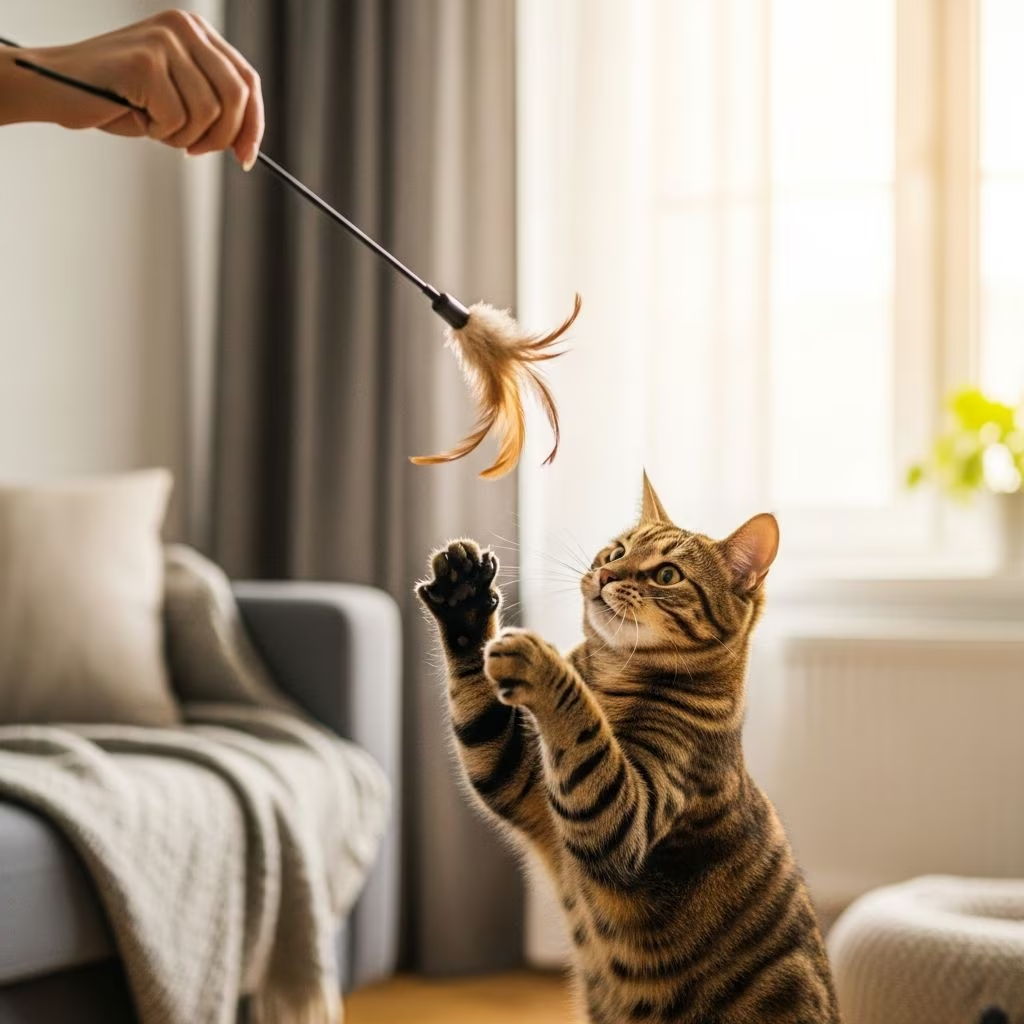
Playing with your cat is more than just fun—it’s essential for their physical health, mental stimulation, and strengthening the bond between you. Cats are natural predators descended from wild ancestors, and play mimics their hunting instincts, helping them stay active and content. Regular interactive sessions prevent boredom, reduce stress, and curb destructive behaviours like scratching furniture or excessive meowing. According to cat behaviour experts, daily play should last 15-30 minutes, ideally split into short bursts to match a cat’s energy cycles.
Why Play is Important for Cats
Play fulfils a cat’s innate needs rooted in their evolutionary history as solitary hunters. In the wild, cats spend much of their day stalking, pouncing, and capturing prey, behaviours replicated during play with toys. This activity keeps them physically fit, preventing obesity—a common issue in indoor cats—and supports muscle tone and cardiovascular health. Mentally, play combats boredom, which can lead to anxiety or depression-like symptoms in felines.
Research highlights play’s role in social development, especially in multi-cat homes or with human companions. Interactive play builds trust and reduces territorial aggression by providing positive outlets for energy. Kittens learn vital skills like coordination and bite inhibition through play, while adults maintain cognitive sharpness. Neglecting play can result in problem behaviours: a study on domestic cats notes that insufficient stimulation correlates with higher stress levels and unwanted actions like night-time zooming.
- Physical benefits: Burns calories, improves agility, and promotes healthy weight.
- Mental benefits: Reduces stress hormones, enhances problem-solving skills.
- Emotional benefits: Strengthens human-cat bonds, fosters confidence.
- Behavioural benefits: Prevents issues like furniture clawing or litter box avoidance.
Free-ranging cats form social groups where play reinforces kinship and hierarchy, underscoring its natural importance even in domestic settings.
Understanding Cat Play Styles
Cats engage in four primary play styles: locomotive, predatory, object, and social. Recognising these helps tailor sessions to your cat’s preferences. Locomotive play involves chasing and running, ideal for high-energy cats. Predatory play simulates hunting with sudden movements and strikes. Object play uses static toys like balls, while social play includes wrestling with other cats or interactive tugs with you.
Behaviourist Mikel Delgado emphasises that interactive play—where you control the toy—best mimics real prey, making it more engaging than solo toys. Electronic gadgets have a place but can’t replace one-on-one time, especially for kittens developing social skills.
| Play Style | Description | Example Toys | Best For |
|---|---|---|---|
| Locomotive | Chasing, leaping | Laser pointers, feather wands | Energetic adults |
| Predatory | Stalking, pouncing | Mice toys, puzzle feeders | Hunting instincts |
| Object | Batting, carrying | Balls, crinkle tunnels | Solo sessions |
| Social | Wrestling, tugging | Soft kick toys, hands (safely) | Bonding |
Best Toys for Cats
Selecting the right toys maximises engagement. Opt for items that move unpredictably to trigger predatory responses—cats crouch, pause, then pounce just like with real prey. Avoid strings or small parts that pose choking hazards. Rotate toys weekly to maintain novelty.
- Wand toys: Feathers or strings on poles for aerial chases.
- Interactive lasers: Great for exercise but end with a ‘catchable’ toy to avoid frustration.
- Kick toys: Plush body-pillow shapes for rabbit-kicking instincts.
- Puzzle toys: Treat-dispensing balls for mental work.
- Scratching posts with toys: Combine clawing with play.
Some cats ‘play’ with food by batting kibble, a harmless extension of predatory behaviour, though discourage it to maintain mealtime hygiene.
How to Play with Your Cat: Step-by-Step Guide
Effective play sessions follow a hunt-chase-capture-kill sequence. Start slow to build excitement, escalate to frenzy, then allow ‘victory’ by letting them catch the toy.
- Warm-up (5 mins): Dangle toy out of reach, twitch gently to awaken interest.
- Hunt phase: Drag toy away, hide behind furniture for stalking.
- Chase: Run toy erratically across floors or up walls.
- Capture: Let cat ‘catch’ it for a satisfying bite/kick.
- Cool-down: Offer solo toy or treat; end positively.
Play twice daily, dawn and dusk, aligning with cats’ crepuscular nature. Use enthusiastic voice cues like ‘get it!’ to engage. If your cat ignores toys, try catnip-infused options or food-motivated games.
Daily Play Routines for Different Cats
Tailor routines by age and personality. Kittens need 30-60 minutes spread out, focusing on socialisation. Seniors benefit from gentle object play to maintain mobility. Multi-cat homes require supervised sessions to ensure fair play.
- Kittens: Short, frequent bursts; teach bite inhibition.
- Adults: 15-20 mins x2; mix styles.
- Seniors: Low-impact chasing; puzzle toys.
- Indoor-only: Emphasise vertical spaces like cat trees.
Track progress: happier cats groom more, sleep soundly, and seek affection.
Play vs Fight: How to Tell the Difference
Distinguishing play from aggression prevents injuries. Healthy play features relaxed ears, forward whiskers, and role reversals. Cats take breaks, vocalise minimally (chirps, not growls), and regroup loosely.
Aggressive signs: pinned ears, dilated pupils, arched backs (beyond playful hops), hissing, and one-sided chasing. Mismatched play—e.g., a rough kitten overwhelming a gentle one—shows one cat hiding or swatting defensively. In studies, playful wrestling involves position changes and no staring; fights have vocal conflicts and avoidance.
- Good play: Taking turns, pauses, loose body language.
- Bad (aggression): Staring, growling, no breaks.
- Ugly (mismatched): One cat relentless, other retreats.
Intervene in bad/ugly scenarios with distractions or separation. Experts note play fades if unbalanced, as cats prefer reciprocal fun.
Common Play Mistakes and How to Avoid Them
Avoid these pitfalls for safe, enjoyable sessions:
- Using hands as toys: Encourages biting; stick to toys.
- No ‘kill’ phase: Frustrates cats; always let them win.
- Inconsistent sessions: Leads to demanding behaviours.
- Ignoring signals: Yawning or tail thrashing means stop.
- Overstimulation: Watch for dilated pupils, twitching tail.
Interactive Play for Bonding
Playtime is prime bonding opportunity. Mirror prey unpredictability: freeze, dart, vary speeds. Reward with praise post-session. In social groups, play reinforces familiarity and reduces tension, much like wild cat kinship dynamics.
For solo cats, you become the playmate; consistency builds security.
Frequently Asked Questions
Why does my cat play with food?
It’s predatory instinct—batting mimics hunting. Provide toys to redirect.
How often should I play with my cat?
Daily, 15-30 minutes total, split into 2-3 sessions.
Are my cats playing or fighting?
Play if they switch roles, take breaks; fighting if growling or one-sided.
What if my cat doesn’t like toys?
Try food puzzles or laser starts, transitioning to catchable toys.
Can play help shy cats?
Yes, builds confidence through success in ‘hunts’.
References
- Cat-Cat Play: The Good, the Bad, and the Ugly — IAABC Journal. 2023. https://journal.iaabcfoundation.org/play-the-good-the-bad-and-the-ugly/
- This Is the Difference Between Cat Playing and Fighting — Kinship. 2024. https://www.kinship.com/cat-behavior/are-my-cats-playing-or-fighting
- The Social Lives of Free-Ranging Cats — PMC (PubMed Central). 2022-01-14. https://pmc.ncbi.nlm.nih.gov/articles/PMC8749887/
- Your Cat Really Wants You to Play With Them—Here’s How — Kinship. 2024. https://www.kinship.com/cat-behavior/how-to-play-with-your-cat-mikel-delgado
- Is It Full Goblin-Mode Behavior for Your Cat to Play with Their Food? — Kinship. 2024. https://www.kinship.com/cat-behavior/should-cats-play-with-food
- Why Cats Need Daily Play: Benefits & Expert Tips — Kinship. 2024. https://www.kinship.com/uk/cat-behaviour/why-cats-need-play-daily
- Niche Expansion and the Natural History of Human-Cat Kinship — University of Chicago Journals. 2025. https://www.journals.uchicago.edu/doi/10.1086/737151



