

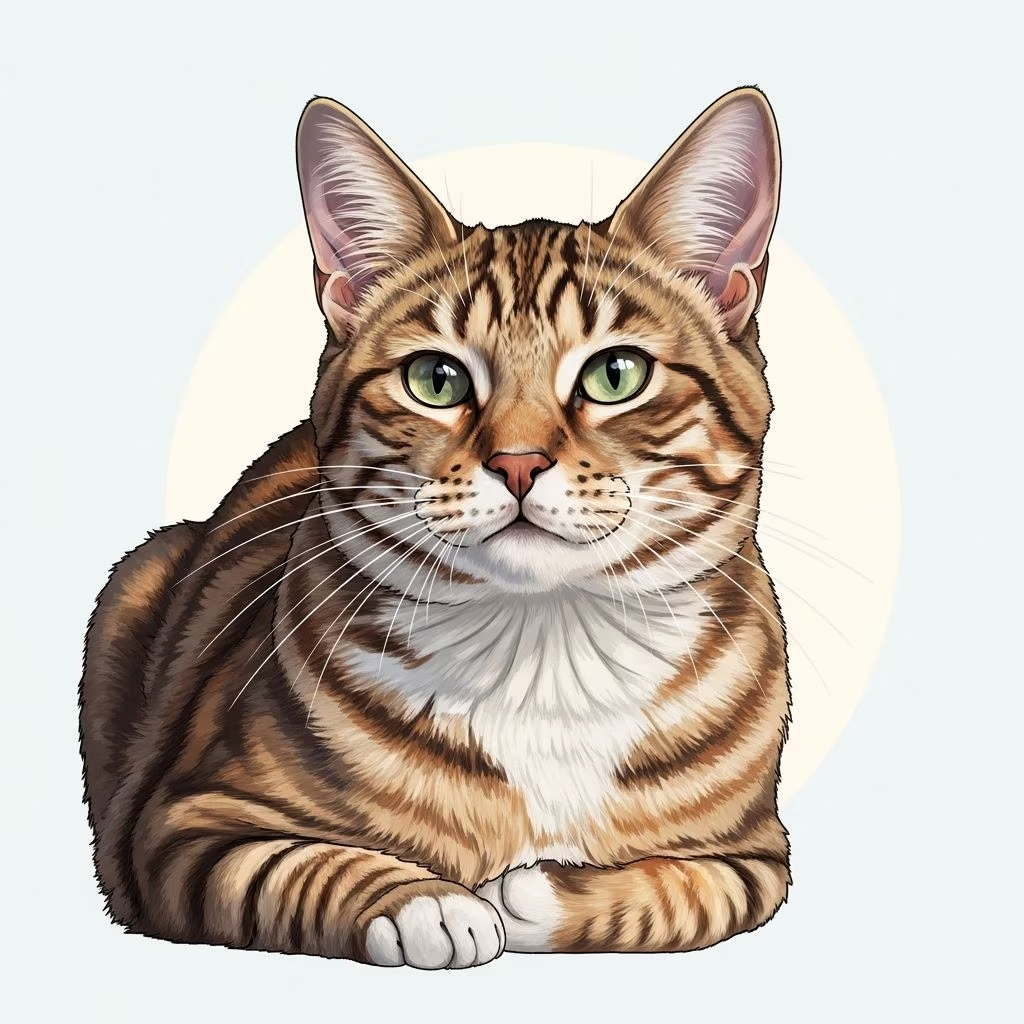
Drawing cats captures their graceful elegance and playful spirit. This guide breaks down the process into simple steps, focusing on anatomy, proportions, and techniques for realistic results.
Understanding Cat Anatomy for Drawing
Accurate cat drawings start with anatomy knowledge. Cats have a flexible spine, powerful legs, and expressive faces that define their agile form.
Key features include:
- Spine: Long and curved, allowing dramatic poses like arching or loafing.
- Legs: Hind legs longer than front for jumping; paws with retractable claws.
- Head: Triangular with large eyes, small nose, and pointed ears.
- Tail: Long and expressive, often curling or swishing.
Study skeletal structure first: skull as a circle, ribcage oval, pelvis smaller oval connected by spine line. Muscles add bulk, especially shoulders and haunches.
Tools and Materials for Cat Drawing
Gather these essentials:
- Pencils (HB to 6B for shading)
- Eraser (kneaded for precision)
- Paper (sketchpad, 80-100gsm)
- Optional: Blending stumps, fine liners
Start light with HB pencil for construction lines.
Step-by-Step: How to Draw a Basic Sitting Cat
Follow these steps for a classic sitting cat.
- Stick Figure Base: Draw vertical spine line. Add head circle at top, large body oval, leg lines, tail curve.
- Refine Shapes: Oval body around spine. Circle head proportionate (1/3 body height). Triangle ears atop head.
- Legs and Paws: Four leg ovals from body. Paws as small ovals or ‘stones’ with egg toes.
- Face Details: Almond eyes, triangle nose, ‘W’ mouth. Whiskers as thin lines.
- Outline Curves: Smooth shapes for furry contours. Erase guides.
Proportions: Head to body 1:2.5; legs half body length.
Drawing Cat Faces: Eyes, Nose, and Expressions
Cats’ faces convey emotion. Divide head circle: eyes on middle horizontal, nose midway down.
- Eyes: Almond slits, vertical pupils. Add ‘veins’ for iris, highlight for shine.
- Nose: Diamond base, nostril wings, bridge curve.
- Ears: Triangles tilted out, inner tufts.
- Mouth/Whiskers: Curved ‘W’, 5-6 whiskers per side.
For kittens, enlarge eyes 20% for cuteness. Expressions: Wide eyes alert, half-closed relaxed.
Cat Poses: From Loaf to Pounce
Cats shift poses fluidly. Use spine curve as guide.
| Pose | Spine Shape | Leg Position |
|---|---|---|
| Loaf | Slight curve | Tucked under body |
| Sitting | Straight with tail loop | Front extended, hind folded |
| Pouncing | Arched back | Hind extended, front reaching |
| Relaxing | Cinnamon roll curve | Legs splayed |
Adjust hip joint angle for pose: forward for stretch, back for crouch.
Shading and Fur Texture Techniques
Shading adds realism. Use Hatching/cross-hatching for fur direction.
- Basic Shading: Light belly, dark back/legs. Shadows under chin, paws.
- Fur: Short directional strokes. Longer on tail/chest. Clumps for fluff.
- Highlights: White fur shine, eye reflections.
Layer lightly; blend for soft fur. Contrast defines form.
Common Mistakes and How to Avoid Them
Avoid these pitfalls:
- Proportions: Head too large; use guidelines.
- Paws: Flat feet; draw bean toes, dewclaw.
- Legs: Equal length; hind longer.
- Eyes: Round human-like; almond slits.
- Fur: Uniform; vary length/texture.
Advanced Tips: Realistic and Cartoon Cats
Realistic: Emphasize muscle bumps, fine fur. Cartoon: Exaggerate eyes, simplify anatomy. Practice from photos for realism.
Frequently Asked Questions (FAQs)
What is the easiest cat pose to draw?
The sitting or loaf pose, using simple ovals and minimal limb extension.
How long to learn cat anatomy?
1-2 weeks daily practice for basics; months for fluency.
Best pencil for cat fur shading?
2B-4B for soft texture; build layers gradually.
Draw cat eyes realistically?
Vertical pupils, radial iris lines, slit shape, glossy highlight.
Practice poses without references?
Use spine/oval skeleton; rotate mentally.
References
- How to Draw a Cat: A Beginner’s Guide — Art Your Cat. 2023. https://artyourcat.com/blogs/art-your-cat-blog/how-to-draw-a-cat-beginners-guide
- How to Draw Animals: Cats and Their Anatomy — Envato Tuts+. 2014-01-01. https://design.tutsplus.com/articles/how-to-draw-animals-cats-and-their-anatomy–vector-17417
- How to draw CATS in ANY POSE – Art Tutorial — YouTube (Proko). 2021-10-20. https://www.youtube.com/watch?v=CxMR30JldA8
- Quick Cat Anatomy Tutorial — DeviantArt. 2012-05-12. https://www.deviantart.com/addictionhalfway/art/Quick-Cat-Anatomy-Tutorial-184337927
- Learn to draw cats (better)! — YouTube. 2022. https://www.youtube.com/watch?v=wEhw3chk2d0
- Cat Anatomy for Artists — John Muir Laws. 2020. https://johnmuirlaws.com/cat-anatomy-for-artists-video/



