

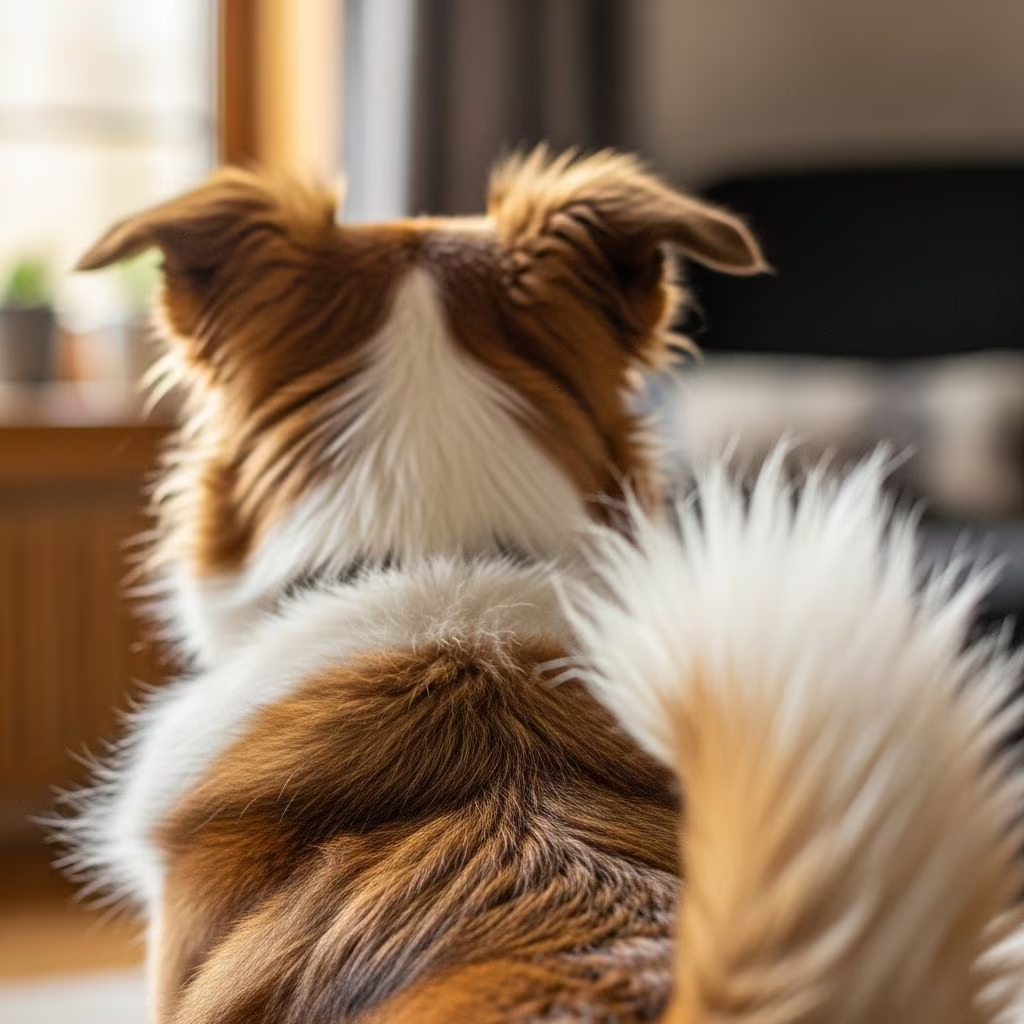
Dogs communicate primarily through body language, and their tails serve as one of the most expressive tools in their arsenal. By learning to read tail positions—from enthusiastic wags to tucked submissions—pet owners can better understand their dog’s emotional state, prevent misunderstandings, and foster deeper connections. This guide breaks down the nuances of dog tail language, drawing from veterinary insights and behavioral research.
Why Dogs Use Their Tails to Communicate
A dog’s tail is far more than a playful appendage; it’s an evolutionary tool for social signaling among pack members. In the wild, wolves and their descendants use tail positions to convey dominance, submission, alertness, and affiliation, aiding group harmony and survival. Domestic dogs retain this instinct, with tail movements controlled by the brain’s limbic system, which processes emotions and triggers specific muscle responses at the tail base.
Studies reveal that tail wagging direction correlates with brain hemispheres: rightward wags indicate positive emotions via left-brain activation, while leftward wags signal negativity from right-brain activity. This asymmetry, observed in experiments where dogs wagged more right when seeing familiar humans and left toward strangers, underscores tails as reliable emotion barometers. An upright tail may also release pheromones from anal sacs, amplifying chemical communication.
Understanding these signals is crucial because misreading them—such as assuming all wags mean friendliness—can lead to bites or conflicts. Always consider the full body context: ears, eyes, posture, and hackles provide a complete picture.
Different Dog Tail Positions and What They Mean
Tail position offers immediate clues to a dog’s mindset. Height, stiffness, and speed vary by emotion, but breed, docking, and context influence interpretation.
High Tail (Erect or Vertical)
A tail held high signals confidence, alertness, or dominance. The dog feels in control of its environment, often seen during exploration or assertive encounters. If stiff and rigid, it may escalate to arousal or aggression, especially with forward-leaning posture or raised hackles. Context matters: playful high tails accompany loose body shakes, while tense ones pair with hard stares.
Relaxed or Neutral Tail
Carried at mid-level without tension, a relaxed tail denotes contentment and security. This ‘default’ position appears during casual walks, petting sessions, or rest, indicating emotional balance. Gentle side-to-side wags here amplify friendliness.
Tucked Tail (Low or Between Legs)
The ultimate fear or submission signal, a tucked tail exposes the vulnerable underside, saying ‘I’m not a threat.’ Slight tucks show mild anxiety or deference; full tucks under the belly scream distress, common in storms, vet visits, or scoldings. Prolonged tucking can signal chronic stress; comfort the dog by removing triggers.
Understanding Tail Wags: Speed, Direction, and Stiffness
Not all wags are happy; nuances reveal true feelings. Watch speed (slow vs. rapid), breadth (narrow vs. wide), direction (left/right), and accompanying tension.
- Broad, Vigorous Wag: Full-body happiness or excitement. The faster and wider, the greater the joy—think greetings or playtime.
- Slow, Loose Wag: Calm friendliness or mild interest. Often mid-height, with soft eyes.
- Stiff, Fast Wag: Heightened arousal. Could be excitement turning tense or pre-aggression; check for whale-eye (whites showing) or lip licks.
- Short, Twitching Wag: Uncertainty or irritation, like a cat’s annoyed flick. Low amplitude signals ambivalence.
Direction adds precision: right-biased wags for positives (e.g., owner return), left for negatives (e.g., dominant dog approach). Stiffness often overrides speed—loose is good, rigid warns caution.
Tail Positions in Different Contexts
Emotions shift by situation; tails adapt accordingly.
During Play
Play tails are loose, mid-to-high with broad wags, often circling the body. Bows, play faces (open mouth, bouncy posture), and reciprocal chasing confirm fun. Stiffening mid-play signals ‘stop’—respect it to avoid fights.
Meeting Strangers or Other Dogs
Neutral-to-high tails with gentle wags invite interaction. Tucked or stiff high tails urge caution; approach slowly, let dogs sniff in a C-shape. Avoid forcing greetings if tails tuck.
When Anxious or Scared
Tucking dominates, paired with cowering, yawning, or fleeing. Identify triggers (loud noises, separation) and desensitize gradually with positive reinforcement.
Breeds with Unique Tail Language
Not all tails are equal. Docked (e.g., Dobermans) or bobtail breeds (e.g., Corgis, Australian Shepherds) limit expression, so focus on base stubs, ears, and posture.
| Breed Type | Tail Characteristics | Reading Tips |
|---|---|---|
| Long, Feathered (e.g., Labs) | Expressive, plume-like | Full range visible; trust standard cues |
| Docked (e.g., Rottweilers) | Shortened surgically | Watch vigorous base thumps, body wiggles |
| Bobtail (e.g., Pembroke Corgi) | Naturally short | Rely on ears forward for happy, pinned for fear |
Curly-tailed breeds (e.g., Akita) keep flags up naturally—distinguish emotional highs from baselines by stiffness.
Common Misconceptions About Dog Tails
Myth 1: All Wags Mean Happy. False—stiff wags precede snaps; rapid conflicted wags signal discomfort.
Myth 2: Tail Up Always Aggressive. Context rules: playful vs. dominant depends on whole body.
Myth 3: Tails Only Matter in Purebreds. Mixed breeds express similarly; learn your dog’s normal.
Frequently Asked Questions
Why does my dog wag its tail to the right or left?
Dogs wag right for positive emotions (left brain) and left for negative (right brain), per research on asymmetric wagging.
What does a tucked tail mean?
Fear, submission, or anxiety; remove stressors and provide reassurance.
Can I read a dog with no tail?
Yes, via rump movements, ear positions, and overall posture.
Is a fast wag always excitement?
No—stiff fast wags can mean tension; observe body language.
How do I know if my dog’s tail signals aggression?
High, stiff tail with forward posture, growls, hard stare—give space.
Improving Communication with Your Dog
Practice daily observation: note your dog’s baseline tail in calm states, then track changes. Respond appropriately—reward happy wags with play, soothe tucks with calm presence. Training enhances mutual understanding; use positive reinforcement to associate cues with safety.
For professionals, tools like body language charts aid accuracy. Ultimately, tail reading builds trust, reduces stress, and enriches life together.
References
- Interpreting Tail Wags in Dogs — VCA Animal Hospitals. 2023. https://vcahospitals.com/know-your-pet/interpreting-tail-wags-in-dogs
- Dog Tail Positions Explained: Decode Your Pup’s Emotions Today — Halo Collar. 2024. https://www.halocollar.com/blog/dog-facts/dog-tail-positions/
- Understanding Your Dog’s Tail Language — The Trusted Companion. 2024. https://www.thetrustedcompanion.com/understanding-your-dogs-tail-language
- Dog Body Language — LMU Academics (CURB Lab). Accessed 2025. https://academics.lmu.edu/media/lmuacademics/cures/urbanecolab/module09/Dog%20Body%20Language.pdf
- What Your Dog’s Tail Wag Really Means — Carey Animal Hospital. 2024. https://careyanimalhospital.com/blog/what-does-a-wagging-tail-mean/



