

How Smart Are Dogs? How to Test Your Dog’s IQ
Dogs have captivated human interest for thousands of years, not just for their loyalty and companionship, but also for their apparent intelligence and ability to understand human commands. The question of how smart dogs really are remains one of the most intriguing aspects of canine behavior and cognition. Research in animal cognition suggests that dogs possess an intelligence level similar to that of a two-year-old human child, with the ability to understand around 165 words and gestures. This remarkable cognitive capacity allows dogs to learn complex commands, navigate social hierarchies, and solve problems in ways that continue to fascinate both scientists and pet owners alike.
The general results from various intelligence studies indicate that dogs are undeniably intelligent creatures, especially in their interactions with humans. Some dogs excel in specific cognitive tasks, while others demonstrate exceptional problem-solving abilities or working intelligence. Understanding canine intelligence is not simply about determining which dog is “smartest,” but rather appreciating the different types of intelligence that dogs possess and how these abilities manifest in their daily lives and relationships with humans.
What is the IQ of a Dog?
Although there is no specific IQ test for dogs comparable to human intelligence testing, researchers have developed several reliable frameworks and tasks to assess canine intelligence. These assessment methods provide valuable insights into how dogs think, learn, and interact with their environment and with humans. Let’s explore the most recognized approaches to measuring dog intelligence.
Coren’s Intelligence Criteria
Psychologist Stanley Coren proposed one of the most influential frameworks for understanding dog intelligence by organizing it into three distinct categories. This model has become foundational in canine cognition research and helps pet owners understand the different dimensions of their dog’s mental abilities.
- Instinctive Intelligence: What the dog was bred to do, such as herding, guarding, retrieving, or hunting. This type of intelligence reflects the specific purposes for which different breeds were originally developed.
- Adaptive Intelligence: Problem-solving and learning from the environment. This dimension measures how well a dog can learn from its experiences and adapt to new situations.
- Working and Obedience Intelligence: How well a dog learns to obey commands and carries out tasks assigned by humans. This is often what pet owners refer to when discussing a “smart dog.”
Coren’s work showed that Border Collies, Poodles, and German Shepherds ranked highest in working and obedience intelligence. These breeds consistently demonstrate exceptional ability to learn new commands, retain complex information, and execute tasks with minimal repetition.
The Canine Cognitive Battery
Developed by Dr. Brian Hare at Duke University’s Canine Cognition Center, this comprehensive suite of tests evaluates multiple dimensions of canine intelligence. Unlike Coren’s framework, which focuses on breed-specific tendencies, the canine cognitive battery measures individual dog capabilities across various cognitive domains.
- Memory: Can the dog remember where a treat is hidden? This tests spatial memory and object permanence.
- Gesture Understanding: Can the dog follow a human’s gaze or pointing finger? This measures social attentiveness and the ability to interpret human nonverbal communication.
- Reasoning: Can the dog make assumptions from limited data? This evaluates the dog’s ability to infer and problem-solve based on incomplete information.
- Social Intelligence: How does the dog read human emotion and body language? This assesses the dog’s capacity to understand and respond to human emotional states.
The AKC Canine Good Citizen Test
The American Kennel Club’s Canine Good Citizen Test focuses on a dog’s manners, trainability, and response to commands in real-world situations. While it doesn’t assess intelligence in the abstract, it strongly correlates with working intelligence and demonstrates practical application of learned behaviors in everyday contexts.
Comparative Animal Intelligence: Where Dogs Rank
To understand canine intelligence more fully, it’s helpful to place dogs within the broader spectrum of animal cognition. Researchers use encephalization quotient (EQ)—a measure of brain size relative to body size—to compare cognitive capacity across species. Among our four-legged friends, dogs have an EQ of about 1.2, which, while lower than humans and dolphins, still signifies their remarkable ability to learn commands, navigate social hierarchies, and solve problems.
| Animal Species | Average EQ | Key Cognitive Strengths |
|---|---|---|
| Dogs | 1.2 | Learning commands, understanding human emotional states, social bonding |
| Cats | 1.0 | Memory, observational learning, problem-solving through trial and error |
| Horses | 0.9 | Complex command learning, spatial memory, social hierarchies |
| Pigeons | 0.6 | Image recognition, multi-step problem-solving, navigation |
Dogs’ social intelligence sets them apart from many other animals. Dogs have twice as many cortical neurons as cats, suggesting greater potential for complex tasks. This neurological advantage, combined with their evolved ability to understand human communication, makes dogs exceptionally skilled at working alongside humans in roles ranging from service dogs to search-and-rescue operations.
The Smartest Dog Breeds: Who Tops the Intelligence Rankings
While intelligence varies among individual dogs regardless of breed, certain breeds have consistently demonstrated exceptional working and obedience intelligence in scientific studies and real-world applications. These breeds combine natural aptitude with trainability and eagerness to work with humans.
1. Border Collie
Border Collies are known for consistently getting top intelligence rankings among dog breeds. They excel at rapid learning and possess excellent memory, capable of learning hundreds of words. These dogs thrive on mental stimulation and were originally bred for herding livestock, a task requiring quick decision-making and independent problem-solving. Their adaptive intelligence allows them to assess situations and respond appropriately without constant human direction.
2. Poodle
Poodles excel in obedience and trick training, demonstrating remarkable versatility across different tasks. Their intelligence, paired with a calm temperament, makes them highly sought after in therapy and service work. Poodles are highly trainable and eager to please, characteristics that have made them popular for advanced training roles including assistance work for disabled individuals and psychiatric service dog applications.
3. German Shepherd
German Shepherds consistently rank among the most intelligent breeds, excelling in working roles that require complex decision-making. Their combination of working intelligence, instinctive intelligence (developed through selective breeding for herding and protection), and adaptive intelligence makes them ideal for police work, military applications, and search-and-rescue operations.
The Rare Phenomenon of Label-Learning Dogs
Beyond standard intelligence testing, recent scientific research has identified an extraordinarily rare category of dogs that demonstrates exceptional cognitive ability. Label-learner dogs are able to recognize a vast number of objects by name alone, and when it comes to canines, they’re considered to be the smartest of the smart. These dogs represent only a tiny fraction of the canine population and exhibit cognitive abilities that far exceed typical dog intelligence.
A groundbreaking study published in Scientific Reports identified three key traits that set genius dogs apart: curiosity, focus, and self-control. “Being able to pick out such a wide variety of objects is not something any dog can do,” according to study lead Dr. Juliane Kaminski from the University of Portsmouth. “It is extremely rare and appears to be an inherent natural ability which is specific to the dog and not a quality that many dogs have.”
One notable example of a label-learner dog is Harvey, a Border Collie who’s been dubbed one of the smartest dogs in the United Kingdom. Harvey is able to identify over 220 objects, demonstrating an extraordinary vocabulary that exceeds the typical dog’s comprehension by orders of magnitude. His owner conducts retrieval games throughout the day, utilizing Harvey’s natural Border Collie work drive and exceptional learning capacity.
The Three Traits of Genius Dogs
The scientific investigation into label-learning dogs revealed that these exceptional animals possess measurable differences in temperament and cognitive abilities compared to regular dogs:
- Curiosity: A heightened interest in exploring and learning about new objects and environments, driving continuous learning behavior.
- Focus: The ability to concentrate intensely on learning tasks and maintain attention through repetitive training without becoming distracted or disengaged.
- Self-Control: Label-learner dogs exhibited better impulse control than regular dogs. “Inhibitory control might be the essential cognitive building block underlying the label-learners’ genius ability, as subjects must inhibit their preference for certain features of the objects they fetch,” according to Dr. Kaminski.
These findings suggest that canine intelligence is not merely about the capacity to learn, but rather about the personality traits and behavioral characteristics that enable exceptional learning. Dogs with strong self-control can override their instinctive preferences—such as a preference for a ball over a ring—to follow learned commands, a skill that appears central to extraordinary cognitive achievement in dogs.
Can You Test Your Dog’s IQ at Home?
Yes, simple object permanence and problem-solving games with cups and hidden treats can provide valuable insights into your dog’s cognitive abilities. While these home tests cannot replace comprehensive scientific evaluation, they offer fun and engaging ways to assess and stimulate your dog’s mental capabilities.
Simple Home Intelligence Tests
- Object Permanence Test: Hide a treat under one of several cups while your dog watches, then shuffle the cups and see if your dog can find the treat. This tests memory and spatial reasoning.
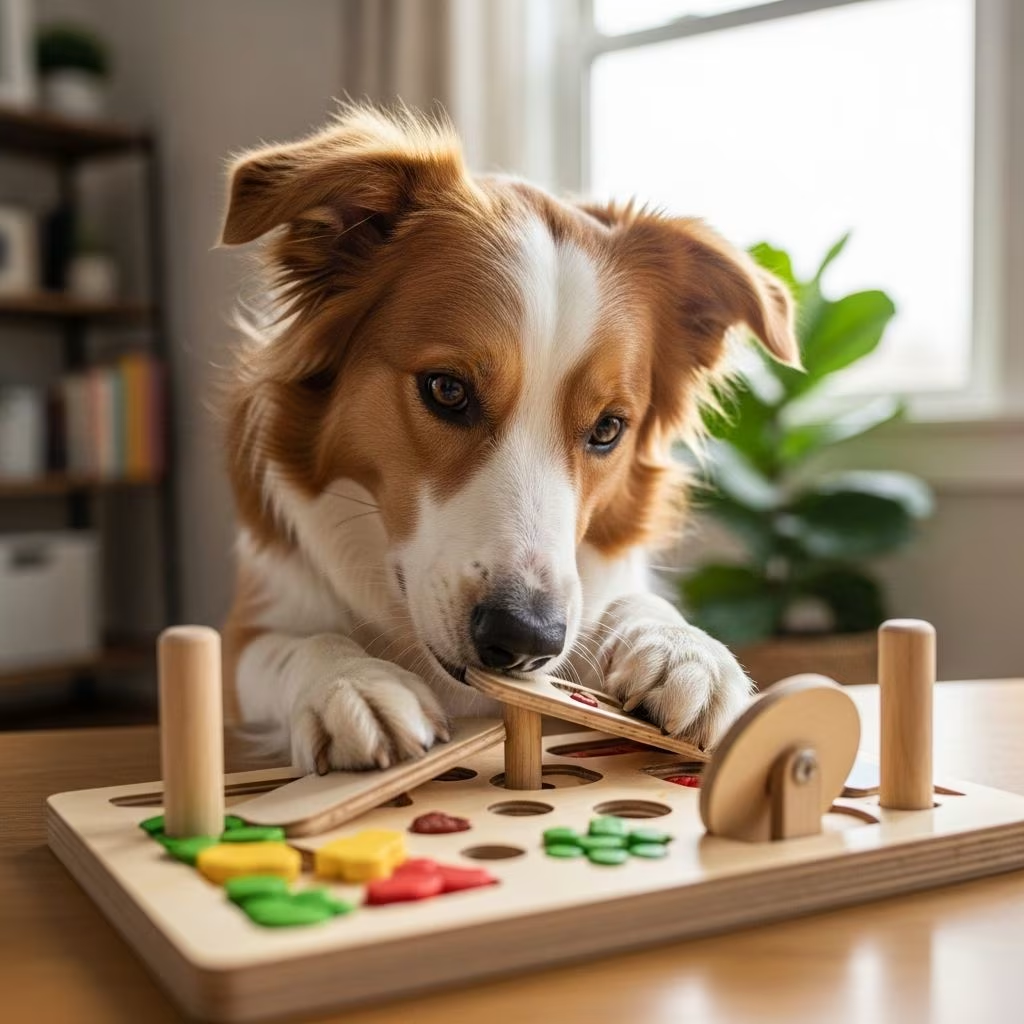
- Problem-Solving Puzzle: Use a puzzle toy or create one by hiding treats in a box with obstacles. Observe how quickly and methodically your dog figures out how to access the treat.
- Command Learning Speed: Teach your dog a new command and track how many repetitions it takes for them to learn it reliably. Faster learners typically demonstrate higher working intelligence.
- Gesture Following: Point in a direction or make eye contact while looking at an object. See if your dog understands and follows your gestural cues without verbal commands.
Do IQ Levels Vary Between Puppies and Adult Dogs?
Yes, IQ levels vary between puppies and adult dogs. Puppies are still developing cognitive skills, while adults have more refined reasoning and memory. This developmental difference is expected, as brain development in dogs continues into early adulthood. Puppies may struggle with impulse control and sustained attention, while adult dogs demonstrate greater consistency in performance and ability to apply learned behaviors across different contexts.
However, the foundational cognitive abilities that distinguish highly intelligent dogs often manifest early in development. Dogs that will become exceptional label-learners or service dogs may show signs of unusual focus and curiosity even as puppies, though these traits typically become more refined and pronounced as the dog matures.
Frequently Asked Questions
Q: Are dogs really smarter than cats?
A: Not necessarily. Dogs tend to score higher on social and working intelligence, but cats may outperform in observational and independent problem-solving tasks. They’re just different from each other in their cognitive strengths and learning preferences. Dogs have evolved to cooperate with humans, while cats developed more independent problem-solving approaches.
Q: Which has more neurons — dogs or cats?
A: Dogs. Studies show dogs have about twice as many cortical neurons as cats, suggesting greater potential for complex tasks. This neurological difference contributes to dogs’ superior performance on tasks requiring working memory and complex command learning.
Q: Can breed influence my dog’s intelligence?
A: Yes, breed significantly influences cognitive abilities. Different breeds were selectively bred for specific tasks, which shaped their instinctive and adaptive intelligence. However, individual dogs within a breed show considerable variation in intelligence, and environmental factors like training and socialization play important roles in developing cognitive abilities.
Q: What’s the best way to keep my dog mentally stimulated?
A: Puzzle toys, obedience training, scent work, interactive games, and varied environmental experiences all provide mental stimulation. Different dogs prefer different types of challenges, so experiment to find what engages your individual dog’s interests and strengths.
Q: Can adult dogs learn new skills as easily as puppies?
A: Adult dogs can learn new skills effectively, though they may require different training approaches than puppies. Adult dogs often demonstrate better focus and impulse control, which can actually make learning easier once they understand what’s expected. The saying “you can’t teach an old dog new tricks” is not scientifically accurate.
References
- How Smart are Dogs? How to Test Your Dog’s IQ — Kinship. 2024. https://www.kinship.com/dog-behavior/how-smart-are-dogs
- How Intelligent Are Dogs? A Comparative Journey Through the Animal Intelligence Spectrum — Uma Singh. 2024. https://umasingh.in/how-intelligent-are-dogs-a-comparative-journey-through-the-animal-intelligence-spectrum-e4af72063c4a



