

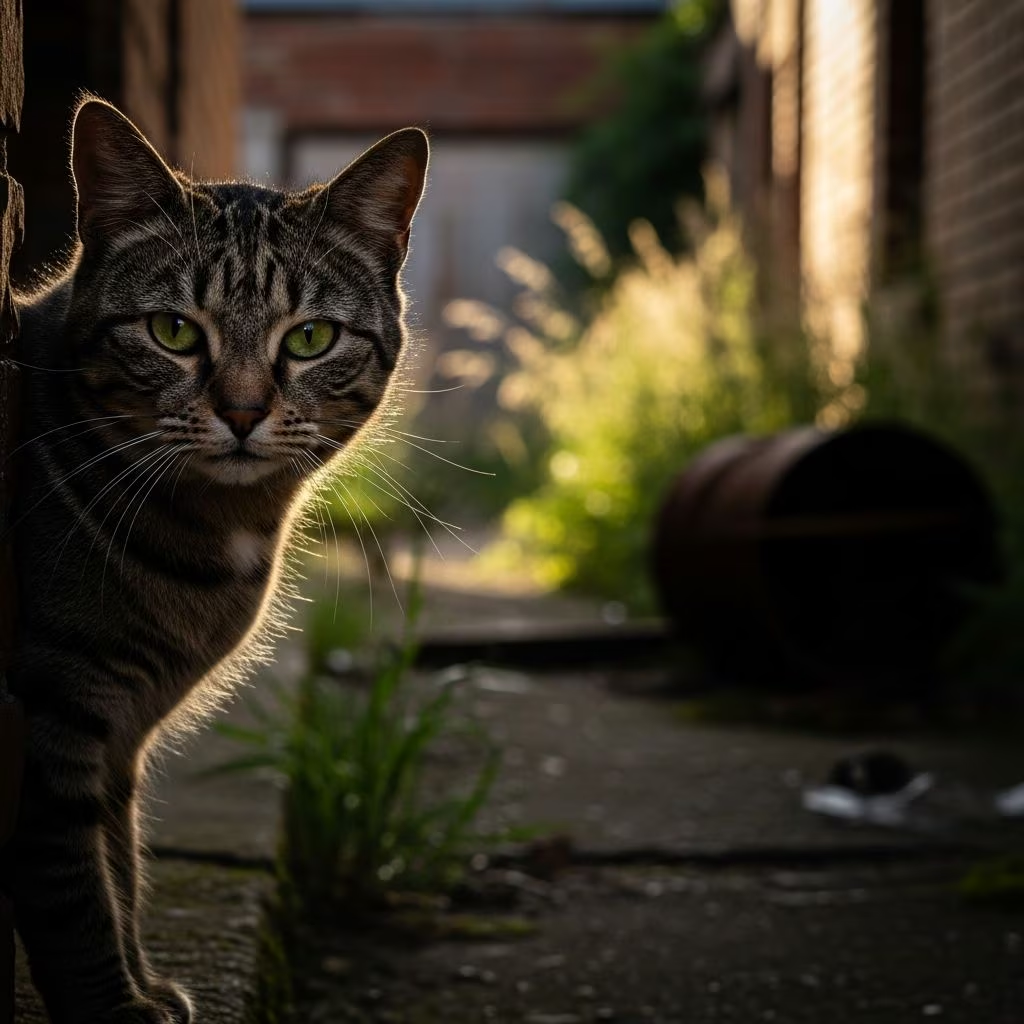
Domestic cats can begin exhibiting feral behaviors within days to weeks of abandonment, but full adaptation to a wild lifestyle typically takes 4-6 weeks, depending on age, environment, and prior socialization. This reversal taps into their ancestral wildcat roots, where survival instincts override human-bonded traits.
The Roots of Feline Domestication and Reversion Potential
Cats trace their origins to the African wildcat (Felis silvestris lybica), domesticated around 10,000 years ago in the Fertile Crescent as humans settled into agriculture. Grain stores attracted rodents, drawing bold wildcats closer to settlements. Unlike dogs, selected for traits like docility, cats underwent minimal genetic changes—only about 13 genes altered by natural selection—retaining much of their independent, solitary nature.
This shallow domestication means modern house cats (Felis catus) remain genetically close to wild ancestors, enabling rapid behavioral shifts when human support vanishes. Archaeological evidence, such as a 9,500-year-old cat burial in Cyprus, marks early human-feline bonds, yet cats spread globally via trade routes, interbreeding minimally with local wildcats. In group settings with ample food, domestic cats even form pride-like social structures, grooming and cooperating like lions, but solitude defines their wild baseline.
Timeline of a Cat’s Shift to Feral Life
The transition isn’t instantaneous; it unfolds in phases, influenced by the cat’s life stage and circumstances.
- Initial Days (0-7 days): Shock and disorientation dominate. A pampered pet, suddenly outdoors, faces hunger, cold, and predators. Instincts kick in—hiding in bushes or under structures—while meowing for absent owners persists.
- Weeks 1-2: Survival mode activates. Cats scavenge trash or hunt small prey, sharpening senses dulled by kibble. Fear of humans intensifies; once-friendly pets hiss at approaches.
- Weeks 3-6: Core feral traits solidify. Solitary hunting becomes routine, social bonds sever, and wild appearance emerges—matted fur, lean build. Kittens weaned young adapt faster than seniors.
- Beyond 6 Weeks: Full feral status. These cats join colonies, defend territories, and breed prolifically, mirroring wildcat behaviors.
Younger cats (under 6 months) revert quickest, leveraging play-honed hunting skills. Adults with outdoor experience transition smoother than lifelong indoors cats. Genetic studies confirm this plasticity; domestic cats in food-rich colonies exhibit sociality, but scarcity enforces feral independence.
Key Behavioral Transformations
From lap cat to shadow hunter, changes are profound:
| Domestic Trait | Feral Adaptation | Reason |
|---|---|---|
| Affectionate rubbing on humans | Avoidance or aggression | Humans become threats or irrelevant |
| Indoor litter use | Outdoor elimination patterns | Natural scent-marking for territory |
| Meowing for food/attention | Silent stalking | Meows reserved for mothers/kittens in wild |
| Playful pouncing | Hunting efficiency | Play evolves into prey capture |
Domestic cats vocalize excessively to humans—a trait absent in wildcats—but feral adults mute this, chirping only at prey or kin. Social groups form in colonies, with females cooperating on kittens, echoing lion prides.
Survival Challenges in the Wild
Feral life is harsh; average lifespan drops to 2-5 years versus 12-15 indoors. Key threats include:
- Predation: Dogs, coyotes, raptors target weakened cats.
- Disease: Feline leukemia, FIV spread rapidly in colonies without vaccines.
- Starvation: Harsh winters or urban decline limits prey.
- Human Factors: Traffic, poisons, trapping.
Yet resilience shines; cats exploit urban niches—dumpsters, parks—thriving where rodents abound, much like their Fertile Crescent forebears. North African wildcat traits, like heat tolerance, aid modern ferals.
Factors Accelerating or Slowing the Process
Not all cats feralize equally:
- Age: Kittens adapt in days; elderly struggle, often perishing quickly.
- Prior Exposure: Barn cats revert faster than apartment dwellers.
- Environment: Mild climates with food sources speed transition; barren areas delay it fatally.
- Health/Neutering: Intact cats breed, strengthening colony ties; fixed ones roam solitarily.
- Genetics: Purebreds with exaggerated traits (e.g., flat faces) fare worse than mixed breeds.
Recent DNA analyses, including 2025 nuclear genome studies, reveal multi-wave dispersal from North Africa to Europe around 2,000 years ago, underscoring adaptable genetics.
Preventing Feral Drift in Your Cat
Owners can mitigate risks:
- Secure Indoors: Microchip, collars prevent escapes.
- Enrichment: Toys, perches mimic wild stimuli, staving off boredom-driven wandering.
- Training: Recall cues, litter routines reinforce bonds.
- Community Support: TNR (Trap-Neuter-Return) manages strays humanely.
Socialization windows close post-8 weeks; early handling cements domesticity.
FAQs
Can a feral cat become a pet again?
Yes, if under 4 months or socialized early. Adults rarely fully reintegrate, though foster care helps.
How do feral colonies form?
Related females anchor groups, sharing nursing duties in food-plentiful areas.
Are feral cats a health risk?
They hunt pests but carry diseases; TNR reduces populations safely.
What’s the difference between stray and feral?
Strays are lost/recently abandoned, still human-friendly; ferals shun contact.
Do all abandoned cats go feral?
No—many perish first, but survivors adapt within weeks.
Ethical Considerations for Feral Populations
Feral cats number in millions globally, sparking debates. Euthanasia vs. TNR divides opinions, but evidence favors sterilization for humane control. Understanding their quick reversion informs compassionate policies—recognizing cats as semi-domestic aids coexistence.
References
- Feline evolution: How house cats and humans domesticated each other — Genetic Literacy Project. 2023-11-27. https://geneticliteracyproject.org/2023/11/27/feline-evolution-how-house-cats-and-humans-domesticated-each-other/
- The Taming of the Cat — PMC – PubMed Central – NIH. 2018-01-18 (updated). https://pmc.ncbi.nlm.nih.gov/articles/PMC5790555/
- Domestic Cat Origins Revealed: DNA Rewrites 10,000-Year History — Big Cat Rescue. 2025 (recent genetic study referenced). https://bigcatrescue.org/conservation-news/rewriting-cat-history-how-new-genetic-evidence-challenges-everything-we-thought-we-knew-about-domestic-cats
- The Natural History of Domestic Cats — Alley Cat Allies. Accessed 2026. https://www.alleycat.org/resources/the-natural-history-of-the-cat/
- The origins of cats — International Cat Care. Recent update. https://icatcare.org/articles/the-origins-of-cats



