

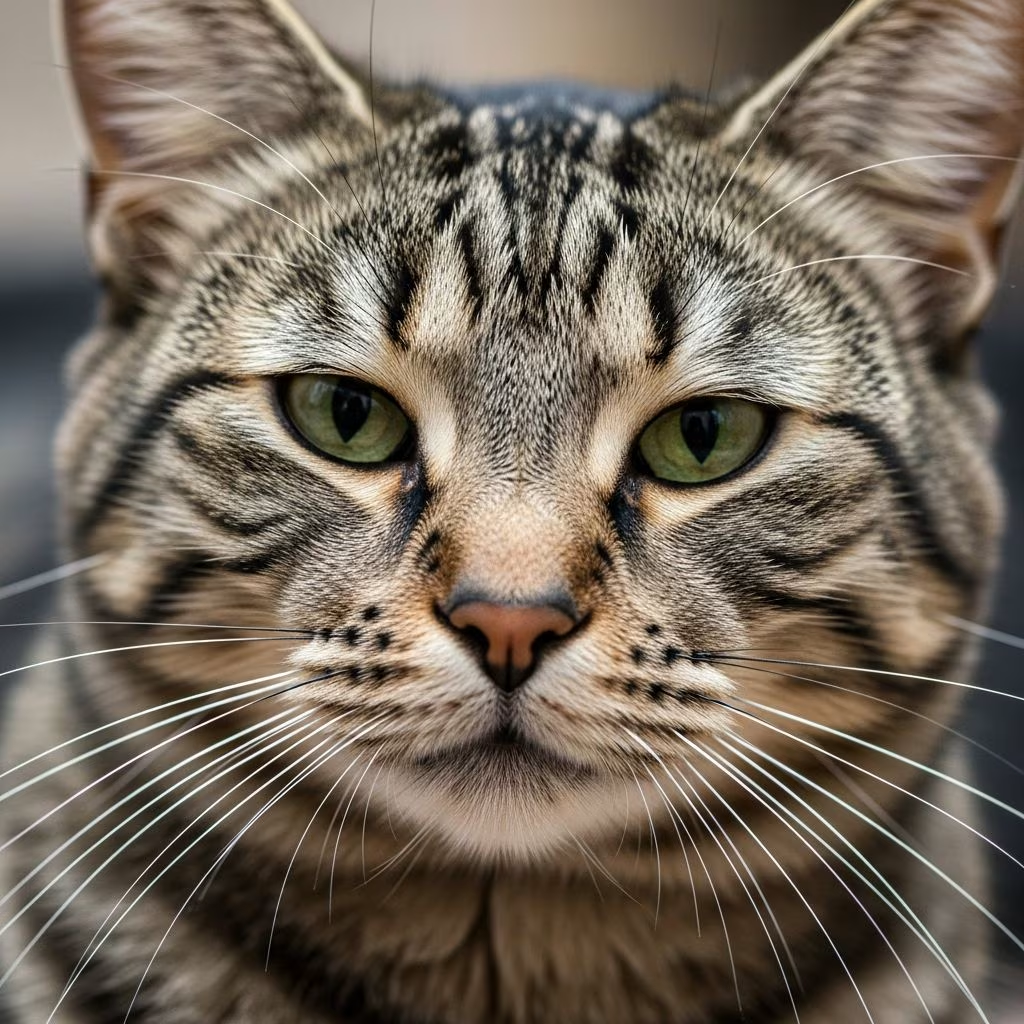
Cat whiskers, or vibrissae, are specialized sensory hairs that play a crucial role in a cat’s perception of the world. Most cats have approximately 24 whiskers on their muzzle—12 on each side arranged in four rows—but they also have additional whiskers on other parts of the body, making the total number vary slightly by individual and breed.
What Are Cat Whiskers?
Whiskers are not ordinary hairs; they are thick, coarse vibrissae deeply rooted in the cat’s skin, connected to muscles and a rich network of nerves. Unlike regular fur, whiskers feature a blood sinus and proprioceptors at their tips, making them highly sensitive to touch, vibrations, and air currents.
These sensory organs allow cats to detect subtle environmental changes, functioning like radar for navigation, hunting, and protection. Composed primarily of keratin, whiskers are twice as thick as normal hairs and embedded three times deeper into the hypodermis, enhancing their durability and sensitivity.
How Many Whiskers Do Cats Have?
The most prominent whiskers are the mystacial vibrissae on the muzzle, numbering about 12 per side (24 total), arranged in four neat rows. This pattern is as unique as a human fingerprint.
Beyond the muzzle:
- Superciliary whiskers: 2–4 above each eye for eye protection.
- Genal whiskers: A few on the cheeks, toward the back.
- Mandibular whiskers: On the chin.
- Carpal whiskers: 4–8 on the back of the front legs (wrists), aiding in climbing and prey handling.
Overall, cats typically have 16–24 muzzle whiskers plus 12–20 supplementary ones, totaling around 40–48, though exact counts vary by genetics and breed.
Where Are Whiskers Located on Cats?
Whiskers are strategically placed for maximum sensory input:
| Location | Name | Number (Approx.) | Function |
|---|---|---|---|
| Muzzle (upper lip) | Mystacial | 12 per side | Primary navigation, spatial awareness |
| Above eyes | Superciliary | 2–4 per eye | Eye protection, trigger blink reflex |
| Cheeks | Genal | 3–5 per side | Detect nearby objects |
| Chin | Mandibular | Few | Sensory feedback |
| Front legs (wrist) | Carpal | 4–8 per leg | Hunting, climbing, prey assessment |
These locations ensure comprehensive environmental monitoring.
Functions of Cat Whiskers
Whiskers serve multiple vital roles, acting as a cat’s sixth sense:
- Touch and Vibration Detection: Nerve-rich follicles sense air currents, vibrations, and textures, equivalent to human fingertips.
- Spatial Awareness: Muzzle whiskers match the cat’s body width; if they bend in a space, the body won’t fit.
- Navigation in Dark: Detect objects without sight, aiding nocturnal movement.
- Eye Protection: Touch triggers instant blinking.
- Hunting Aid: Forward-fanned whiskers locate prey; carpal whiskers pinpoint kill bites.
- Balance and Righting Reflex: Proprioceptors sense body orientation and gravity.
- Communication: Position indicates mood—relaxed (neutral), curious/hunting (forward), aggressive/fearful (back).
Do Cat Whiskers Grow Back?
Yes, cat whiskers naturally shed and regrow in a cycle similar to fur, typically every few months. Kittens are born with short whiskers that lengthen with age. If damaged or trimmed, they regenerate from specialized follicles, but the process takes 2–3 months, during which the cat may be disoriented.
Regrowth length is genetically determined and varies by breed; overweight cats may lose effectiveness as body widens.
Why Shouldn’t You Cut Cat’s Whiskers?
Never cut or trim whiskers—they cause sensory deprivation, leading to confusion, poor navigation, bumping into objects, and hunting difficulties. Short whiskers impair spatial judgment, balance, and mood detection.
Myths suggest trimming for aesthetics or bowls, but this is harmful. Provide wide bowls to avoid whisker fatigue, where sides irritate sensitive whiskers during eating.
Cat Whisker Fatigue: What Is It?
Whisker fatigue occurs when whiskers rub against narrow bowl sides, overwhelming nerves and causing stress, refusal to eat, or messy eating. Signs include pawing food or avoidance.
Solutions:
- Use wide, shallow bowls or plates.
- Switch to whisker-friendly feeders.
- Feed on flat surfaces temporarily.
How Long Are Cat Whiskers?
Whisker length is breed-specific and proportional to body size, typically 2–3 inches for average cats, matching body width for spatial gauging. Siamese may have shorter ones; Maine Coons longer. They don’t grow indefinitely but shed and regrow at appropriate lengths.
Do All Cats Have the Same Whiskers?
No, variations exist:
- Breed Differences: Sphynx have fine, curly whiskers; long-haired breeds like Persians have longer ones.
- Age: Kittens’ whiskers shorten post-birth for nursing, then grow.
- Individuals: Some have extras; patterns are unique.
Caring for Your Cat’s Whiskers
Minimal intervention is key:
- Avoid touching or trimming.
- Monitor for damage (breaks, curling indicate health issues like nutrition deficits).
- Use wide bowls to prevent fatigue.
- Groom gently; don’t pull loose ones—let them shed naturally.
- Consult vets for asymmetry or loss, possibly signaling allergies, infections, or disease.
Frequently Asked Questions (FAQs)
What happens if you cut a cat’s whiskers?
Your cat becomes disoriented, struggles with navigation, balance, and hunting until regrowth (2–3 months).
Do cats have whiskers on their ears?
No, but ear tufts serve similar protective roles; true whiskers are on muzzle, eyes, cheeks, chin, and legs.
Can cats feel their whiskers?
Whiskers themselves lack nerves, but follicles do—movement sends brain signals like touch.
Why do some cats have curly whiskers?
Genetics or nutrition; common in breeds like Selkirk Rex. Curling doesn’t impair function unless extreme.
Do kittens have whiskers?
Yes, born with short ones for nursing; they lengthen quickly.
Are cat whiskers hollow?
Yes, with a blood-filled sinus for sensitivity, surrounded by nerves.
References
- Structure and Function of the Whiskers in Cats — PetPlace.com. Accessed 2026. https://www.petplace.com/article/cats/pet-health/structure-and-function-of-the-whiskers-in-cats
- Cat Whiskers 101 — Zoetis Petcare. Accessed 2026. https://www.zoetispetcare.com/blog/article/cat-whiskers-101
- A Cat’s Whiskers: How Do They Work? — NASC LIVE. Accessed 2026. https://www.nasc.cc/cat/a-cats-whiskers-how-do-they-work/
- Cat Whisker Facts — PawsWI. 2015-03-22. https://www.pawswi.com/single-post/2015/03/22/cat-whisker-facts
- Why Do Cats Have Whiskers? — Purina UK. Accessed 2026. https://www.purina.co.uk/articles/cats/behaviour/common-questions/why-do-cats-have-whiskers
- Cat Whiskers — McGehee Clinic. Accessed 2026. https://mcgeheeclinic.com/blog/cat-whiskers/



