

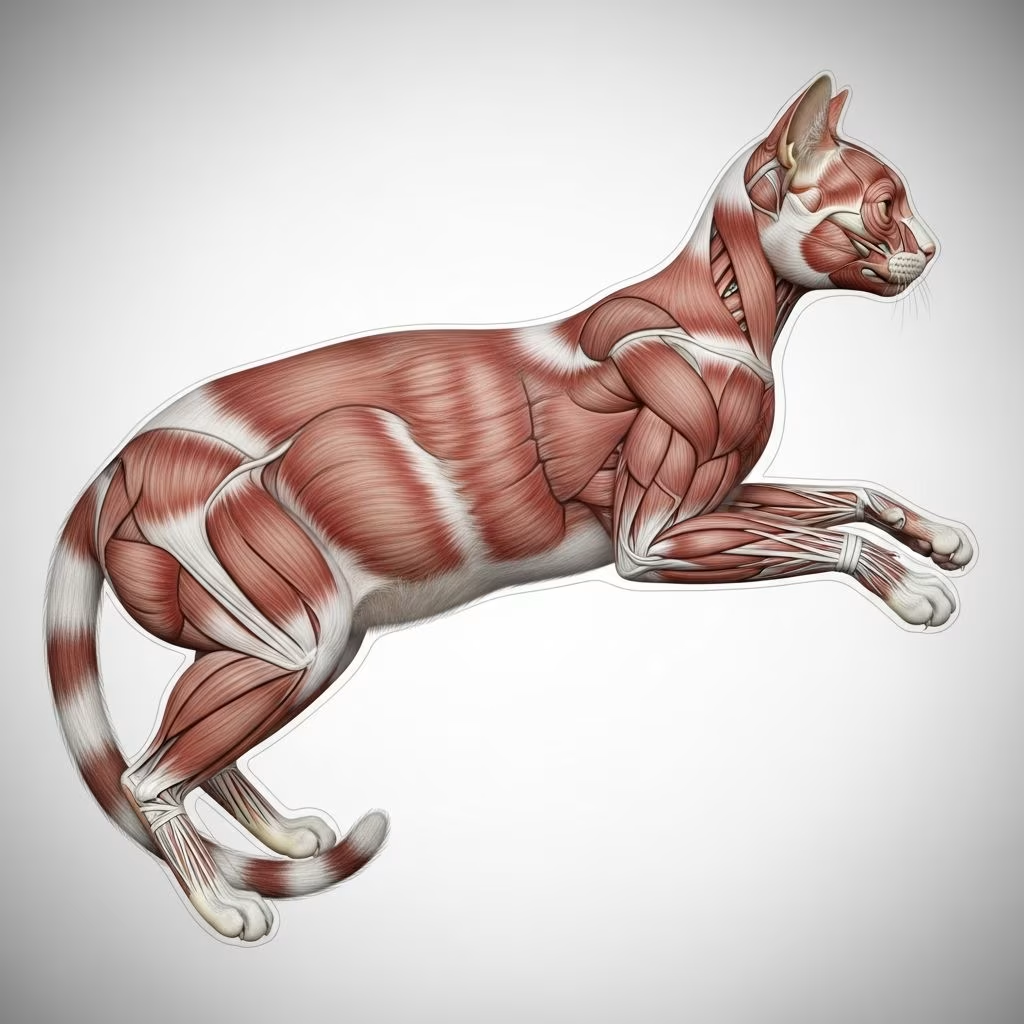
Cats possess a remarkable muscular system that powers their grace, speed, and predatory prowess. While humans have approximately 600 muscles, cats have around 500 distinct skeletal muscles, enabling their agile movements, powerful leaps, and silent stalking. This intricate network is optimized for a quadrupedal lifestyle, with adaptations for climbing, jumping, and pouncing on prey. Understanding cat musculature not only highlights their evolutionary advantages but also aids pet owners in recognizing health issues related to muscle function.
Why Do Cats Have Fewer Muscles Than Humans?
Cats have fewer muscles than humans primarily due to differences in body structure and locomotion. Humans, being bipedal, require more muscles for upright posture, fine motor skills in hands, and complex facial expressions. Cats, as quadrupeds, have fused or reduced certain muscles for efficiency in speed and flexibility. For instance, the cat’s trapezius muscle is divided into three parts (clavotrapezius, acromiotrapezius, spinotrapezius), unlike the single human trapezius, but overall, their system prioritizes power over dexterity. This streamlining supports bursts of energy for hunting rather than endurance walking.
Additionally, cats lack certain muscles prominent in humans, such as those for extensive thumb opposition, as their paws are designed for gripping and retracting claws. Studies on felid scaling show that muscle architecture remains conservative across species, with forelimb muscles scaling to support body mass variations from small domestic cats to large felids. This efficiency means fewer total muscles but greater relative strength per unit.
The Muscular System of Cats: An Overview
The feline muscular system comprises three main types: skeletal (voluntary for movement), smooth (involuntary for organs), and cardiac (heart). Here, we focus on skeletal muscles, totaling about 500, grouped by body region: head and neck, torso, forelimbs, hindlimbs, and integumental muscles. These muscles attach to over 200 bones via tendons, allowing precise control. Key features include powerful extensors for jumping (up to six times their body length) and flexors for climbing.
- Skeletal Muscles: ~500, responsible for locomotion and posture.
- Smooth Muscles: Control digestion, blood vessels.
- Cardiac Muscle: Pumps blood via the heart.
Dissection guides reveal layered muscles, from superficial (e.g., cutaneous maximus for skin twitching) to deep (e.g., erector spinae for spinal support).
Muscles of the Head and Neck
Head and neck muscles enable eating, grooming, and head movements essential for hunting. The masseter and temporalis provide powerful jaw closure for biting prey, while digastric and mylohyoid assist in opening the mouth. Neck muscles like splenius and trapezius variants support head rotation and scapular movement.
- Masseter: Chewing, strongest jaw muscle.
- Temporal(is): Elevates mandible.
- Digastric: Depresses jaw.
- Mylohyoid & Geniohyoid: Floor of mouth support.
- Splenius: Head extension and rotation.
These muscles are compact, reflecting cats’ need for quick bites over grinding food.
Muscles of the Chest, Back, and Shoulders
Chest and back muscles stabilize the torso and power forelimb actions. Cats have unique divisions: three trapezius muscles (clavotrapezius draws clavicle dorsally; acromiotrapezius and spinotrapezius retract scapula) and three deltoids (clavobrachialis, acromiodeltoid, spinodeltoid for arm flexion/abduction).
Back muscles include latissimus dorsi (adducts forelimb), rhomboideus (scapular elevation), and erector spinae group (sacrospinalis with semispinalis, longissimus, iliocostalis for spinal extension). Intercostals aid breathing, while scalenes flex the neck.
| Muscle Group | Function | Cat Specifics |
|---|---|---|
| Trapezius | Scapular movement | Three separate muscles vs. human’s one |
| Deltoid | Arm flexion/abduction | Acromiodeltoid, spinodeltoid, clavobrachialis |
| Erector Spinae | Back extension | Multifidus spinae, sacrospinalis |
These enable the ‘scapular hinge’ for extended reach in swipes.
Muscles of the Forelimbs
Forelimbs are crucial for landing jumps and grappling prey. Proximal muscles include triceps brachii (three heads: lateral, long, medial for elbow extension), biceps brachii (elbow flexion), and brachialis. Distal ones: extensors (carpi radialis/ulnaris, digitorum) for paw extension; flexors (carpi radialis/ulnaris, profundus) for gripping.
- Triceps Brachii: Elbow extension, powerful for pushing off.
- Biceps Brachii: Flexes elbow, supinates forearm.
- Supraspinatus/Infraspinatus: Shoulder stability.
- Teres Major/Minor: Limb adduction.
- Serratus Ventralis: Scapula protraction.
Forelimb muscles scale with body size, becoming relatively stronger in smaller cats for climbing. Dissections show 20+ muscles per forelimb.
Muscles of the Hindlimbs
Hindlimbs drive propulsion, with quadriceps (vastus lateralis/medialis/intermedius, rectus femoris) for knee extension and powerful jumps. Hamstrings include semimembranosus, semitendinosus, biceps femoris for flexion. Thigh muscles: sartorius (knee flexion), gracilis, pectineus, adductors.
Lower leg: gastrocnemius (calf, plantar flexion), tibialis anterior (dorsiflexion), peroneus. Gluteus maximus aids hip extension.
- Quadriceps: Four muscles for stifle extension.
- Hamstrings: Three primary for propulsion.
- Gastrocnemius: Ankle flexion for pouncing.
- Iliopsoas: Hip flexion for leaping.
Hindlimbs have ~24 muscles, optimized for speed up to 30 mph.
Integumental Muscles and Other Specialized Groups
Integumental muscles allow skin twitching to dislodge parasites: cutaneous maximus (dorsal skin shake), platysma (neck skin stretch). Abdominals: external/internal obliques, transversus abdominis (compress abdomen), rectus abdominis (flexion). These support core stability during twists and turns.
How Cat Muscles Enable Super agility
Cat muscles facilitate 180° spine rotation, 30-foot leaps, and silent paws via specialized fibers (fast-twitch for power, slow-twitch for endurance). Retractable claws pair with flexor muscles for grip/release. This system evolved for arboreal and terrestrial hunting.
Frequently Asked Questions (FAQs)
What is the total number of muscles in a cat?
A cat has approximately 500 skeletal muscles, fewer than humans’ 600 due to quadrupedal efficiency.
Do cats have more muscles in their hind legs?
Yes, hindlimbs have more powerful extensors like quadriceps for jumping, around 24 muscles vs. forelimbs’ focus on dexterity.
How do cat trapezius muscles differ from humans?
Cats have three (clavo-, acromio-, spino-trapezius) vs. one in humans, aiding scapular mobility.
Why can cats jump so high?
Powerful hindlimb muscles (quadriceps, gastrocnemius) and elastic tendons store/release energy.
Are cat muscles stronger relative to size?
Yes, forelimb muscles scale to provide greater strength in smaller felids.
References
- Complete List of Cat Muscles — Scribd. Accessed 2026. https://www.scribd.com/doc/261538372/Complete-List-of-Cat-Muscles
- Cat Anatomy — Wikipedia (primary refs). 2026. https://en.wikipedia.org/wiki/Cat_anatomy
- Cat Dissection, Muscular System — YouTube (Bennington College). 2026. https://www.youtube.com/watch?v=DVcl2Lq0NQI
- Cat Dissection: A Laboratory Guide — Bennington College (.edu). Accessed 2026. https://www.bennington.edu/sites/default/files/sources/docs/Cat_Dissection_Guide.pdf
- The scaling of postcranial muscles in cats (Felidae) I: forelimb — Wiley Online Library (peer-reviewed). 2016-02-29. https://onlinelibrary.wiley.com/doi/10.1111/joa.12477



