

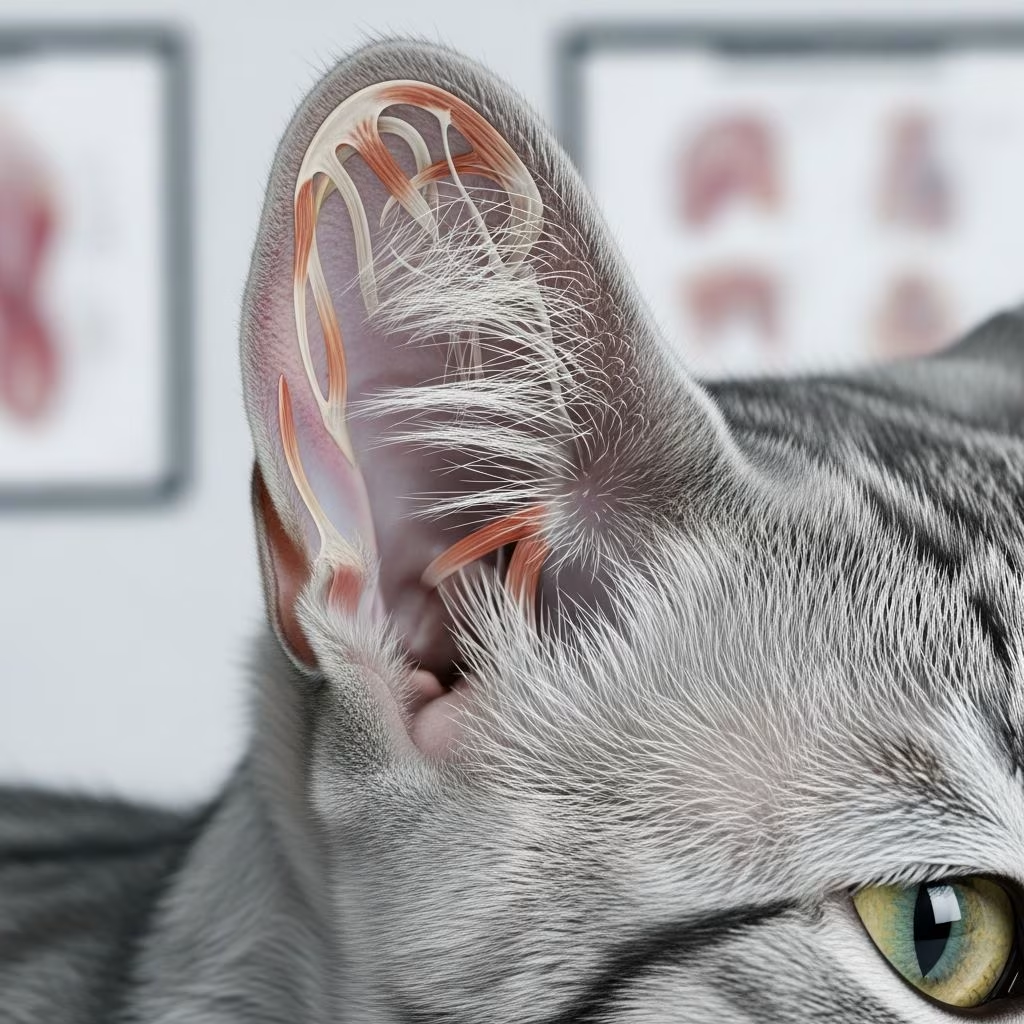
Cats have **32 muscles in each ear**, specifically in the external ear (pinna), allowing for extraordinary mobility such as 180-degree swiveling independently. This muscular complexity far surpasses humans, who have only three extrinsic and six intrinsic ear muscles, totaling nine. Dogs lag behind with 18 ear muscles, highlighting cats’ superior auditory adaptability as agile hunters.
These muscles enable cats to pinpoint sounds with precision, tilting, rotating, or flattening ears to express emotions or detect prey. Understanding this anatomy reveals why cats hear frequencies up to 64 kHz—double humans’ range—and respond swiftly to subtle noises like a treat bag rustle.
Why Do Cats Have So Many Muscles in Their Ears?
The abundance of ear muscles stems from cats’ evolutionary role as predators. Each ear operates independently, swiveling up to 180 degrees to localize sounds from all directions without head movement. This is facilitated by three sets of muscles—rostral, ventral, and caudal—innervated by the facial nerve (cranial nerve VII).
Muscles attach to elastic cartilages: the broad auricular cartilage forming the pinna, annular cartilage in the canal, and L-shaped scutiform cartilage acting as a fulcrum over the temporalis muscle for efficient movement. Ceruminous and sebaceous glands produce earwax (cerumen), protecting the canal while keeping the eardrum pliable.
In hunting, these muscles direct the pinna like radar dishes, amplifying faint sounds. They also signal mood: forward for curiosity, backward for aggression, flat for fear.
Cat Ear Anatomy
A cat’s ear comprises three parts: outer (external), middle, and inner ear, each optimized for sound capture, transmission, and balance.
The Outer Ear (Pinna and Canal)
The **pinna** (auricle) is upright in most cats, funneling sound via auricular cartilage expanding into the tubus auris, which encircles the vertical canal. The ear canal is L-shaped: vertical (mostly cartilaginous) and horizontal (partly osseous), lined with hair follicles and glands producing cerumen to trap debris.
**32 muscles** control the pinna’s mobility, grouped into rostral (forward), ventral (downward), and caudal (backward) sets. The scutiform cartilage, over a fat cushion, enhances leverage.
The Middle Ear
Separated by the **tympanic membrane** (eardrum), the middle ear is an air-filled bulla housing three ossicles: malleus (hammer), incus (anvil), and stapes (stirrup). These amplify vibrations. Two muscles—tensor tympani and stapedius—dampen loud sounds; tensor tympani has type 1, 2A, and unclassified fibers.
The auditory tube connects to the nasopharynx, equalizing pressure.
The Inner Ear
The inner ear’s labyrinth includes the **cochlea** (spiral for hearing), vestibular system, and semicircular canals for balance, all fluid-submerged. Vibrations move fluid, stimulating nerves to the brain.
Cat Ears vs. Human Ears
| Feature | Cats | Humans |
|---|---|---|
| Muscles in External Ear | 32 | 3 extrinsic + 6 intrinsic = 9 |
| Frequency Range | Up to 64 kHz | Up to 20 kHz |
| Ear Mobility | 180° independent swivel | Minimal |
| Canal Shape | L-shaped, deep | Straight, shorter |
Cats’ ears prioritize mobility and sensitivity; humans’ focus on speech.
Cat Ears vs. Dog Ears
| Feature | Cats | Dogs |
|---|---|---|
| External Ear Muscles | 32 | 18 |
| Pinna Carriage | Mostly upright | Breed-specific (floppy/upright) |
| Mobility | Full 180° rotation | Less independent |
Cats edge dogs in precision due to more muscles, aiding predation over pack hunting.
Cool Facts About Your Cat’s Ears
- Cats swivel ears lightning-fast to sounds behind them without turning.
- Ears have ~20-30 blood vessels, pinkening when healthy; pale signals anemia.
- The slit (scutiform notch) aids muscle attachment for movement.
- Cats hear high pitches (e.g., chirps) inaudible to humans/dogs.
- Ears rotate 180°, expressing 6+ positions for emotions.
Signs of Ear Problems in Cats
Monitor for:
- Head shaking/scratching.
- Odor/discharge (infections/parasites).
- Redness/swelling.
- Hearing loss/balance issues (inner ear).
- Flattened posture (pain).
Deep canals hide issues; vet checks needed.
When to See a Vet About Your Cat’s Ears
Seek care for persistent symptoms, as untreated issues lead to ruptures or hearing loss. Clean only outer ear; never probe canal.
Frequently Asked Questions (FAQs)
What Muscles Are in a Cat’s Ear?
32 extrinsic muscles in the pinna for movement, plus middle ear muscles (tensor tympani, stapedius).
Why Are My Cat’s Ears Warm?
Normal; many vessels regulate heat. Cool ears may indicate illness.
Can Cats Move Their Ears Independently?
Yes, each ear swivels separately up to 180°.
How Well Can Cats Hear?
Excellent; detect ultrasound, localize precisely via muscles.
Do Cats Have More Ear Muscles Than Dogs?
Yes, 32 vs. 18.
Conclusion
Cat ears’ 32 muscles exemplify nature’s engineering for survival, offering insights into health and behavior. Regular checks ensure these assets thrive.
References
- Hear, Kitty, Kitty! How Many Muscles Are in a Cat’s Ear? — Rover.com. 2023. https://www.rover.com/blog/how-many-muscles-in-cats-ear/
- Anatomy of the Canine and Feline Ear — Veterian Key. 2016-10-26. https://veteriankey.com/anatomy-of-the-canine-and-feline-ear/
- How Many Muscles Does a Cat Have in Each Ear? Vet-Reviewed — Catster. 2024. https://www.catster.com/cat-health-care/how-many-muscles-do-cats-have-in-each-ear/
- Ear Structure and Function in Cats — Merck Veterinary Manual. 2023-05-01. https://www.merckvetmanual.com/cat-owners/ear-disorders-of-cats/ear-structure-and-function-in-cats
- Ear Structure and Function in Cats — MSD Veterinary Manual. 2023-05-01. https://www.msdvetmanual.com/cat-owners/ear-disorders-of-cats/ear-structure-and-function-in-cats
- Muscle fiber types in the cat middle ear muscles. II. Tensor tympani — PubMed (Peer-reviewed). 1988. https://pubmed.ncbi.nlm.nih.gov/2964826/
- Ear Structure and Function in Cats — Merck Veterinary Manual (Primary veterinary authority, recent update). 2023-05-01. https://www.merckvetmanual.com/cat-owners/ear-disorders-of-cats/ear-structure-and-function-in-cats



