

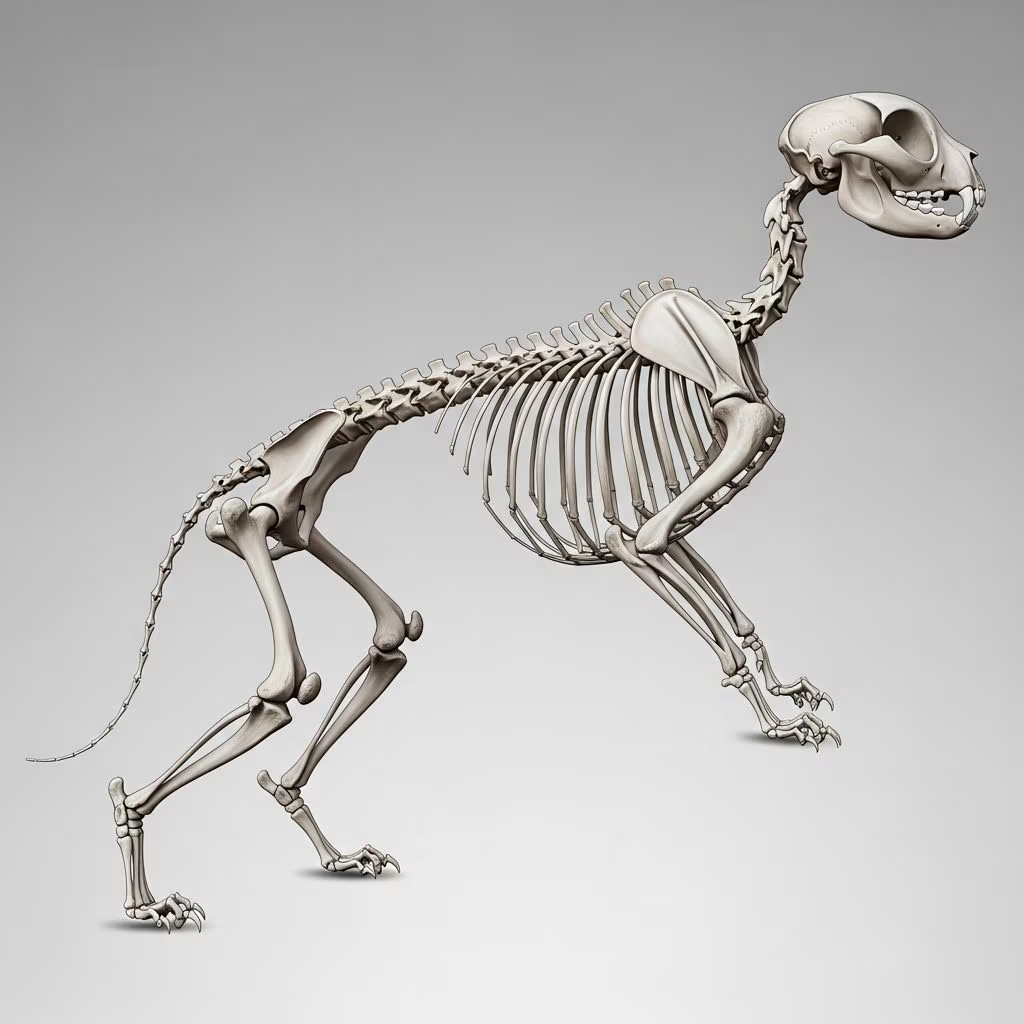
Cats possess between **230 and 250 bones** in their skeleton, exceeding the 206 bones in the human body, primarily due to their elongated spine and tail.
This higher bone count equips cats for extraordinary agility, flexibility, and predatory prowess. Domestic cats’ skeletons vary slightly by breed, tail length, and conditions like polydactyly (extra toes). Understanding this anatomy aids cat owners in recognizing health issues, such as fractures or arthritis, and appreciating their pet’s physical capabilities.
Why Do Cats Have More Bones Than Humans?
Cats’ skeletons are optimized for a quadrupedal, predatory lifestyle, featuring more vertebrae—especially in the tail and spine—for enhanced flexibility and balance. Humans, adapted for bipedalism, have fused sacral and fewer caudal vertebrae, reducing the total to 206.
The feline frame prioritizes lightness and elasticity: loose shoulder connections via rudimentary collarbones allow squeezing through tight spaces, while spongy intervertebral discs enable independent twisting of front and back halves. This design supports leaps up to six times their body length and righting reflexes during falls.
The Skull: A Compact Powerhouse
The cat skull comprises approximately **29 bones**, safeguarding the brain, eyes, and sensory organs while powering a predatory bite.
Key features include large eye sockets for binocular vision, a mobile mandible for precise jaw strikes, and robust structure despite its compactness. This vertebrate setup balances protection with minimal weight, essential for agile hunters. The chondrocranium alone involves six specialized bones or parts, contributing to complex 3D shapes.
Spinal Column: The Key to Feline Flexibility
The spine, with **52-53 vertebrae**, is the cat’s flexibility engine, divided into regions for varied functions.
| Region | Number of Vertebrae | Function |
|---|---|---|
| Cervical (Neck) | 7 | Head movement and neck flexibility |
| Thoracic (Upper Back) | 13 | Anchors ribs, supports upper body |
| Lumbar (Lower Back) | 7 | Powerful hindlimb propulsion |
| Sacral | 3 | Spine-pelvis connection for stability |
| Caudal (Tail) | 22-23 (18-23 typically) | Balance, communication, agility |
Elastic ligaments and thick, spongy discs between vertebrae allow extreme bending and twisting, far beyond human limits. The tail’s caudal vertebrae, real bones connected by muscles and tendons, enhance mobility and signaling. Breeds like Manx have fewer, affecting tail presence.
Rib Cage: Guardian of Vital Organs
Thirteen pairs of ribs form a flexible **rib cage**, protecting the heart, lungs, and other organs while permitting deep breaths during exertion.
Attached to thoracic vertebrae and sternum, this structure withstands impacts and supports high-energy pursuits like chasing prey. Its narrow design, aided by loose shoulders, lets cats navigate crevices.
Limbs: Engineered for Explosive Power
Each limb hosts 40-50 bones, including scapula, humerus, radius, ulna, carpals (forelimbs), femur, tibia, fibula, tarsals (hindlimbs), and phalanges.
Forepaws mimic palms with metacarpals for fine motor skills—some cats even ‘eat politely’ by paw-to-mouth. Hindlimbs power jumps via robust muscles. Most cats have 18 digits (5 fore, 4 hind per paw), but polydactyly adds more; dewclaws are non-weight-bearing. Retractable claws anchor to terminal phalanges for grip.
- Forelimbs: Scapula (floating for flexibility), humerus, radius/ulna, 8 carpals, 5 metacarpals, 14 phalanges.
- Hindlimbs: Pelvis, femur, patella, tibia/fibula, 7 tarsals, 4 metatarsals, 12 phalanges.
- Shoulder: Rudimentary clavicle connected by ligaments only.
The Tail: More Than a Fluff of Fur
The tail’s **18-23 caudal vertebrae** extend the spine, aiding balance during leaps and conveying emotions.
Shorter tails in breeds like Manx reduce bone count; longer tails increase it. Muscles, tendons, and ligaments enable expressive swishes, while flexibility absorbs landing shocks.
Factors Influencing a Cat’s Bone Count
- Breed Variations: Manx (tailless, fewer vertebrae); bobtails (short tails).
- Polydactyly: Extra toes add phalanges; famous in Maine Coons or Hemingway cats.
- Age/Growth: Kittens have more cartilage, ossifying into bones.
- Health Issues: Fractures, arthritis affect mobility; nutrition impacts density.
Overall count: 230-250, with axial (skull, spine, ribs ~140) and appendicular (~90+) skeletons.
Common Skeletal Health Concerns in Cats
Cats’ active lifestyles risk injuries: falls cause fractures, obesity strains joints, arthritis stiffens spines.
Monitor for limping, reluctance to jump, tail dragging. X-rays reveal issues; vets recommend joint supplements, weight control. High-rise syndrome highlights righting reflex limits from heights over 2 stories.
How the Cat Skeleton Supports Incredible Feats
Light, stable bones (244 avg.) plus 500 muscles enable 2m standing jumps. Flexible joints, powerful hindlegs, and balanced tail make cats supreme athletes.
Shoulder freedom squeezes through gaps; paw dexterity hunts precisely. This synergy defines feline grace.
Frequently Asked Questions (FAQs)
What is the total number of bones in a cat?
A domestic cat has **230-250 bones**, varying by tail length, breed, and polydactyly.
Do all cats have the same number of bones?
No, variations occur due to genetics, extra toes, or tail length; Manx have fewer.
How many bones are in a cat’s tail?
**18-23 caudal vertebrae**, real bones for balance and expression.
Why do cats have more bones than humans?
Extra vertebrae in spine/tail for flexibility; humans fuse more for bipedalism.
How many vertebrae does a cat have?
**52-53 total**: 7 cervical, 13 thoracic, 7 lumbar, 3 sacral, 22-23 caudal.
Do cats have collarbones?
Yes, but rudimentary and ligament-connected for shoulder mobility.
Can cats survive high falls due to their bones?
Flexible skeleton and righting reflex help, but terminal velocity limits protection above certain heights.
References
- Cat Skeletal System: A Closer Look at Feline Anatomy — Vet Today. 2023. https://vettoday.com/blog/pet-health/cat-skeletal-system/
- Cat Anatomy & Physiology 101 — Purina US. 2024. https://www.purina.com/articles/cat/behavior/understanding-cats/cat-anatomy
- Interesting Facts About the Anatomy of the Cat — MAXI ZOO. 2024. https://www.maxizoo.ie/magazine/cat/health/anatomy-cat/
- 2024 Ultimate Guide to Cat Anatomy — VetCheck. 2024-01-01. https://vetcheck.it/cat_anatomy/
- Cat Anatomy — Wikipedia (referencing veterinary standards). 2025. https://en.wikipedia.org/wiki/Cat_anatomy
- Do Cats Have Tail Bones? — Laurel Veterinary Clinic. 2023. https://laurelpets.com/blog/do-cats-have-tail-bones/



