

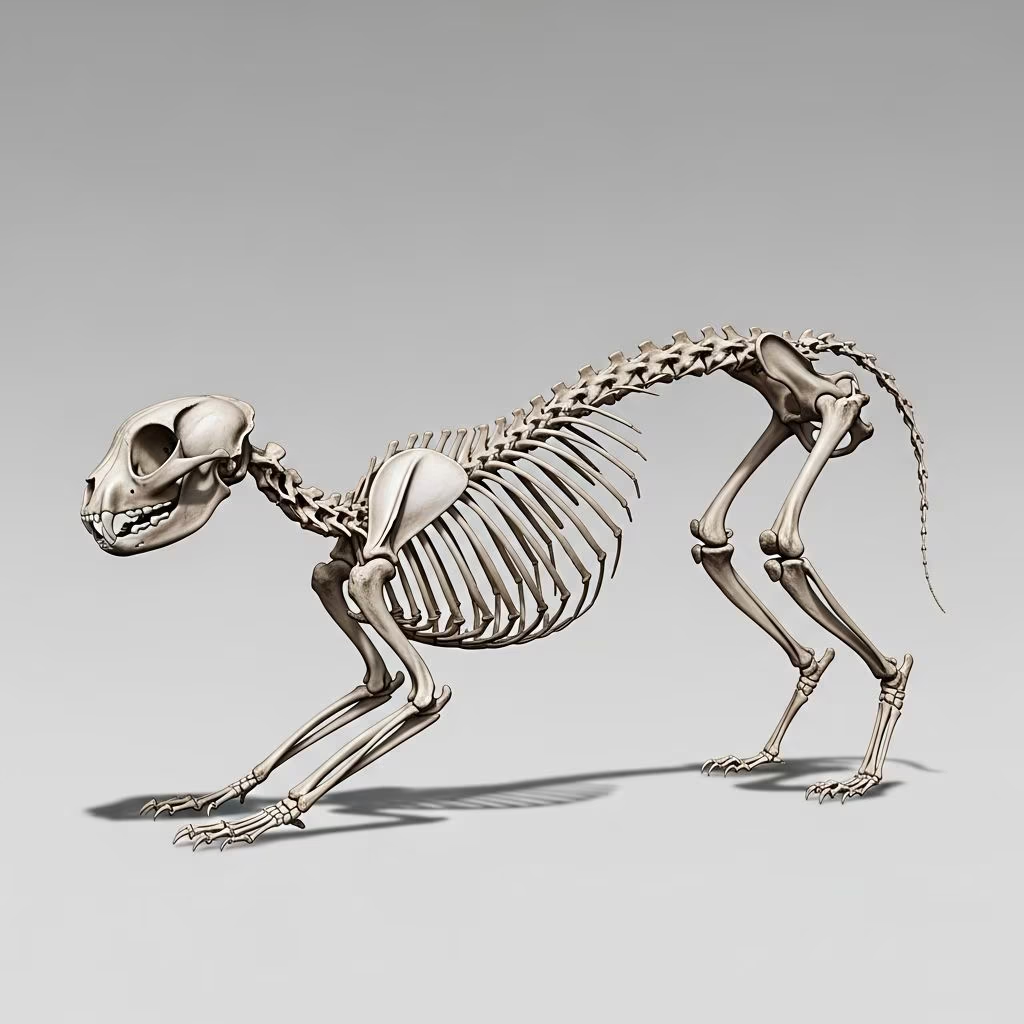
Cats possess between **230 and 250 bones** in their skeleton, surpassing the human count of 206 due to their flexible spine and tail. This higher number supports their extraordinary agility, jumping ability, and predatory prowess, with variations arising from breed, tail length, and conditions like polydactyly.
Why Do Cats Have More Bones Than Humans?
The feline skeleton is engineered for flexibility and speed, featuring an elongated spinal column with 52-53 vertebrae compared to humans’ 33. Cats lack a prominent collarbone, allowing shoulders to connect loosely via ligaments, enabling them to squeeze through tight spaces and absorb fall impacts. Their **13 pairs of ribs** protect vital organs while permitting expansive breathing during chases. This structure, lighter and more vertebrae-rich, equips cats for leaping up to six times their body length.
The Cat Skull: A Predatory Masterpiece
The cat skull comprises approximately **29 bones**, forming a compact, robust cradle for the brain, eyes, and jaws. Large eye sockets facilitate binocular vision for hunting, while the mobile mandible delivers precise, powerful bites. This design balances strength with lightness, essential for a predator’s survival. Variations in counting arise from fused or small bones, but the core function remains protection and sensory support.
The Feline Spine: Flexibility Defined
Central to cat agility is the spine, with **52-53 vertebrae** segmented as follows:
- Cervical (7): Enable neck flexibility and head movement.
- Thoracic (13): Anchor ribs, supporting upper body power.
- Lumbar (7): Power hindlimb propulsion for jumps.
- Sacral (3): Fuse to pelvis for stability.
- Caudal (22-23): Form the tail for balance.
Elastic ligaments interconnect these vertebrae, allowing twists and bends that aid the ‘righting reflex’ during falls. Arthritis or injury here can impair mobility, underscoring spinal health’s importance.
| Region | Number of Vertebrae | Primary Function |
|---|---|---|
| Cervical | 7 | Head and neck mobility |
| Thoracic | 13 | Rib attachment, torso support |
| Lumbar | 7 | Hindquarter strength |
| Sacral | 3 | Pelvic connection |
| Caudal | 22-23 | Balance and expression |
Rib Cage: Guardian of Vital Organs
Thirteen pairs of ribs encase the heart, lungs, and other organs, linking thoracic vertebrae to the sternum. This flexible cage expands for deep breaths during exertion and cushions against impacts, vital for resilient hunters. The narrow thorax from minimal clavicle enhances squeezing ability.
Cat Limbs: Built for Explosive Power
Forelimbs feature scapula, humerus, radius, ulna, carpals, and phalanges (about 40-50 bones total per set of limbs). Hindlimbs include femur, tibia, fibula, tarsals, optimized for propulsion. Retractable claws on terminal phalanges grip prey and climb. Polydactyly adds extra toes, boosting the bone count. Cats’ 500 muscles synergize with these bones for feats like 2-meter standing jumps.
- Forepaws: 5 toes (dewclaw non-weight bearing), fine motor skills for paw-feeding.
- Hindpaws: 4 toes, explosive launch power.
The Tail: Balance and Communication Hub
Composed of **22-23 caudal vertebrae** (10% of total bones), the tail counterbalances during leaps and signals mood. Muscles and ligaments grant flexibility for mid-air corrections. Breeds like Manx have fewer (or none), slightly reducing bone totals, but adaptations maintain function.
Factors Influencing a Cat’s Bone Count
Bone numbers vary by:
- Tail Length: Shorter tails mean fewer caudal vertebrae.
- Polydactyly: Extra digits add phalanges.
- Breed: Manx or Bobtails have reduced tails.
- Age/Health: Kittens have more cartilage; fractures heal with callus formation.
Standard domestic cats average **244 bones**.
How the Cat Skeleton Supports Incredible Agility
Loose shoulder joints, flexible spine, and powerful limbs enable squeezing through 1.5-inch gaps, falls from heights with righting reflex, and 5x body-length leaps. Hindleg muscles propel vertical jumps equaling 6x length. This skeleton, paired with tendons and 500 muscles, makes cats supreme athletes.
Common Skeletal Health Issues in Cats
Despite resilience, cats face:
- Arthritis: Degenerates joints in hips, elbows.
- Fractures: From falls or trauma; tail breaks common but often heal.
- Polydactyly: Harmless extra toes.
- Osteoporosis: Rare, from nutrition deficits.
Veterinary checkups catch issues early; X-rays reveal bone density.
Frequently Asked Questions (FAQs)
What is the average number of bones in a cat?
A domestic cat has **230-250 bones**, more than humans’ 206, thanks to extra vertebrae.
Do all cats have the same number of bones?
No, variations from tail length, polydactyly, or breed like Manx alter counts.
How many bones are in a cat’s tail?
**22-23 caudal vertebrae**, aiding balance and communication.
Why don’t cats have a collarbone?
Cats have a rudimentary one or none, allowing flexible shoulders for agility and tight squeezes.
Can cats survive high falls due to their skeleton?
Yes, flexible spine and terminal velocity adjustments via righting reflex help.
How many vertebrae does a cat have?
**52-53 total**: 7 cervical, 13 thoracic, 7 lumbar, 3 sacral, 22-23 caudal.
Do polydactyl cats have more bones?
Yes, extra toes add phalanges, increasing the total.
References
- Cat Skeletal System: A Closer Look at Feline Anatomy — Vet Today. 2024. https://vettoday.com/blog/pet-health/cat-skeletal-system/
- Interesting Facts About the Anatomy of the Cat — Maxi Zoo. 2024. https://www.maxizoo.ie/magazine/cat/health/anatomy-cat/
- Cat Basics: The Anatomy of a Cat — PetFriendly Box. 2024. https://petfriendlybox.com/resource-center/anatomy-of-a-cat
- 2024 Ultimate Guide to Cat Anatomy — VetCheck. 2024-01-15. https://vetcheck.it/cat_anatomy/
- Cat Anatomy — Wikipedia (referencing veterinary standards). 2024. https://en.wikipedia.org/wiki/Cat_anatomy



