

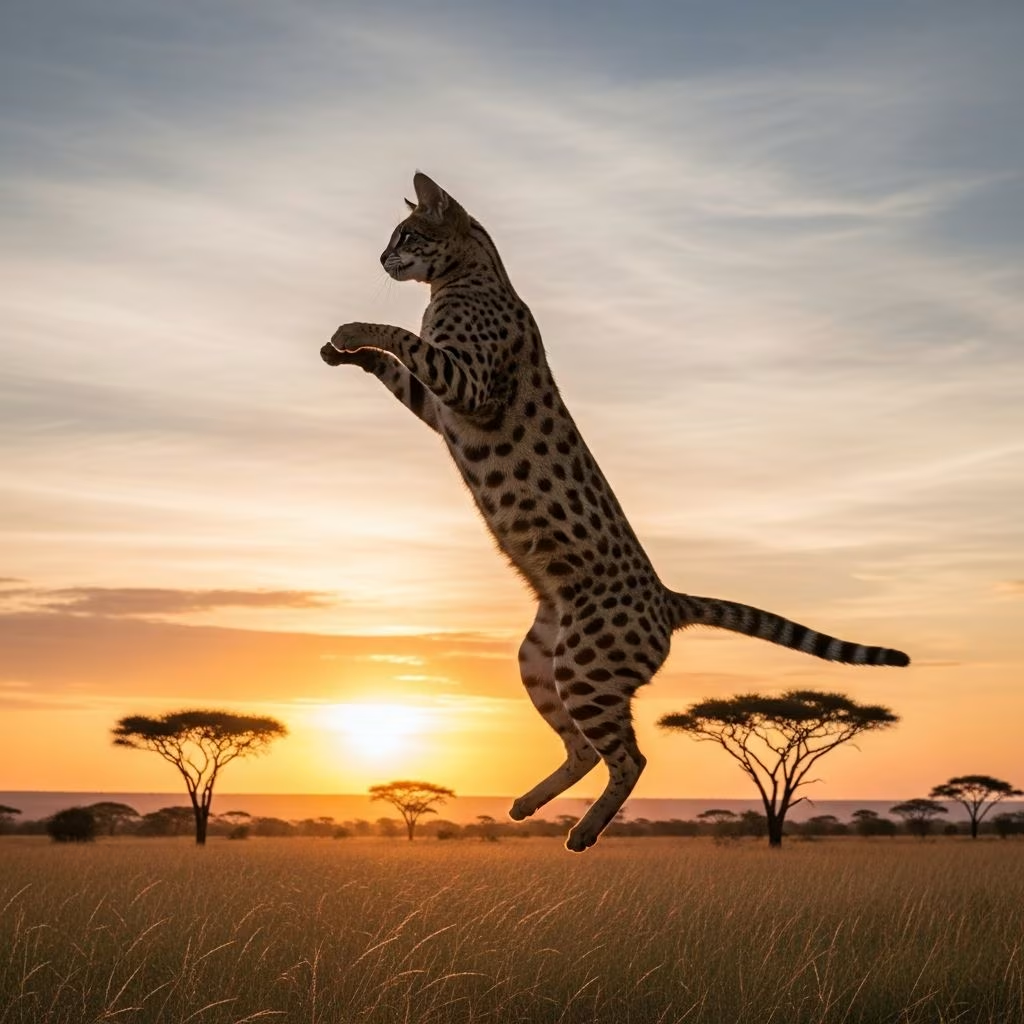
Savannah cats possess remarkable athleticism, capable of jumping approximately 8 feet vertically, a feat driven by their African serval ancestry and enhanced agility compared to typical domestic cats.
These exotic hybrids blend wild traits with domestic temperaments, making them playful yet challenging pets that demand careful management to prevent escapes.
What Is a Savannah Cat?
Savannah cats represent a hybrid breed resulting from crosses between a domestic cat and the African serval, a wild feline known for its towering leaps and predatory prowess.
First developed in the 1980s, this breed inherits distinctive spotted coats, long legs, and an energetic personality, setting them apart in the world of domesticated felines.
Despite their wild lineage, later generations integrate well into homes, offering loyalty and interactivity akin to dogs, though early generations retain stronger feral instincts.
Savannah Cat Generations (F1–F5)
Savannah cats are classified by filial generations, denoted as F1 through F5, indicating the dilution of serval genetics across breeding cycles.
- F1 Savannah: Direct offspring of a serval and domestic cat, featuring the highest wild DNA percentage (around 50%), resulting in the largest size, boldest temperament, and most pronounced athleticism.
- F2 Savannah: Offspring of an F1 and domestic cat (about 25% serval DNA), still exhibiting significant height, jumping prowess, and hunting drive.
- F3–F5 Savannahs: Further diluted serval influence (12.5% down to 3.125%), progressively smaller, more docile, and easier to manage as pets.
Higher serval content in F1 and F2 cats correlates directly with superior jumping ability, often surpassing 8 feet, while later generations maintain impressive but moderated skills.
Breeders prioritize early generations for their exotic appeal, but these require experienced owners due to amplified energy and size.
How High Can a Savannah Cat Jump?
The hallmark of Savannah cats is their extraordinary vertical leap, consistently reported at up to 8 feet from a standing position, rivaling wild servals who jump even higher in nature.
This capability stems from powerful hind leg muscles, lightweight frames, and an innate pouncing instinct honed for hunting.
Owners frequently witness these cats scaling refrigerators, cabinets, and doors effortlessly, turning vertical spaces into playgrounds.
Video evidence, such as an F1 Savannah named Ruby leaping 8 feet, underscores this breed’s prowess. Factors like generation, age, health, and training influence peak performance, with prime adults in F1–F2 achieving the highest marks.
Jump Comparisons: Savannah Cats vs. Other Species
Savannah cats outjump many common animals relative to body size, highlighting their hybrid superiority.
| Animal | Average Jump Height | Notes |
|---|---|---|
| Savannah Cat (F1–F2) | 8 feet | Vertical from stand; body weight 12–25 lbs |
| Domestic Cat (Average) | 5–6 feet | Standard shorthair breeds |
| Large Dog Breeds (e.g., Labrador, Golden Retriever) | 5–6 feet | Despite much larger size |
| Great Dane | 5–6 feet | Impressive for mass but lower relative to cats |
| Rabbit | 2–3 feet | Smaller leaper |
| Horse | 8 feet | Absolute height match, but vastly heavier |
| Average Human | ~2 feet | Savannahs exceed untrained adults |
| NBA Player (Vertical Leap) | ~3 feet | Elite athletes still fall short |
These comparisons emphasize the Savannah’s disproportionate power-to-weight ratio, making their 8-foot jumps particularly astonishing for a house cat.
Physical Properties of the Savannah Cat
Savannahs boast a tall, slender build with shoulder heights of 14–19 inches, often exceeding other domestic breeds.
- Height and Size: F1–F2 males reach 17–19 inches tall, weighing 13–25 pounds; record holder Fenrir (F2) stands 18.83 inches. Females are slightly smaller at 12–20 pounds.
- Body Structure: Long, muscular legs with elevated hindquarters, defined shoulders, chest, and powerful hind legs for propulsion.
- Head and Features: Small, triangular head wider at base; hooded eyes in green/gold; short tail with black tip; tall, rounded ears.
- Coat: Short, spotted like a serval, in tawny, silver, or smoke patterns.
This lean, athletic physique enables fluid movement, stealthy stalking, and explosive jumps, mimicking their serval progenitors.
They mature slowly, potentially living 15–20 years with proper care.
Are Savannah Cats Dangerous?
Savannah cats pose no inherent danger to humans when properly socialized, displaying affection and playfulness, though their size and energy warrant respect.
Hunting instincts can lead to intense play, potentially overwhelming smaller pets or children if unsupervised. F1–F2 generations exhibit stronger predatory drives, risking escapes during chases.
They thrive with stimulation; boredom amplifies mischief, but routine exercise mitigates risks. Legal restrictions in some areas ban early generations due to wild traits.
Overall, they suit active, experienced households prioritizing enrichment over complacency.
How to Keep Savannah Cats Contained
Containment challenges arise from their 8-foot jumps and curiosity; standard fences fail against their agility.
- Indoor Living: Prioritize indoor environments with expansive vertical spaces like tall cat trees and shelves.
- Enrichment: Provide interactive toys, puzzle feeders, scratching posts, and daily play sessions (30–60 minutes) to channel energy.
- Leash Training: Many adapt to harnesses for safe outdoor walks, satisfying exploration needs.
- Secure Enclosures: Use 8+ foot fencing with inward overhangs, roller bars, or fully enclosed catios for outdoor access.
- Supervision: Monitor near windows/doors; microchip and ID collars prevent loss from impulsive hunts.
Consistent routines reduce escape attempts; veterinary advice on spaying/neutering curbs roaming.
Final Thoughts
Savannah cats captivate with their 8-foot jumps, serval-derived athleticism, and dog-like devotion, ideal for dedicated owners embracing their vigor.
From F1 giants to adaptable later generations, they demand stimulation, secure homes, and commitment to thrive.
With proper care, these majestic hybrids deliver years of adventure without compromising safety.
Frequently Asked Questions (FAQs)
What is the highest a Savannah cat can jump?
Savannah cats, especially F1–F2, routinely jump up to 8 feet vertically.
How do Savannah cats compare in jump height to dogs?
They surpass large breeds like Labs (5–6 feet) despite being far smaller.
Are F1 Savannah cats bigger jumpers than later generations?
Yes, F1–F2 exhibit peak athleticism due to higher serval DNA.
Can Savannah cats be kept outdoors?
Not freely; use leashes or enclosures exceeding 8 feet to contain their leaps.
How tall do Savannah cats grow?
Shoulder heights reach 14–19 inches, with records near 19 inches.
References
- How High Can a Savannah Cat Jump? Vet-Verified Facts & Info — Catster. 2023. https://www.catster.com/lifestyle/how-high-can-a-savannah-cat-jump/
- Savannah Cat Guide: Facts, Traits, and F1 Breed Info — Litter-Robot. 2023. https://www.litter-robot.com/blog/f1-savannah-cats/
- 10 Wild Facts About Savannah Cats — Cats.com. 2023. https://cats.com/savannah-cats-facts
- Savannah cat — Wikipedia. 2024-01-10. https://en.wikipedia.org/wiki/Savannah_cat
- Ruby (F1 Savannah) Jumping 8 feet — YouTube. 2015. https://www.youtube.com/watch?v=vprEInOl1o0



