

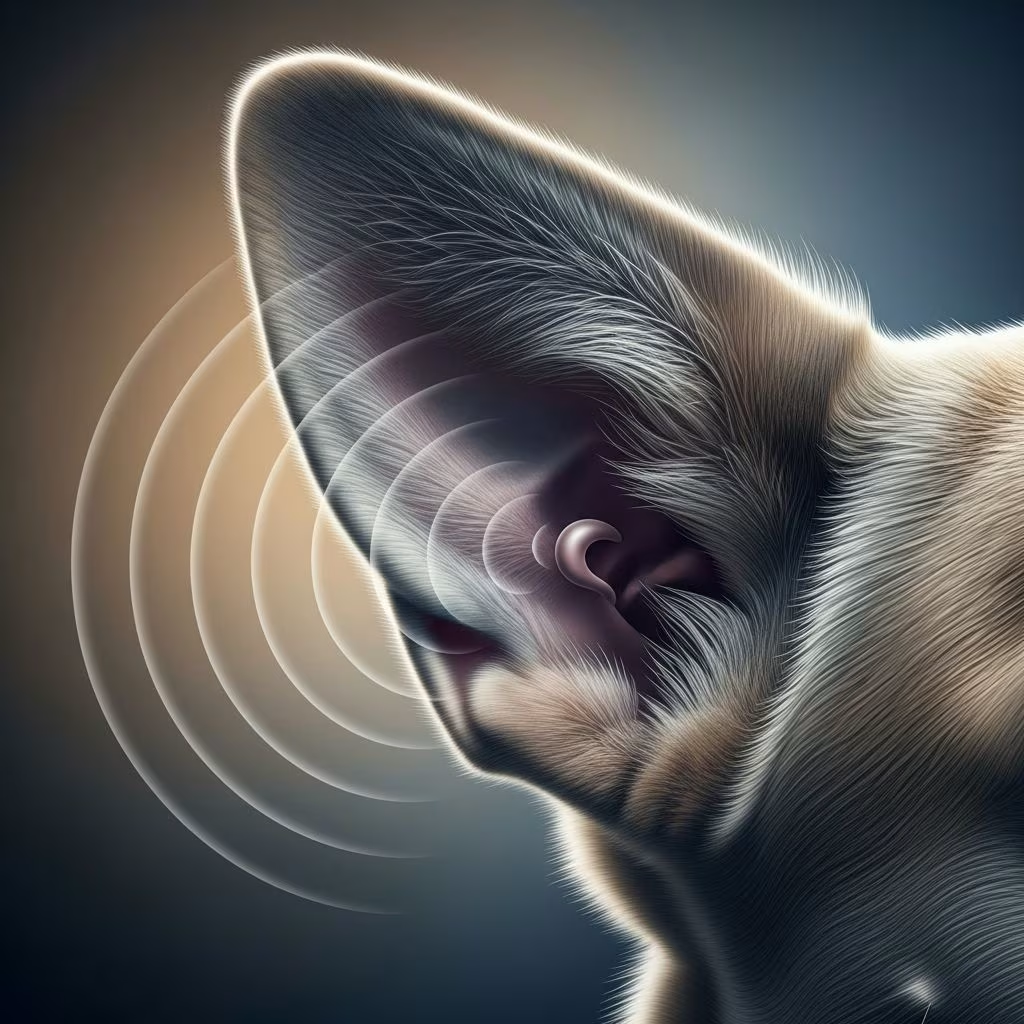
Dogs possess extraordinary hearing capabilities that far exceed those of humans, enabling them to detect sounds at greater distances and across a wider frequency spectrum. While human hearing typically spans 20 Hz to 20 kHz, dogs can hear frequencies from approximately 40-67 Hz up to 45-47 kHz, with peak sensitivity around 8 kHz. This superior auditory range allows dogs to pick up distant sounds like footsteps, rustling leaves, or even ultrasonic whistles used in training, often from hundreds of meters away under ideal conditions.
The question of “how far” dogs can hear doesn’t have a single answer, as it depends on factors like sound frequency, intensity, environmental noise, obstacles, and individual dog variations. Behavioral studies show dogs detecting pure tones at low intensities (under 10 dB SPL) within their optimal range of 4-16 kHz, but distance diminishes rapidly with higher frequencies and background interference. In open fields, dogs might hear a familiar voice up to 1 km away, but urban settings reduce this to 100-200 meters.
How Dogs Hear: Anatomy of Canine Ears
A dog’s ear structure is key to their exceptional hearing. Unlike humans with external ears that primarily funnel sound, dogs have highly mobile pinnae— the floppy or erect outer ears—that swivel up to 180 degrees to pinpoint sound sources. These pinnae amplify high-frequency sounds by up to 10-15 dB and help localize noises with pinpoint accuracy, often within 5-10 degrees azimuthally.
Internally, dogs have larger cochleae relative to body size, packed with more hair cells tuned to higher frequencies. The middle ear ossicles (malleus, incus, stapes) are optimized for rapid vibration transmission, enhancing sensitivity to faint, distant sounds. Sound enters the ear canal, vibrates the eardrum, and travels through the ossicles to the cochlea, where it’s converted to neural signals. This system excels at detecting transient sounds like predator footsteps or prey movements from afar.
- Mobile pinnae: Rotate independently to capture directional cues.
- Large cochlea: Supports frequencies up to 47 kHz.
- Thin tympanic membrane: Vibrates easily to low-intensity sounds.
Compared to humans, dogs’ ears provide a 15-20 dB advantage in sound localization, crucial for hunting and survival.
Dogs’ Hearing Range vs. Humans
Dogs hear a broader spectrum than humans. Key comparisons from audiometric studies:
| Species | Low Frequency (Hz) | High Frequency (kHz) | Peak Sensitivity (kHz) |
|---|---|---|---|
| Human | 20-64 | 20-23 | 2-4 |
| Dog | 40-67 | 45-47 | 8 |
| Cat | 45 | 64 | ~10 |
Behavioral audiograms reveal dogs’ “U-shaped” hearing curve: poorest at extremes (e.g., 40 Hz needs 59 dB SPL, 46 kHz needs 64-73 dB SPL), best between 4-16 kHz where tones under 10 dB SPL are detected. One study found dogs responding from 63 Hz to 47 kHz at 60 dB SPL, with high sensitivity from 4-16 kHz. Electrophysiological data sometimes shows discrepancies, with behavioral thresholds lower by up to 25 dB at low frequencies, indicating dogs’ acute perception in real-world tests.
High frequencies (20-45 kHz) are ultrasonic to humans but vital for dogs detecting bat echolocation or rodent squeaks from 50-100 meters. Low-end hearing captures earth rumbles or distant thunder.
Hearing Sensitivity: What Dogs Hear Best
Dogs’ peak sensitivity at 8 kHz allows detection of whispers or soft rustles at low volumes. Studies using staircase methods at 0.5, 4, and 20 kHz found thresholds of ~18 dB at low frequencies, dropping to optimal levels mid-range. Variability exists: inter-dog differences up to 12-25 dB SPL, influenced by breed (e.g., hounds with long ears amplify lows better).
In quiet environments, dogs detect sounds at 0 dB SPL in their best range, outperforming humans by 15-20 dB. Emotional soundscapes show varied sensitivity: low at poorest-heard lows (<125 Hz), inconsistent mid-high despite improving thresholds.
How Far Can Dogs Actually Hear Sounds?
Distance varies by sound type:
- Low-frequency (e.g., thunder, 100 Hz): Travels farthest (up to 10+ km) due to less attenuation, but dogs need higher intensity (~45-60 dB SPL).
- Mid-range (e.g., voices, 1-4 kHz): Optimal for distance; familiar calls heard 400-1000 meters in fields.
- High-frequency (e.g., whistles, 20-40 kHz): Attenuates quickly (air absorption ~1 dB/100m at 20 kHz), effective 50-200 meters.
Inverse square law applies: sound intensity halves every doubling of distance. A 60 dB bark at 1m drops to 30 dB at 8m—still audible to dogs. Real-world tests: dogs alert to cars 300m away via engine rumble. Forests/obstacles reduce range 50-70%; wind aids downwind hearing.
Factors Affecting How Far Dogs Can Hear
Several variables impact canine hearing distance:
- Frequency: High pitches fade faster.
- Amplitude: Louder sounds carry farther.
- Environment: Echoes in cities mask; open spaces enhance.
- Breed/Age: Herding breeds excel highs; seniors lose up to 20 kHz by age 10.
- Health: Infections raise thresholds 10-20 dB.
Recent studies suggest optimal range may extend to 20 kHz better than thought, with variability emphasizing individual testing.
Practical Implications: Training, Safety, and Communication
Understanding hearing range aids training: ultrasonic whistles (25-35 kHz) recall from 100-300m silently. Avoid high-freq household noises harming ears. In safety, dogs detect gas leaks (high-freq hiss) early. Communicate via mid-range tones they hear best.
Frequently Asked Questions (FAQs)
Q: What is the hearing range of dogs?
A: Dogs hear from 40-67 Hz to 45-47 kHz, compared to humans’ 20 Hz-20 kHz.
Q: At what frequency are dogs most sensitive?
A: Peak sensitivity is at 8 kHz, where they detect sounds under 10 dB SPL.
Q: Can dogs hear dog whistles from far away?
A: Yes, up to 200 meters in open areas, as whistles target 20-40 kHz.
Q: Do all dog breeds hear equally well?
A: No, variations exist; erect-eared breeds often have better high-frequency detection.
Q: How does age affect a dog’s hearing distance?
A: Older dogs lose high-frequency sensitivity, reducing detection of distant faint sounds.
Q: Can dogs hear TV or music?
A: Yes, they perceive ultrasonic components humans miss, often reacting more.
References
- Determining Hearing Thresholds in Dogs Using the Staircase Method — Damasceno et al. 2024-03-15. https://pmc.ncbi.nlm.nih.gov/articles/PMC10892234/
- The Dog Soundscape: Recurrence, Emotional Impact, Acoustics — Farina et al. 2024-02-28. https://pmc.ncbi.nlm.nih.gov/articles/PMC10812668/
- How Well Do Dogs and Other Animals Hear? — LSU School of Veterinary Medicine. 2023. https://www.lsu.edu/vetmed/deafness/hearingrange.php
- How Good Is a Dog’s Hearing Compared to Humans? — Psychology Today. 2024-07-10. https://www.psychologytoday.com/us/blog/canine-corner/202407/how-good-is-a-dogs-hearing-compared-to-humans
- How far away can dogs smell and hear? — University of Adelaide. 2020-06-09. https://set.adelaide.edu.au/news/list/2020/06/09/how-far-away-can-dogs-smell-and-hear



