

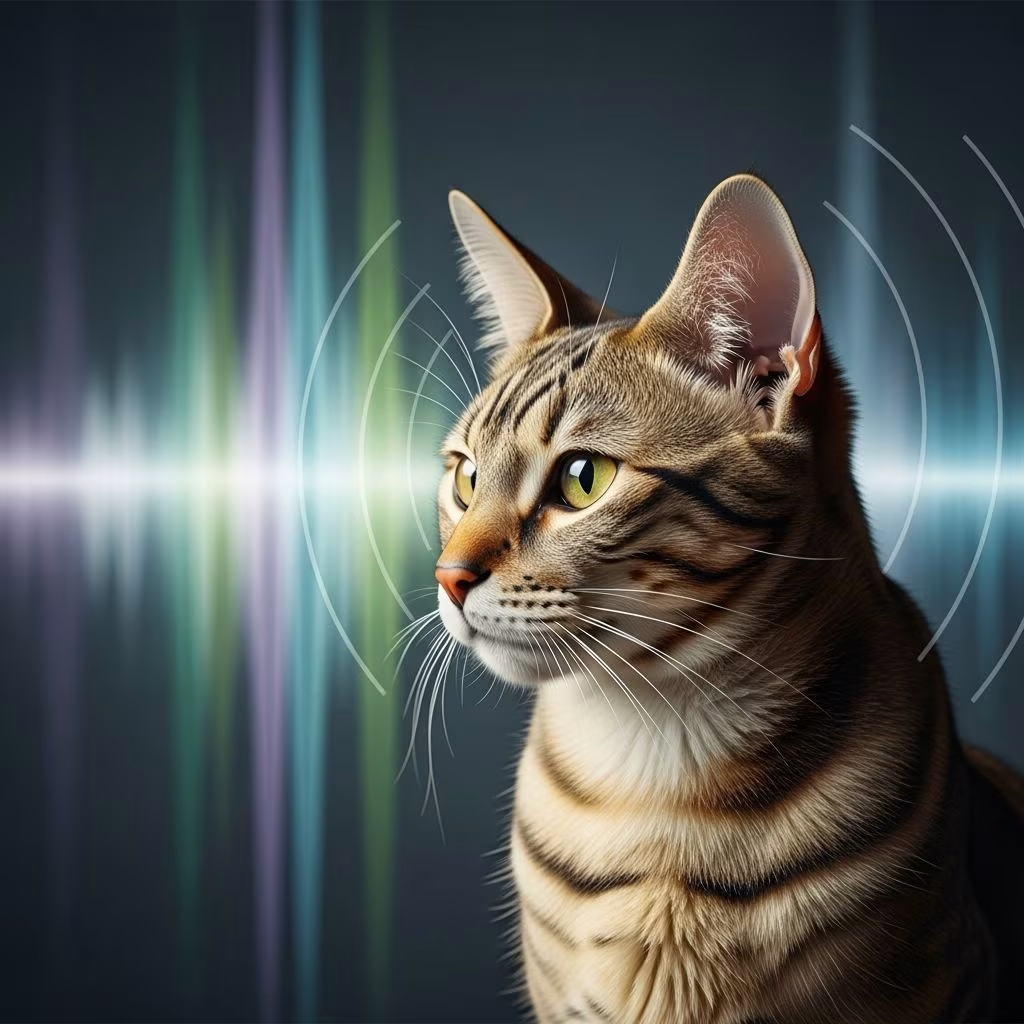
How Far Can Cats Hear? Understanding Feline Auditory Abilities
Cats possess one of the most remarkable hearing capabilities in the animal kingdom. While many pet owners recognize that cats can hear sounds beyond human perception, few understand just how extraordinary their auditory abilities truly are. The question of how far cats can hear involves understanding both the distance they can detect sounds and the frequency range their ears can process. This comprehensive guide explores the fascinating science behind feline hearing and what it means for your pet’s daily life.
The Frequency Range of Cat Hearing
Cats can hear from approximately 40 Hz to 85,000 Hz, which is more than three times higher than human hearing capability. To put this in perspective, humans can only hear sounds between 20 Hz and 20,000 Hz. This dramatic difference means that cats experience a sonic world far richer and more complex than what humans perceive.
The hearing range of cats varies slightly depending on the study, with some research indicating ranges from 50 Hz to around 80 kHz. Other scientific investigations have reported even more impressive ranges, with some studies noting that cats can detect frequencies reaching up to 85 kHz or potentially higher. The lower frequency limit of cat hearing is generally reported as approximately 45 Hz, compared to the human baseline of about 20 Hz, indicating that cats actually struggle somewhat with very low frequencies.
Cats’ hearing is most sensitive between 500 Hz and 32 kHz, which represents their peak auditory perception zone. This sweet spot in their hearing range is particularly important for their natural hunting behaviors and survival instincts.
How Cats Hear Ultrasound
One of the most distinctive features of feline hearing is their ability to detect ultrasonic frequencies—sounds above 20 kHz that are completely inaudible to humans. Ultrasonic hearing in cats provides them with a significant evolutionary advantage, particularly when hunting small rodents like mice and rats. These prey animals communicate using ultrasonic vocalizations at frequencies exceeding 19 to 20 kHz, making them audible only to predators with similarly advanced hearing capabilities.
Research has identified specialized neurons in the cat’s auditory cortex that are selective for ultrasonic frequencies reaching 60 kHz and beyond. The cat’s brain contains distinct auditory processing areas that handle these ultrasonic frequencies separately from lower-frequency sounds, allowing for sophisticated auditory discrimination and localization.
The Anatomy Behind Cat Hearing Excellence
The exceptional hearing ability of cats is not accidental; it results from specialized anatomical structures that have evolved over millennia. Unlike other mammals whose middle ear contains a single chamber, the cat’s middle ear features two distinct chambers. This dual-chamber design increases the range of frequencies over which the eardrum can vibrate, effectively expanding the cat’s frequency range compared to other mammals.
Cats’ pinnae—the visible outer ear structures—play a crucial role in their hearing superiority. The nooks and crannies (corrugations) in the pinnae serve to intensify incoming sound frequencies by causing them to reflect off these structures. This amplification allows cats to gauge the elevation of sound sources and determine whether sounds originate from in front of or behind them. Additionally, the remarkable mobility of cat ears enables them to rotate independently up to 180 degrees, allowing precise sound localization from virtually any direction.
When comparing hearing ranges to other species, cats demonstrate exceptional auditory abilities. While humans can hear sounds within a range of 8.5 octaves, cats can hear across 10.5 octaves, giving them the broadest range of hearing among all mammals. Research has also shown that cats have greater sensitivity to sound than dogs, making them among the most sensitive mammals tested in comparative auditory studies.
Comparing Cat Hearing to Other Species
| Species | Hearing Range (Hz) | Upper Frequency Limit | Octave Range |
|---|---|---|---|
| Cats | 40-85,000 Hz | 85 kHz | 10.5 octaves |
| Dogs | 40-60,000 Hz | 60 kHz | ~9 octaves |
| Humans | 20-20,000 Hz | 20 kHz | 8.5 octaves |
| Ferrets | 40-40,000 Hz | 40 kHz | ~8 octaves |
This comparative analysis demonstrates that cats not only exceed human hearing capabilities by a factor of three in terms of maximum frequency detection, but they also surpass most other domesticated animals in their overall hearing range and sensitivity.
The Distance Factor: How Sound Travels
While the frequency range cats can hear is extraordinary, the practical distance at which they can detect sounds depends on several factors beyond frequency capability. Sound travels differently through air based on its frequency and intensity. Lower frequencies typically travel farther than higher frequencies, which tend to attenuate more quickly. This means that while cats can hear ultrasonic frequencies, those ultrasonic sounds may not travel as far as lower-frequency sounds that humans can perceive.
The intensity or volume of sound is measured in decibels (dB). Cats’ hearing is optimized for comfort at sound pressure levels between 60 and 80 dB, representing the range where their hearing is both sensitive and pleasant. Sounds exceeding these comfortable levels can trigger stress responses in cats, even if the frequencies themselves are within their normal hearing range.
In practical terms, a cat can likely detect sounds from several rooms away, particularly if those sounds fall within their most sensitive frequency range of 500 Hz to 32 kHz. However, the exact distance varies based on sound intensity, frequency, environmental obstacles, and the cat’s state of alertness.
How Cats Use Their Superior Hearing
Cats’ exceptional auditory abilities serve multiple vital functions in their daily lives. The primary evolutionary purpose of their sensitive hearing was hunting efficiency. Being able to hear in the ultrasonic range helps cats locate and hunt small rodents, which communicate using ultrasonic vocalizations. This hunting advantage remains relevant even for domesticated cats, where the instinct to detect and respond to rodent sounds persists.
Beyond hunting, cats use their hearing for communication, safety awareness, and social interaction. They can detect subtle sounds that might indicate danger, allowing them to respond appropriately to environmental threats. Cats also use their hearing to locate other cats, particularly during mating season, and to monitor their human family members’ activities.
The acoustic environment significantly impacts feline behavior and stress levels. Cats are naturally hypervigilant creatures, constantly monitoring their surroundings for potential threats or opportunities. This heightened awareness makes them sensitive to environmental noise, which can trigger behavioral stress responses in some cats.
Sound Sensitivity and Feline Well-being
Understanding cat hearing capabilities is essential for providing a comfortable living environment for your pet. Because cats can perceive such a wide range of frequencies and at greater sensitivity than humans, sounds that we find tolerable or even unnoticeable may cause significant stress for our feline companions. Loud noises, high-pitched sounds, and certain frequencies can trigger anxiety and behavioral changes in cats.
The implications for cat health are significant. Chronic exposure to stressful sounds can elevate cortisol levels, reduce heart rate variability (a marker of relaxation), and increase overall anxiety. Scientific studies have demonstrated that cats exposed to sound environments tailored to their hearing comfort show measurably lower stress levels, including reduced heart rates and improved heart rate variability.
Pet owners can optimize their home environment by being mindful of high-pitched noises from appliances, electronic devices, and household sounds. Creating quiet spaces where cats can retreat from acoustic stimulation supports their emotional well-being and overall health.
Sound Localization: A Cat’s Directional Advantage
Beyond simple detection of sound, cats possess remarkable abilities in sound localization—determining the precise direction from which a sound originates. The cat is one of the most accurate sound localizers in the animal kingdom. This precision results from multiple anatomical and neurological features working in concert.
The primary auditory cortex of the cat plays an essential role in sound localization, providing neural representation of acoustic parameters that allow the brain to pinpoint sound sources. The cat’s mobile ears can rotate independently, scanning different directions while the cat remains stationary. By comparing the timing and intensity differences between the sounds reaching each ear, cats can calculate the sound source’s direction with impressive accuracy.
This localization ability made cats formidable hunters in their evolutionary past and continues to influence their behavior today. The ability to precisely locate the source of a sound allows cats to pounce on prey with remarkable accuracy or to orient toward interesting sounds in their environment.
Frequently Asked Questions About Cat Hearing
Q: Can cats hear all ultrasonic sounds that rodents make?
A: While cats can hear ultrasonic frequencies in the range that rodents use for communication (above 19-20 kHz), their hearing sensitivity is not uniform across all ultrasonic frequencies. Their hearing is most sensitive between 500 Hz and 32 kHz, and sensitivity decreases at very high ultrasonic frequencies. However, they can detect the ultrasonic calls that rodents use, giving them a hunting advantage.
Q: Do all cats have the same hearing range?
A: While all healthy cats share the same basic hearing capabilities, individual variation exists. Age affects hearing, with older cats experiencing progressive hearing loss. Breed differences and individual health conditions can also influence auditory sensitivity. Indoor cats and outdoor cats may develop slightly different auditory sensitivity based on their environmental exposure.
Q: How does cat hearing compare to dog hearing?
A: Both cats and dogs have superior hearing to humans, but cats have the advantage. Cats can hear frequencies up to 85,000 Hz compared to dogs’ maximum of around 60,000 Hz. Cats also demonstrate greater sensitivity to sound overall and have a broader octave range of hearing (10.5 octaves versus approximately 9 octaves for dogs).
Q: Can loud noises permanently damage a cat’s hearing?
A: Yes, prolonged exposure to very loud sounds can damage a cat’s hearing just as it can in humans. Protecting cats from excessively loud noises is important for maintaining their long-term auditory health. Sudden loud noises can also startle and stress cats, even if they don’t cause permanent damage.
Q: Why does my cat react to sounds I can’t hear?
A: Your cat’s ability to detect frequencies ranging from 40 Hz to 85,000 Hz means they hear sounds completely beyond human perception. This explains why cats may appear to react to “nothing”—they are responding to ultrasonic sounds, distant noises at frequencies we cannot perceive, or sounds at very low frequencies below our hearing threshold.
Q: Does indoor versus outdoor living affect cat hearing?
A: The acoustic environment can influence how cats utilize their hearing abilities, but it doesn’t typically change their physiological hearing range. However, outdoor cats may develop enhanced auditory awareness and localization skills due to constant exposure to diverse environmental sounds.
Conclusion: Appreciating Your Cat’s Sonic World
The question of how far cats can hear encompasses both the impressive frequency range they can detect and the distance from which they can perceive sounds. With a hearing range extending from 40 Hz to 85,000 Hz and exceptional sensitivity across most of this spectrum, cats experience a sonic landscape vastly richer than our own. Their ability to hear ultrasonic frequencies, localize sounds with precision, and detect extremely subtle acoustic signals represents millions of years of evolutionary refinement.
Understanding your cat’s hearing capabilities helps explain many behaviors and allows you to create a more comfortable environment for your feline companion. By recognizing that cats perceive a world of sounds beyond human experience, we can better appreciate their unique sensory abilities and support their emotional and physical well-being.
References
- Clinical Study Proves Benefits of Feline-Specific Music Through Biometric Data — Pet Acoustics. 2021. https://www.petacoustics.com/blog/clinical-study-proves-benefits-of-feline-specific-music-through-biometric-data
- Your Cat Lives in a Noisy World – What do Cats Hear — Feline Purrspective. https://www.felinepurrspective.com/your-cat-lives-in-a-noisy-world-what-do-cats-hear/
- Feline vocal communication — National Center for Biotechnology Information (NCBI), National Institutes of Health. https://pmc.ncbi.nlm.nih.gov/articles/PMC7000907/
- Animals with the best hearing in the world — International Fund for Animal Welfare (IFAW). https://www.ifaw.org/journal/animals-best-hearing-world
- A Cat’s Sense of Hearing: A Happy Cat Expert Explains — FELIWAY. https://www.feliway.co.uk/blogs/news/a-cats-sense-of-hearing-a-happy-cat-expert-explains
- Ultrasonic Hearing in Cats and Other Terrestrial Mammals — Acoustics Today, M. Charlotte Kruger. Spring 2021. https://acousticstoday.org/wp-content/uploads/2021/03/Ultrasonic-Hearing-in-Cats-and-Other-Terrestrial-Mammals-M.-Charlotte-Kruger.pdf



