

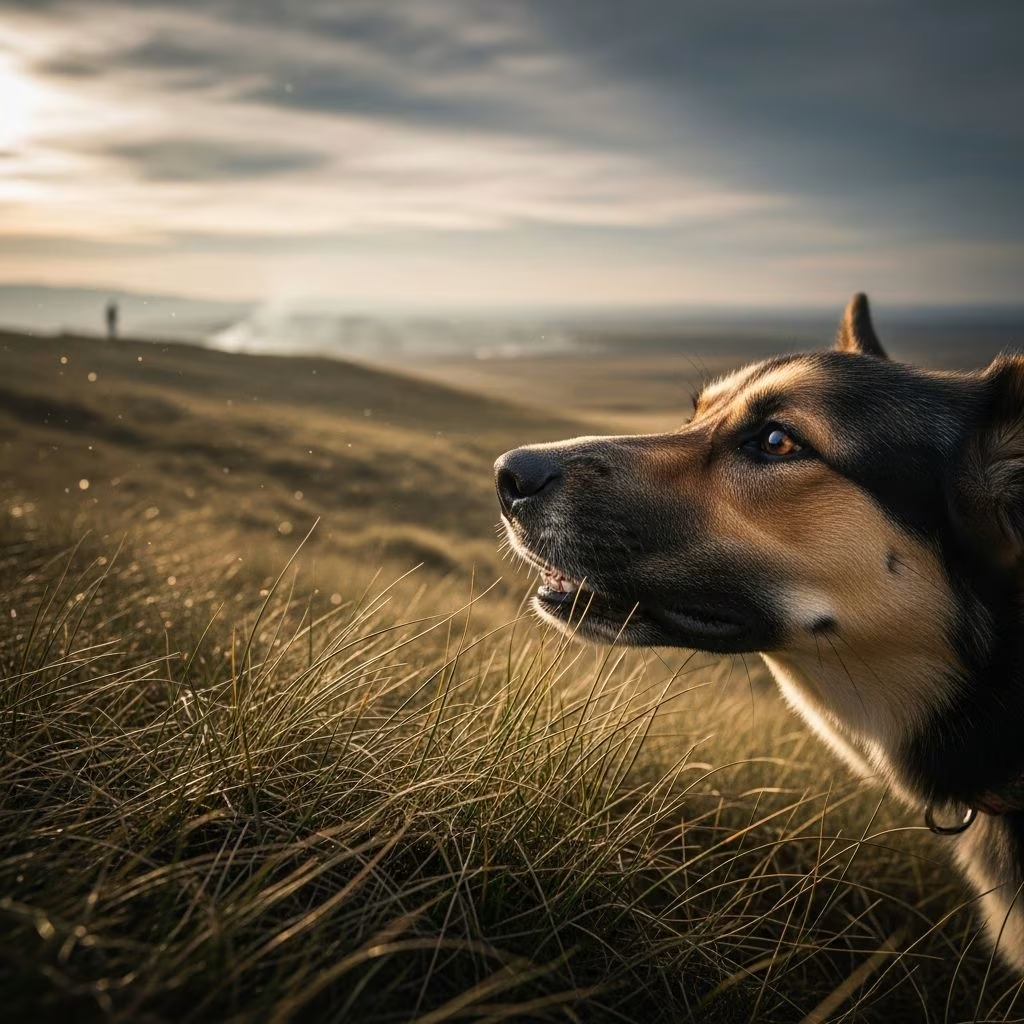
How Far Away Can Dogs Smell You?
Your dog’s ability to detect your scent from a distance is truly remarkable. In perfect conditions, dogs can smell you from up to 12 miles away, though some research suggests they may detect scents from even greater distances under ideal circumstances. However, this impressive range isn’t consistent—it varies significantly based on numerous environmental and biological factors that influence how effectively their nose works.
Dogs possess an extraordinary olfactory system that far surpasses human capabilities. While we rely primarily on sight to navigate and understand our world, dogs depend heavily on their sense of smell. To your dog, your unique scent is as distinctive as a fingerprint—a complex combination of your sweat, breath, skin chemistry, hormones, laundry detergent, and diet. This personalized scent profile means your dog can recognize you specifically from among millions of other odors in their environment.
The Science Behind Your Dog’s Powerful Sense of Smell
Understanding why dogs can smell you from so far away requires examining their nose structure and neural processing. Dogs have approximately 300 million olfactory receptors in their nasal cavity, compared to humans who have only 5-6 million. This difference alone explains part of their superior olfactory abilities.
However, the advantage extends beyond simple receptor numbers. The area of a dog’s brain devoted to analyzing odors is about 40 times larger than the comparable region in the human brain. This neural real estate allows dogs to process and interpret scent information with remarkable complexity and detail. In fact, it has been estimated that dogs can smell 1,000 to 10,000 times better than humans.
The structural design of a dog’s nose also contributes significantly to their scent detection abilities. Dogs have a more complex nasal cavity with greater surface area, and they are more efficient at moving air through their nostrils than humans. When you watch a dog sniffing, you can observe how they manipulate airflow to maximize scent particle collection. Additionally, the wet moisture on a dog’s nose primes it to detect even very faint and distant scents.
The Jacobson’s Organ: A Hidden Advantage
Beyond their primary olfactory system, dogs possess a specialized sensory structure called the Jacobson’s organ. This additional sensory mechanism allows dogs to detect pheromones and other chemical cues in scents that humans cannot perceive. This organ explains how your dog can identify which neighborhood dogs might be in heat and can even sense your emotional state when you’re stressed or afraid. It’s why your dog often seems to know exactly when you need comfort or when something exciting is about to happen.
Factors That Influence How Far Dogs Can Smell You
While the 12-mile range is impressive, the actual distance your dog can smell you depends on several critical factors:
Wind and Air Currents
Wind direction dramatically affects scent detection range. A dog positioned downwind of you can potentially detect your scent over several miles, while a dog upwind would need to be much closer—potentially within a few feet of you—to pick up your odor. Wind carries scent particles either toward the dog or away from them, creating vastly different detection scenarios. In ideal conditions with a steady, favorable wind, moderate humidity, and a strong scent source, a dog’s effective detection range can extend many miles.
Humidity and Temperature
Environmental conditions play a significant role in olfactory performance. Higher humidity generally enhances scent detection because moisture helps carry scent particles through the air. Temperature also affects how scent molecules disperse—cooler temperatures may help preserve scent trails, while extremely hot conditions might cause scent to dissipate more quickly. Rain, snow, and dew on the ground can all influence how effectively your dog can track your scent.
Scent Strength and Concentration
The potency of a scent dramatically affects detection distance. A fresh, concentrated odor such as a blood trail will be detectable over a far greater distance than a faint, weak odor. The stronger the odor, the more scent molecules are released into the environment, and the farther the scent cone extends. This principle explains why trained search-and-rescue dogs can pick up human scent trails several miles away under ideal conditions.
Dog Breed and Genetics
Not all dogs have equal olfactory abilities. Some breeds, mainly hounds, have a much stronger sense of smell than others. Bloodhounds, for example, have large drooping ears and facial skin folds that appear to help aid scent collection, which is why this breed excels at tracking and trailing. Breed genetics significantly influence how far any individual dog can smell.
Dog’s Age and Health
A dog’s ability to detect scents also depends on their age and physical health. Younger dogs with healthy olfactory systems will generally outperform older dogs or those with health issues. Additionally, any medications your dog takes might affect their sense of smell.
Training and Experience
Training significantly enhances a dog’s olfactory abilities. Dogs can be trained to pick up odors as little as a pictogram—a trillionth of a gram. With proper training, dogs have located items buried 40 feet underground and found people who drowned in over 80 feet of water, and they’ve followed trails over a week old. Medical detection dogs trained to identify conditions like diabetes or cancer demonstrate how specialized olfactory training can unlock extraordinary abilities.
Environmental Landscape
The terrain and topography where scent detection occurs affects how far a dog can smell. Urban environments with multiple competing odors, buildings blocking air currents, and pavement surfaces present different challenges than rural areas with open space and natural terrain. Even the time of year can affect how far dogs can smell across different terrains—for example, in early spring when grass begins to grow again.
How Far Dogs Can Smell Specific Things
Research has documented impressive specific examples of canine scent detection. Trained dogs can smell a wild tortoise from 60 meters away, a rodent from 50 meters, spoiling meat from 200 meters, and whale feces from just under 2 kilometers. These examples demonstrate that dogs’ olfactory abilities extend far beyond simply detecting their owner’s scent.
Regarding detecting other dogs, particularly those in heat, many sources report dogs can scent heat over about 1-3 miles, though there isn’t extensive research on this specific distance. This remarkable ability relies on the Jacobson’s organ’s ability to detect pheromones released by females in heat.
Can Your Dog Smell You From Miles Away?
The question of whether your dog can smell you specifically from miles away has a nuanced answer. A study showed that dogs are powerfully motivated by their owner’s scent, making them far more persistent in tracking it. This motivation means that even when multiple scents are available, your dog’s brain prioritizes detecting your scent.
In a rural environment with minimal competing odors and favorable wind conditions, studies show that dogs can pick up a scent from as far away as 1.6 miles. However, in urban environments with numerous competing odors, the detection range would be considerably shorter. The key factor is that your dog knows your specific scent as uniquely as a fingerprint, making it easier for them to identify and track compared to an unfamiliar scent.
Medical Detection: Dogs Sniffing Out Illness
One of the most remarkable applications of canine olfaction is medical detection. With the help of their Jacobson’s organ, dogs are able to sniff out chemosignals from our bodies and have been trained to identify conditions like diabetes or even cancer based on a person’s scent. This demonstrates that dogs don’t just smell you—they can literally sniff out your health status. This ability suggests that our bodies release chemical markers when we’re experiencing certain medical conditions, and dogs’ superior olfactory systems can detect these markers that humans cannot.
Frequently Asked Questions
Q: What is the maximum distance a dog can smell?
A: Under perfect conditions, dogs can smell up to 12 miles away, though some research suggests they may detect scents from up to 20 kilometers (approximately 12.4 miles) under ideal circumstances.
Q: How many times better can dogs smell compared to humans?
A: Dogs can smell 1,000 to 10,000 times better than humans, with approximately 300 million olfactory receptors compared to humans’ 6 million.
Q: What is the Jacobson’s organ and what does it do?
A: The Jacobson’s organ is a sensory structure in dogs that allows them to detect pheromones and other chemical cues in scents, enabling them to sense things like heat in other dogs and human emotions.
Q: Can wind direction affect how far my dog can smell me?
A: Yes, wind direction dramatically affects scent detection. A dog downwind can smell you from miles away, while a dog upwind would need to be much closer.
Q: How far away can dogs smell other dogs in heat?
A: Dogs can typically scent heat over about 1-3 miles, though this distance varies based on weather conditions and the dog’s olfactory abilities.
Q: Can dogs be trained to improve their sense of smell?
A: Yes, dogs can be trained to detect extremely faint odors—as little as a pictogram (a trillionth of a gram)—and to locate items buried deep underground or people in water.
Q: Do different dog breeds have different smelling abilities?
A: Yes, some breeds, particularly hounds like Bloodhounds, have a much stronger sense of smell than other breeds due to their genetic makeup and physical features.
References
- How Far Can Dogs Smell? Dog Sniffing Senses Explained — Tractive. 2024. https://tractive.com/blog/en/safety/how-far-can-dogs-smell-dog-sniffing-senses-explained
- What Dogs Smell — Ark-Valley Humane Society. https://www.ark-valley.org/what-dogs-smell/
- How Far Can a Dog Smell? — Whole Dog Journal. https://www.whole-dog-journal.com/lifestyle/how-far-can-a-dog-smell/
- How far away can dogs smell and hear? — University of Adelaide. 2020-06-09. https://set.adelaide.edu.au/news/list/2020/06/09/how-far-away-can-dogs-smell-and-hear
- Can My Dog Smell Me From Far Away? — Rover.com. https://www.rover.com/blog/dogs-can-smell-youre-leaving-make-easier/
- How Dogs Use Smell to Perceive the World — VCA Animal Hospitals. https://vcahospitals.com/know-your-pet/how-dogs-use-smell-to-perceive-the-world
- 13 Fun Facts About Your Dog’s Sense of Smell — CareCredit. https://www.carecredit.com/well-u/pet-care/how-well-can-your-dog-smell/



