

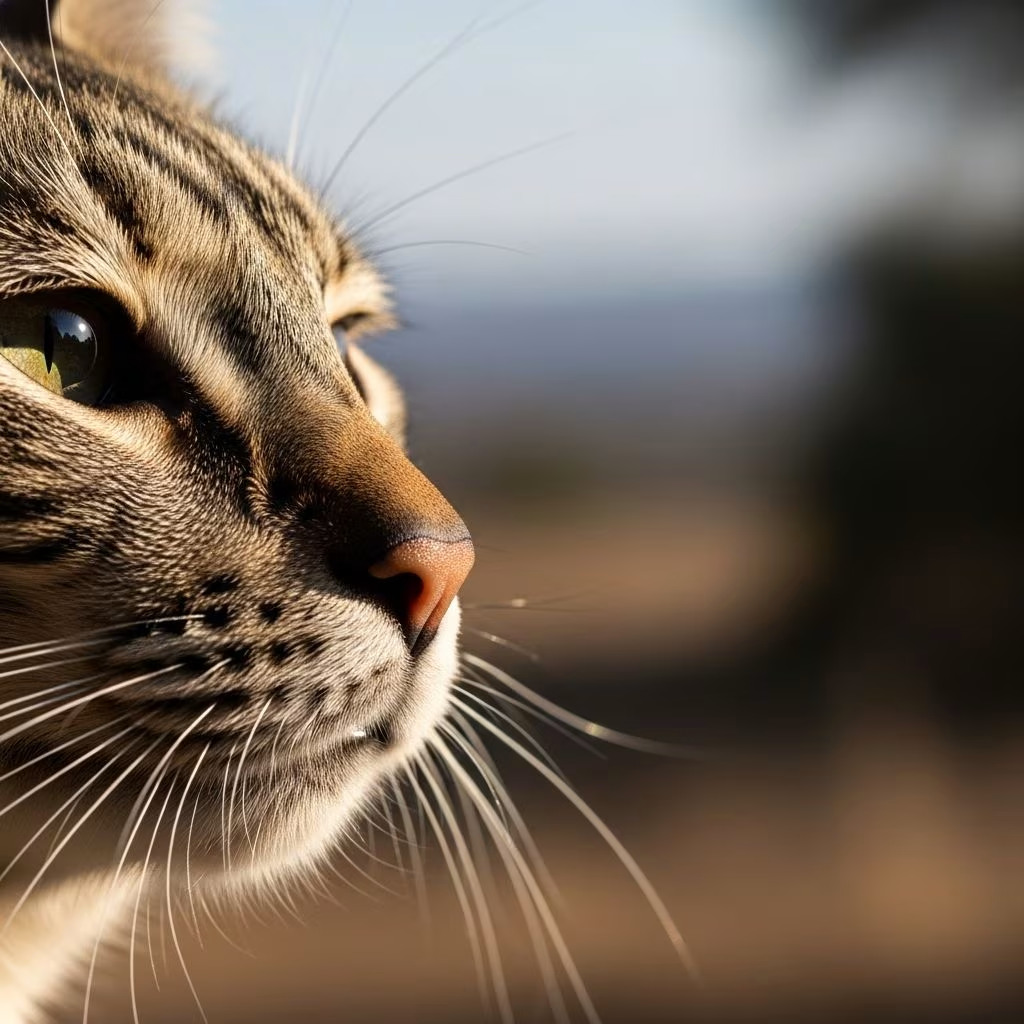
Cats have an extraordinary sense of smell that plays a pivotal role in their survival, communication, and daily activities. From newborn kittens finding their mother’s milk to adult cats hunting prey or navigating home, olfaction is essential. But **how far away can cats pick up a smell**? Research and anecdotal evidence suggest cats can detect scents from **1.5 to 4 miles (2.4–6.4 km) away** under optimal conditions.
This impressive range stems from their advanced nasal structure and high number of olfactory receptors. Unlike humans, cats’ noses function like natural gas chromatographs, separating air streams for breathing and odor detection with over 100 times greater efficiency than simpler nasal designs. In this article, we’ll explore the anatomy of a cat’s nose, comparisons to other species, factors affecting smell detection, and the science-backed distances.
The Anatomy of a Cat’s Nose: A Natural Wonder
A cat’s nose is a marvel of evolutionary engineering, far more sophisticated than a human’s. Cats possess **45 to 80 million olfactory receptors** (possibly up to 200 million), compared to humans’ mere 5 million. This gives them a sense of smell **14 times stronger** than ours.
Recent research from Ohio State University created a detailed 3D model of a cat’s nasal cavity using micro-CT scans. The findings, published in PLOS Computational Biology, reveal how inhaled air splits into two streams: one for respiration (cleansing and humidifying air) and another high-speed stream delivering odors directly to the olfactory region. This dual system recirculates air in parallel coiled channels, enhancing processing time and efficiency—making the cat nose **over 100 times more effective** at odor detection than an amphibian-like straight nose.
- Olfactory Epithelium: The surface area in cats is about 4 times larger than in humans, packed with receptor cells.
- Vomeronasal Organ (VNO): Cats have this secondary scent organ in the roof of their mouth, specialized for detecting pheromones.
- Parallel Coiled Channels: These increase the effective path length for odor molecules, slowing local airflow for better analysis.
This structure allows cats to identify subtle scents, track prey, and even discriminate between human odors.
How Cats’ Sense of Smell Compares to Humans and Dogs
Cats outperform humans across sensory domains, but their **olfaction** is particularly superior.
| Sensory Ability | Cats | Humans | Dogs (e.g., Beagle) |
|---|---|---|---|
| Visual Field | 200 degrees | 180 degrees | ~240 degrees |
| Hearing Range | 48 Hz–85 kHz | 20 Hz–20 kHz | 67 Hz–45 kHz |
| Olfactory Receptors | 45–200 million | 5 million | 225 million |
| Smell Strength | 14x human | Baseline | 10,000–100,000x human |
While dogs have more receptors, cats excel in pheromone detection via their VNO and have nasal airflow optimized for speed and precision. Dogs may detect general scents up to 12 miles under perfect conditions, but cats’ efficiency suggests comparable or superior performance for specific odors like pheromones.
Factors Affecting How Far Cats Can Smell
Not all conditions allow cats to reach maximum detection distances. Several environmental and biological factors influence scent range:
- Wind and Air Currents: Favorable winds carry scents farther; headwinds or turbulence disperse them.
- Precipitation: Rain dilutes or washes away odors, reducing range.
- Humidity and Temperature: Higher humidity helps odors linger; extreme heat can evaporate them quickly.
- Scent Concentration: Strong, familiar smells (e.g., food, litter box) travel farther than faint ones.
- Indoor Interference: Fans, air conditioning, or cleaning products mask scents indoors.
- Age and Health: Kittens and seniors have reduced olfaction; respiratory issues impair detection.
Under ideal conditions—no wind, stable air, concentrated scent—cats can theoretically smell up to **4 miles**.
Evidence from Studies and Anecdotes: The 4-Mile Claim
The **4-mile figure** originates from anecdotal reports and limited studies on cats’ homing abilities. One older study documented domestic cats returning home from **1.5–4 miles (2.4–6.4 km)**, relying on scent cues. Heartwarming stories of lost pets finding their way support this, though exact mechanisms blend smell, memory, and Earth’s magnetic field.
Modern science bolsters these claims. The Ohio State model shows cats’ noses deliver odors **rapidly and efficiently**, enabling detection of low-concentration scents from afar. A PMC study found cats discriminate human odors at close range (3 cm tubes) by nostril positioning, hinting at precision over distance.
For litter boxes, cats detect them from **1.5–4 miles** optimally, explaining why they seek them out even in large homes. Wild felids use similar abilities to track prey over vast territories.
Practical Implications for Cat Owners
Understanding feline olfaction helps improve care:
- Litter Box Placement: Cats smell it from far; keep clean to avoid aversion.
- Food and Toys: Scented items engage their nose—hide treats for enrichment.
- Stress Reduction: Pheromone diffusers mimic natural scents for calming.
- Health Monitoring: Sudden smell loss signals illness—vet check needed.
Cats’ superb smell underscores their independence; respect their sensory world for happier pets.
Frequently Asked Questions (FAQs)
Q: How far can a cat smell its owner?
A: Cats can detect familiar human scents from up to 1.5–4 miles under ideal conditions, thanks to their 14x superior olfaction.
Q: Can cats smell better than dogs?
A: Dogs have more receptors, but cats’ nasal structure is highly efficient for pheromones and quick detection, potentially matching dogs in specific scenarios.
Q: Why do cats sniff everything?
A: Sniffing gathers vital info on territory, food, and threats—their primary sense.
Q: How does weather affect a cat’s sense of smell?
A: Wind aids dispersion, rain dilutes scents, reducing effective range significantly.
Q: Do all cats have the same smelling ability?
A: No—breeds vary slightly; age, health, and sex influence strength.
Conclusion: The Superpower of Feline Olfaction
Cats’ ability to pick up smells from up to 4 miles showcases nature’s ingenuity. Their gas chromatograph-like noses, packed with receptors, make them scent-tracking masters. As research advances, we gain deeper insights into this superpower.
References
- Sniffing Out the Secrets: The Science Behind Cats’ Superb Sense of Smell — Neuroscience News. 2023-06-29. https://neurosciencenews.com/cat-olfaction-23557/
- From How Far Away Can Cats Pick Up a Smell? What Science Says — Catster. Accessed 2026. https://www.catster.com/lifestyle/how-far-away-can-cats-pick-up-a-smell/
- How the cat nose knows what it’s smelling — Ohio State University News. 2023-06-29. https://news.osu.edu/how-the-cat-nose-knows-what-its-smelling/
- Behavioral responses of domestic cats to human odor — PMC (NIH). 2023. https://pmc.ncbi.nlm.nih.gov/articles/PMC12118816/
- How Far Away Can a Cat Smell Its Litter Box — UAH Pet. Accessed 2026. https://www.uahpet.com/blogs/post/how-far-away-can-a-cat-smell-its-litter-box-unraveling-the-mystery



