

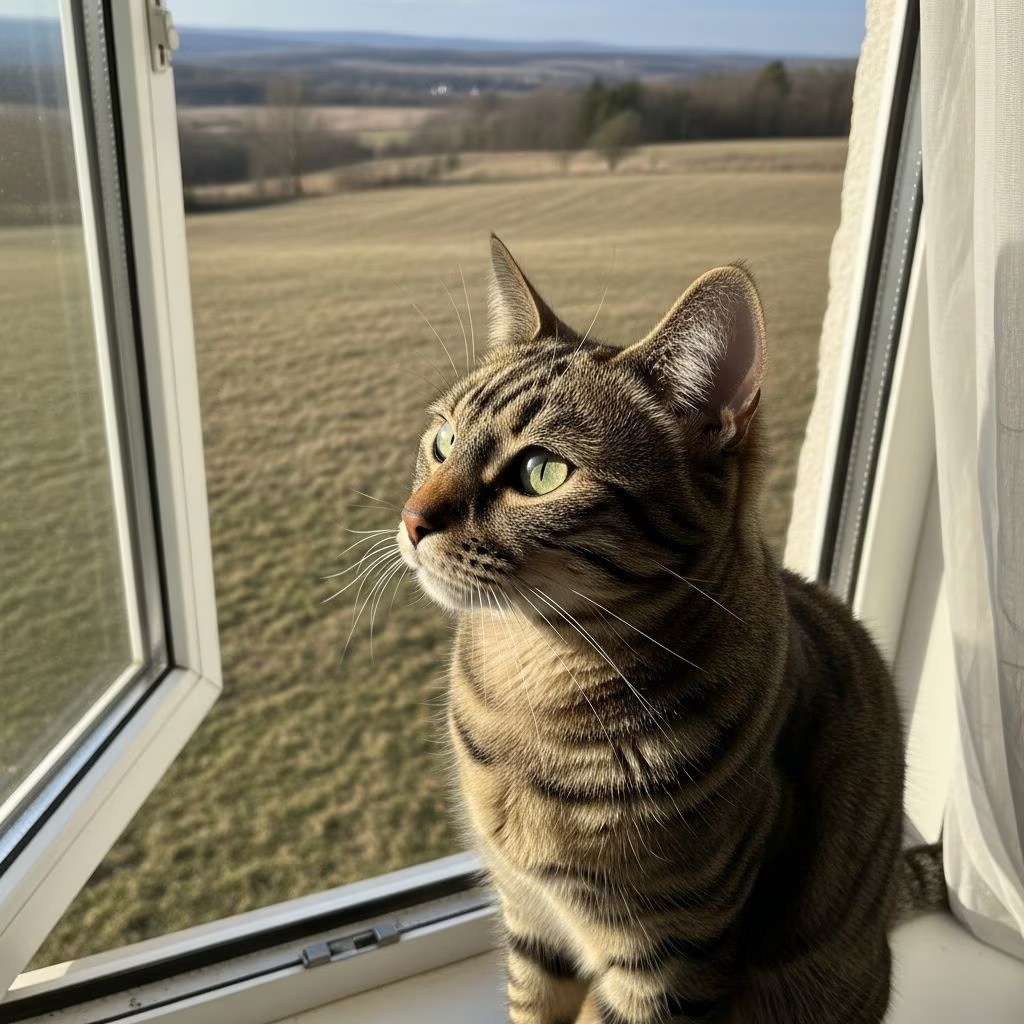
Cats’ sense of smell is one of nature’s marvels, enabling them to detect odors from remarkable distances. Research and anecdotal evidence suggest cats can pick up smells up to **4 miles (6.4 km)** away under optimal conditions. This ability is crucial for survival, from locating prey to finding their way home.
Why Is a Cat’s Sense of Smell So Important?
A cat’s olfactory system plays a pivotal role from birth. Kittens are born blind and deaf, relying entirely on smell to find their mother’s milk and navigate their environment. This sense continues to guide them throughout life for hunting, territory marking, communication via pheromones, and avoiding dangers.
The importance extends to social bonding. Cats use scent to recognize family members, detect intruders, and even assess health through subtle odor changes. Meteorological factors like wind, rain, or indoor fans can disperse or dilute scents, impacting detection range.
How Far Can Cats Smell?
While precise measurements are challenging due to variables like wind and odor concentration, studies indicate domestic cats can detect familiar scents from **1.5 to 4 miles (2.4–6.4 km)**. One older study specifically measured cats returning home from these distances, providing empirical support.
Anecdotal reports of lost cats traveling miles to reunite with owners align with this. Under perfect conditions—calm air, strong, familiar scents like food or pheromones—cats may rival or exceed dogs in certain detections. However, no large-scale modern research confirms exact maximums for all scents.
How Does a Cat’s Sense of Smell Compare to Ours?
Humans pale in comparison to cats olfactorily. Cats boast **45 to 80 million scent receptors** (possibly up to 200 million), versus humans’ mere 5 million. This grants cats a sense of smell **14 times stronger** than ours.
| Sense | Humans | Cats |
|---|---|---|
| Olfactory Receptors | 5 million | 45-200 million |
| Smell Sensitivity | Baseline | 14x better |
| Visual Field | 180 degrees | 200 degrees |
| Hearing Range | 20 Hz – 20 kHz | 48 Hz – 85 kHz |
Cats also have a **vomeronasal organ (VNO)**, or Jacobson’s organ, in the roof of their mouth for detecting pheromones—absent or vestigial in humans. This dual system enhances pheromone and subtle odor processing.
The Nasal Structure: A Natural Gas Chromatograph
Recent research using 3D models from micro-CT scans reveals why cats excel. Their nasal cavity separates inhaled air into two streams: one for respiration (cleansing/humidifying) and a high-speed dorsal stream delivering odors directly to the olfactory region.
This structure functions like a **gas chromatograph**, over **100 times more efficient** than a straight-nose amphibian equivalent. Air recirculates in parallel ethmoid coils, prolonging exposure for precise detection. The study, published in PLOS Computational Biology (2023), suggests bio-inspired lab tech improvements.
- Dual Flow Zones: Respiratory stream filters air; olfactory stream speeds pure odorants.
- Parallel Coils: Extend path length within skull limits, slowing local flow for better processing.
- Efficiency Metric: Theoretical plate number >100x higher than straight channels.
How Many Scent Receptors Do Cats Have?
Domestic cats have **45-80 million olfactory receptors**, with estimates up to 200 million. This dwarfs humans and approaches some hounds (e.g., Beagles at 225 million). More receptors mean finer discrimination of odor concentrations and mixtures.
Breeds vary slightly, but all felines share large olfactory epithelium—4:1 larger than humans relative to body size. Detection thresholds are far lower, spotting subtle changes humans miss.
Factors That Affect Detection Distance
Several variables influence how far cats smell:
- Wind Direction/Speed: Carries scents toward or away from the cat.
- Precipitation/Humidity: Rain dilutes odors; high humidity preserves them.
- Odor Strength: Food, pheromones, or urine travel farther than faint scents.
- Indoor Airflow: Fans or AC disrupt plumes.
- Cat’s Health/Age: Older cats or those with nasal issues have reduced range.
- Familiarity: Known scents (home, owner) detected sooner.
Studies show cats discriminate human odors, approaching known scents more readily, using nostril positioning for directional sniffing.
How Cats Use Their Sense of Smell
Beyond distance detection, cats employ smell strategically:
- Hunting: Track prey by airborne/fresh trails.
- Navigation: Follow scent maps home.
- Communication: Rub cheeks (F3 pheromones) or spray urine for territory.
- Feeding: Sniff food quality; reject spoiled items.
- Social: Identify stress/illness via pheromones.
The VNO triggers flehmen response (lip curl) for deep analysis.
Cats vs. Dogs: Who Smells Better?
Dogs often win overall (225+ million receptors), detecting up to 12 miles in ideal cases. But cats excel in **pheromone detection** and efficiency per skull size. Cats’ curved nasal passages optimize small heads; dogs rely on volume.
| Aspect | Cats | Dogs (e.g., Beagle) |
|---|---|---|
| Receptors | 45-200 million | 225 million |
| Max Distance (Est.) | 4 miles | 12 miles |
| Nasal Efficiency | 100x+ baseline | High volume-based |
| Pheromone Focus | Superior (VNO) | Strong but less specialized |
Cats may outperform in concentrated, species-specific scents.
Frequently Asked Questions (FAQs)
What is the maximum distance a cat can smell?
Up to **4 miles** under optimal conditions, based on homing studies and estimates.
How many scent receptors does a cat have?
**45-80 million**, possibly up to 200 million—far more than humans’ 5 million.
Can cats smell better than dogs?
Dogs detect farther generally, but cats are superior in efficiency and pheromones.
Why do cats sniff everything?
To gather environmental data for safety, food, territory, and social cues.
Does age affect a cat’s sense of smell?
Yes, seniors may lose sensitivity due to receptor decline or health issues.
How does weather impact cat smelling ability?
Wind aids/disperses scents; rain dilutes them.
References
- Sniffing Out the Secrets: The Science Behind Cats’ Superb Sense of Smell — Neuroscience News. 2023-06-29. https://neurosciencenews.com/cat-olfaction-23557/
- From How Far Away Can Cats Pick Up a Smell? What Science Says — Catster. Accessed 2026. https://www.catster.com/lifestyle/how-far-away-can-cats-pick-up-a-smell/
- How the cat nose knows what it’s smelling — Ohio State University News. 2023-06-29. https://news.osu.edu/how-the-cat-nose-knows-what-its-smelling/
- Behavioral responses of domestic cats to human odor — PMC (NIH). 2024. https://pmc.ncbi.nlm.nih.gov/articles/PMC12118816/
- How Far Away Can a Cat Smell Its Litter Box — UAH Pet. Accessed 2026. https://www.uahpet.com/blogs/post/how-far-away-can-a-cat-smell-its-litter-box-unraveling-the-mystery



