

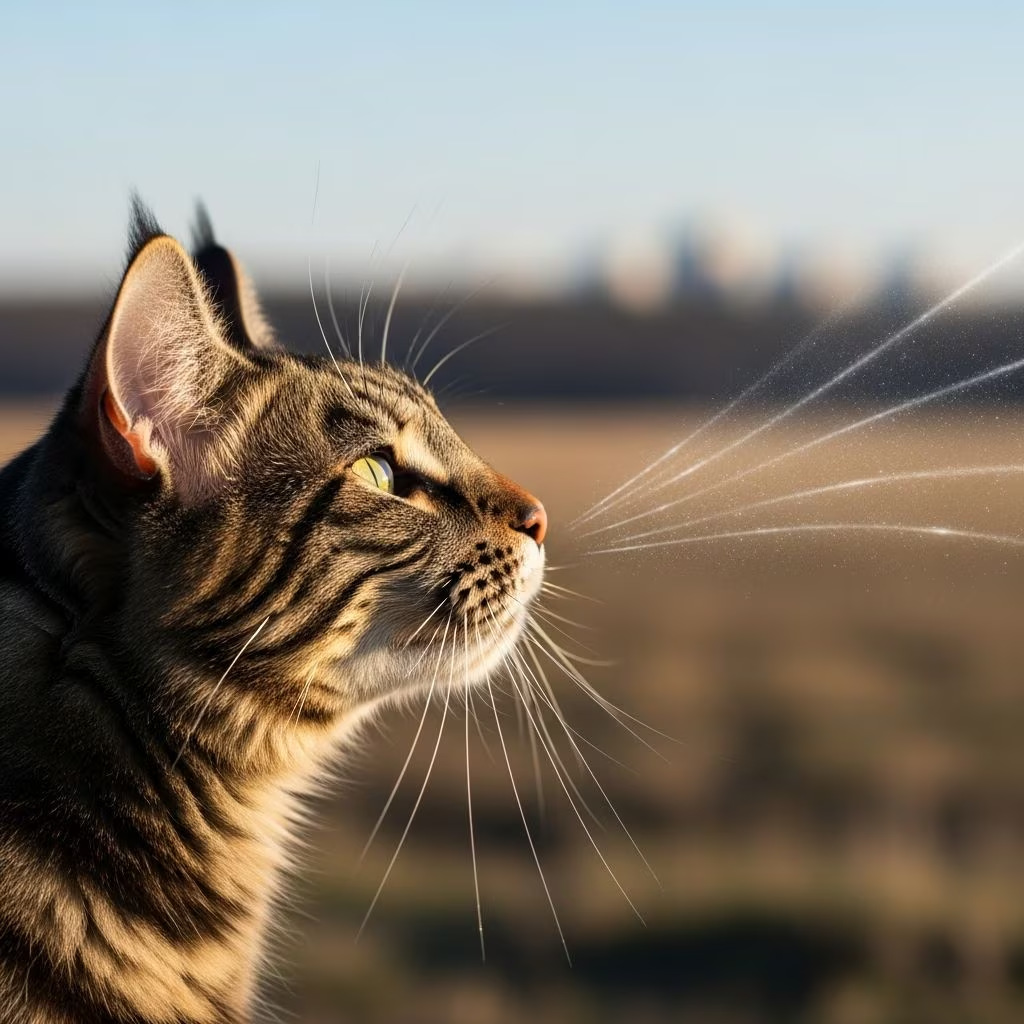
Cats have an extraordinary sense of smell that plays a pivotal role in their survival, communication, and navigation. It’s believed that under optimal conditions, cats can detect odors from as far as **1.5 to 4 miles (2.4–6.4 km)** away. This impressive capability stems from their specialized nasal anatomy and a high number of olfactory receptors, far surpassing human abilities. This article delves into the science, anatomy, and factors affecting how far cats can smell, drawing from recent research and anatomical studies.
Why Is a Cat’s Sense of Smell So Important?
From the moment they are born, kittens rely heavily on their sense of smell. Born blind and deaf, they use olfaction to locate their mother, identify littermates, and find milk sources. This primal instinct underscores smell’s critical role in feline life.
As adults, cats use their sense of smell for hunting, territory marking, mating, and avoiding dangers. Pheromones—chemical signals—allow cats to communicate emotions, reproductive status, and boundaries without visual or auditory cues. Their olfactory prowess helps them track prey, detect hidden food, or even find their way home over long distances, as evidenced by anecdotal stories of lost cats returning from miles away.
How Does a Cat’s Sense of Smell Compare to Ours?
Humans possess about 5 million olfactory receptors, but cats have between **45 to 80 million, and possibly up to 200 million**. This gives cats a sense of smell **14 times stronger** than humans. While dogs like Beagles boast 225 million receptors, cats excel in specific areas, such as pheromone detection.
| Sense | Humans | Cats |
|---|---|---|
| Visual Field | 180 degrees | 200 degrees |
| Hearing Range | 20 Hz–20 kHz | 48 Hz–85 kHz |
| Olfactory Receptors | ~5 million | 45–200 million |
| Smell Strength | Baseline | 14x stronger |
Cats also have a **vomeronasal organ (VNO)**, or Jacobson’s organ, located in the roof of their mouth. This secondary olfactory system detects pheromones, enhancing their ability to process social and environmental scents.
The Anatomy of a Cat’s Nose: A Natural Gas Chromatograph
Recent research from Ohio State University reveals the cat’s nose functions like a highly efficient **gas chromatograph**. Using high-resolution micro-CT scans, scientists created a 3D model of a cat’s nasal cavity, showing inhaled air divides into two streams: one for respiration (cleansing and humidifying) and another delivering odors rapidly to the olfactory region.
This structure is **over 100 times more effective** at odor detection than a straight, amphibian-like nose. Air in the olfactory zone recirculates in parallel coiled channels, prolonging exposure for better processing. This parallel gas chromatography theory explains cats’ rapid and precise scent detection despite their smaller head size.
- Dorsal medial stream: High-speed odor delivery to ethmoid region.
- Respiratory stream: Filters and conditions air for breathing.
- Parallel coils: Increase flow path length, slowing local airflow for enhanced analysis.
The olfactory membrane in cats is proportionally **4 times larger** than in humans, amplifying their sniffing power.
How Far Can Cats Actually Smell?
While definitive research is limited, estimates suggest cats can detect smells from **1.5–4 miles** under perfect conditions—no wind, stable air, strong scents. This figure comes from a historical study on cats navigating home and comparisons to dogs, which can smell up to 12 miles.
Anecdotal evidence supports this: cats locating owners or food from afar. However, real-world distances vary. Meteorological factors like wind disperse scents unpredictably, while indoor fans or precipitation dilute them.
Indoor detection is more reliable; cats can smell litter boxes or food from rooms away, thanks to low detection thresholds for subtle odors.
Factors That Affect Detection Distance
Several variables influence a cat’s smelling range:
- Wind and Weather: High winds scatter molecules; rain washes them away.
- Humidity and Temperature: Ideal conditions (moderate humidity, warm air) allow scents to travel farther.
- Scent Strength: Concentrated odors (e.g., fish, pheromones) carry longer than faint ones.
- Obstacles: Walls, furniture, or terrain block airflow.
- Cat’s Health: Age, respiratory issues, or nasal infections reduce sensitivity.
- Experience: Familiar scents are detected from farther away due to learned patterns.
Studies show cats discriminate human odors at close range (e.g., 3 cm intervals) using nostril positioning, highlighting precision over distance in controlled settings.
Myths and Anecdotes About Cats’ Sense of Smell
Common myths include cats smelling farther than dogs—unlikely, given dogs’ receptor count—but cats may outperform in pheromone sensitivity. Stories of cats traveling 4+ miles home blend olfaction with memory and Earth’s magnetic field sensing.
No direct studies confirm 4-mile detection, but nasal efficiency supports plausibility for strong, persistent scents.
Practical Tips for Cat Owners
Understanding feline olfaction improves care:
- Litter Box Placement: Cats smell unclean boxes from afar; scoop daily and place away from food.
- Food Appeal: Strong-smelling foods entice picky eaters.
- Scent Enrichment: Use catnip or pheromone diffusers for stress relief.
- Cleaning Products: Avoid strong chemical scents that overwhelm their nose.
- Health Checks: Sneezing or refusal to eat may signal olfactory issues—consult a vet.
Frequently Asked Questions (FAQs)
Can cats smell better than dogs?
Cats have fewer receptors (45–200 million vs. dogs’ 225 million) but excel in pheromone detection via the VNO. Dogs may detect farther generally, but cats are specialized.
How far can a cat smell its owner?
Up to several miles for familiar scents under ideal conditions, aided by memory and pheromones.
Do all cats have the same sense of smell?
No—breeds vary; some like Siamese have fewer receptors. Age and health also impact.
Can cats smell emotions?
Yes, via pheromones and stress odors; studies show discrimination of familiar vs. unknown humans.
Why do cats sniff everything?
To gather environmental data—safer and richer than sight for them.
Conclusion
Cats’ ability to pick up smells from up to 4 miles showcases evolutionary genius, powered by a nose that’s a biological marvel. From newborn survival to adult hunting, olfaction defines feline life. Advances in nasal modeling may even inspire lab tech, proving cats’ sniff is world-class.
References
- Sniffing Out the Secrets: The Science Behind Cats’ Superb Sense of Smell — Neuroscience News. 2023-06-29. https://neurosciencenews.com/cat-olfaction-23557/
- From How Far Away Can Cats Pick Up a Smell? What Science Says — Catster. N/A. https://www.catster.com/lifestyle/how-far-away-can-cats-pick-up-a-smell/
- How the Cat Nose Knows What It’s Smelling — Ohio State University News. 2023-06-29. https://news.osu.edu/how-the-cat-nose-knows-what-its-smelling/
- Behavioral Responses of Domestic Cats to Human Odor — PMC (NCBI). 2024. https://pmc.ncbi.nlm.nih.gov/articles/PMC12118816/
- How Far Away Can a Cat Smell Its Litter Box — UAH Pet. N/A. https://www.uahpet.com/blogs/post/how-far-away-can-a-cat-smell-its-litter-box-unraveling-the-mystery



