
How Dogs See the World: Vision Explained
Discover how dogs perceive their surroundings through their unique vision and sensory abilities.
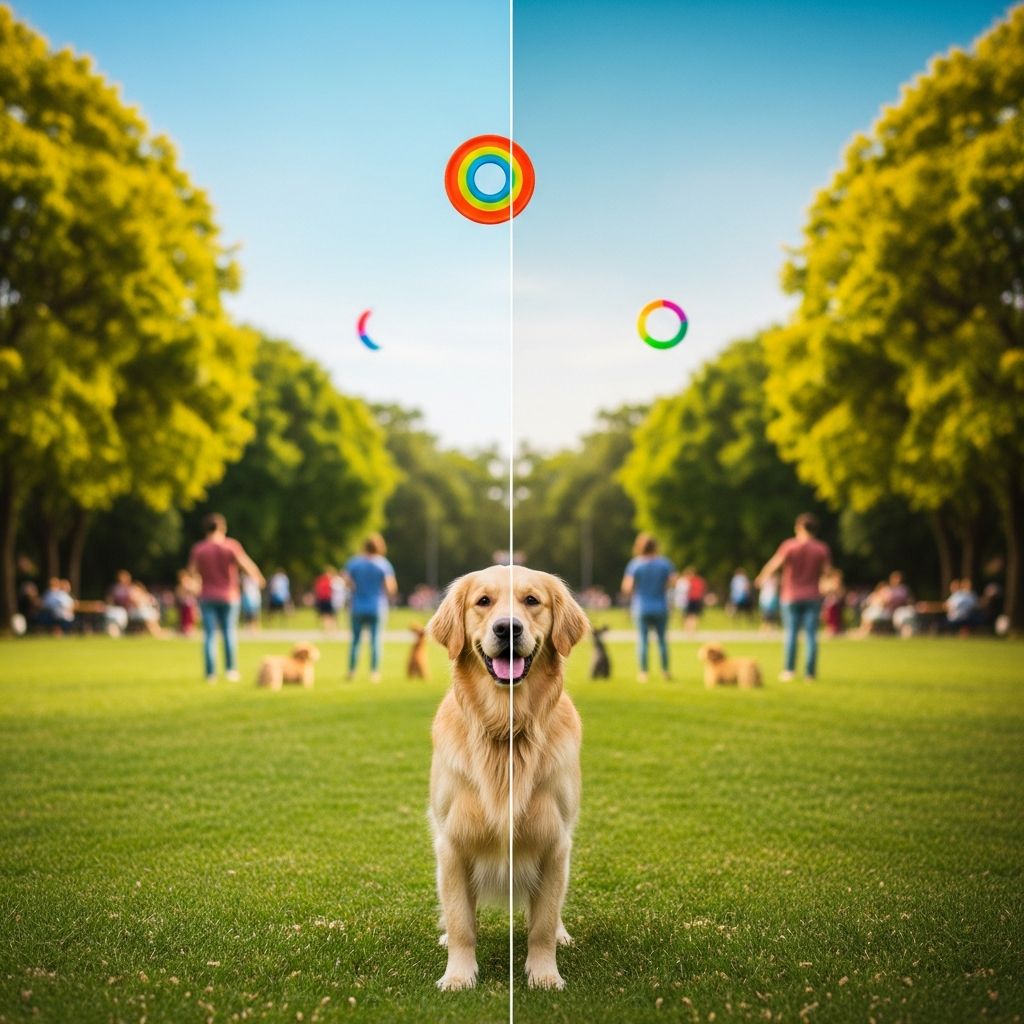
How Dogs See the World: Understanding Canine Vision
Dog owners often wonder how their beloved pets perceive the world around them. While many people assume dogs see everything in shades of gray, the reality of canine vision is far more complex and fascinating. Understanding how dogs see can help pet owners better appreciate their dogs’ behavior and strengthen the bond between humans and their four-legged companions. Unlike humans who rely heavily on visual information, dogs experience the world through a unique combination of sight, smell, and other sensory cues that create a distinctly different perception of their environment.
Dog Eye Anatomy and Structure
To understand how dogs see, it’s essential to first examine the structure of their eyes. The anatomy of a dog’s eye differs in several key ways from human eyes, which directly impacts how they perceive visual information. Dogs have eyes positioned more toward the sides of their heads compared to humans, which gives them a significantly wider field of vision. This lateral positioning of their eyes is an evolutionary adaptation that helped their ancestors detect predators and prey from multiple angles.
The retina in a dog’s eye contains a higher concentration of light-sensitive cells called rods compared to humans. These rods are particularly sensitive to movement and function well in dim light conditions, making dogs excellent at detecting motion even in low-light environments. Dogs also have a reflective layer behind their retina called the tapetum lucidum, which acts like a mirror to reflect light back through the photoreceptors. This adaptation enhances their ability to see in darkness, which is why their eyes appear to glow when light shines on them at night.
Can Dogs See Color?
One of the most persistent myths about dog vision is that dogs see only in black and white. This misconception has been thoroughly debunked by modern vision research. Dogs do indeed see in color, though their color perception differs significantly from human color vision. The difference lies in the types of color-processing cones present in their eyes.
Humans have trichromatic vision, meaning we possess three types of color-processing cones that allow us to see red, green, blue, and all the colors in between. Dogs, however, are dichromats, meaning they have only two types of color-processing cones. Dogs can see blue and yellow colors quite well, but they lack the medium-wavelength cone necessary to perceive red and green hues. What appears red or green to a human looks more like shades of brown, tan, or gray to a dog.
Despite having less colorful vision than humans, dogs do use color cues effectively, particularly during daylight hours. They can distinguish between different shades and use these color differences to navigate their environment and identify objects of interest. However, their overall color perception creates a world that is less vibrant than what humans experience.
Visual Acuity in Dogs
While dogs can see color, their visual acuity—the ability to see fine details—is not as sharp as human vision. The average human with normal vision has 20/20 vision, but dogs typically have approximately 20/75 vision. This means that an object a dog can clearly see from 20 feet away would need to be at 75 feet away for a human with average vision to see it with similar clarity.
This reduced visual acuity doesn’t mean dogs have poor vision; rather, it reflects different evolutionary priorities. Dogs evolved to be hunters and guardians, roles that prioritize detecting movement and changes in their environment over identifying fine details. Their vision is well-suited for their needs as companion animals and working dogs, even if it doesn’t match human sharpness of sight.
Motion Detection and Sensitivity
One area where dog vision significantly surpasses human ability is motion detection. Dogs have 10 to 20 times greater motion sensitivity than humans, allowing them to notice even the smallest changes in movement and body posture. This exceptional sensitivity to motion is due to the high concentration of rods in their retinas, which are specialized for detecting movement rather than fine details.
This heightened motion sensitivity has practical implications for dog training and behavior. It explains why dogs respond so well to hand signals and silent cues during training—they can pick up on subtle shifts in a trainer’s posture and movement that humans might not consciously register. Similarly, a dog’s ability to detect your slight movement toward the treat jar or your hand reaching for the leash demonstrates how finely tuned their motion detection truly is.
Field of Vision
Dogs possess a significantly wider field of vision than humans. While humans have a field of vision of approximately 190 degrees, dogs can see roughly 250 degrees around them. This wider field of view comes from their laterally positioned eyes, which allow them to see more to the sides and behind them without turning their heads. This adaptation made ancestral dogs more aware of threats and opportunities in their environment from multiple directions.
However, this wider peripheral vision comes with a trade-off. Dogs have a smaller area of binocular vision—the region where both eyes overlap and provide depth perception. This means dogs don’t perceive depth as precisely as humans in many situations, though they compensate for this limitation using other sensory information, particularly their powerful sense of smell and hearing.
Night Vision in Dogs
Dogs have substantially better night vision than humans, an adaptation that reflects their evolutionary history as twilight and dawn hunters. The combination of their high rod concentration, larger pupils that can dilate more widely than human pupils, and the reflective tapetum lucidum layer all work together to enable dogs to see effectively in dim light conditions. This is why dogs can navigate dark rooms with apparent ease while humans struggle.
The superior night vision of dogs also explains why they often seem to sense things in low-light environments that humans cannot perceive. A dog’s ability to see movement in near darkness can sometimes make them appear to react to invisible threats, when in fact they’re simply detecting subtle motion that human eyes cannot resolve.
What Do Dogs Focus On?
Recent research has provided fascinating insights into what actually captures a dog’s visual attention. A 2025 study published in Cognitive Science examined the gaze patterns of dogs wearing specialized eye-tracking goggles as they walked on predetermined routes. The research revealed that dogs are highly individualistic in their visual preferences, with different dogs finding different objects and situations compelling.
The study tracked over 20,000 individual gazes from participating dogs and found that canine attention is directed toward various elements in their environment including people, plants, vehicles, and the ground ahead. Dogs spent time looking where they were going, similar to humans navigating a route. Interestingly, individual dogs showed distinct preferences—one dog became fascinated by a shuttle bus on a university campus while other dogs largely ignored it.
This research demonstrates that dogs, like humans, have individual visual interests and preferences. Their vision isn’t simply a passive recording of their environment; instead, dogs actively choose what to look at based on what they find meaningful or interesting.
How Dogs See Humans
Dogs have developed a special relationship with human faces and expressions. Research shows that dogs are particularly attentive to human visual cues and can read facial expressions to some degree. In the eye-tracking study mentioned above, dogs showed distinct gazing patterns when looking at humans—they would fixate on people at a distance as if trying to figure them out, and they would frequently glance back at their owners or handlers in quick, purposeful gazes.
When dogs encounter unfamiliar objects like Halloween decorations or unusual items, their focused gaze may serve multiple purposes. They might be assessing whether something poses a threat, exhibiting curiosity about an interesting visual stimulus, or simply wondering about human choices, much like a person might wonder why someone erected a nine-foot Halloween skeleton.
Dogs don’t naturally focus intensely on human faces the way humans do when looking at each other. However, research indicates that dogs make genuine efforts to read human social cues and understand human expressions, suggesting they have learned to prioritize human facial information as part of their adaptation to living alongside people.
The Role of Other Senses in Dog Vision
While vision is important to dogs, it’s crucial to understand that canine perception extends far beyond sight alone. Dogs possess a sense of smell that is exponentially more powerful than human olfaction, with a much larger portion of their brain devoted to processing scent information. Recent neuroscience research has revealed that dogs’ olfactory centers are strongly connected to their visual processing centers in the brain, suggesting that dogs may literally ‘see’ through their sense of smell in ways that are difficult for humans to comprehend.
This multisensory integration means that when a dog looks at something, they’re not just using their eyes—they’re combining visual information with rich olfactory and auditory data to create a complete picture of their environment. What we perceive primarily through sight, dogs perceive through a sophisticated combination of all their senses working in concert.
Action-Oriented Vision
Dogs perceive the world in a fundamentally different way than humans when it comes to what captures their attention. While humans are highly object-oriented—notice how English has many more nouns than verbs—dogs appear to be action-oriented. Dogs focus more on what something is doing rather than what something is. This difference in visual processing reflects distinct evolutionary priorities and cognitive preferences between the two species.
This action focus may stem from dogs’ need to be constantly aware of potential threats and opportunities in their environment, or it could relate to their reliance on other sensory modalities like smell and hearing as primary information sources. Regardless of the cause, this difference means dogs and humans are literally watching different things when they look at the same scene.
Comparing Dog and Human Vision
| Vision Characteristic | Dogs | Humans |
|---|---|---|
| Color Processing Cones | Two (dichromatic) | Three (trichromatic) |
| Color Perception | Blue and yellow | Red, green, blue, and spectrum |
| Visual Acuity | 20/75 average | 20/20 average |
| Motion Sensitivity | 10-20x greater | Standard baseline |
| Field of Vision | 250 degrees | 190 degrees |
| Night Vision | Excellent | Poor |
| Focus Priority | Actions and movement | Objects and details |
Practical Implications for Dog Owners
Understanding how dogs see the world has practical implications for how we interact with our pets. Knowing that dogs detect motion exceptionally well helps explain why they respond so readily to hand signals and dynamic gestures during training. Recognizing that dogs have a wider field of vision explains why they notice things happening at the periphery that might escape human attention.
The knowledge that dogs have reduced color perception helps owners understand why certain toys or objects might be less visually distinct to their dogs than to humans. A toy that appears brightly colored and obvious to us might be harder for a dog to spot if it contains colors in the red-green spectrum that dogs cannot distinguish.
Understanding that dogs are more action-oriented than object-oriented can help owners better interpret their dogs’ behavior and reactions to various situations. When a dog stares intently at something, they may be more focused on what that thing is doing than on what it is, which can change how we interpret their attention and reactions.
Frequently Asked Questions
Q: Do dogs really see in black and white?
A: No, this is a common misconception. Dogs see in color, specifically shades of blue and yellow. They cannot distinguish red and green, which appear as shades of brown or gray to them.
Q: Why do dogs respond better to hand signals than verbal commands?
A: Dogs have exceptional motion sensitivity—10 to 20 times greater than humans. They can detect subtle movements and changes in body posture, making them naturally responsive to hand signals and visual cues during training.
Q: Can dogs see in the dark?
A: Yes, dogs have significantly better night vision than humans. They can navigate in low-light conditions due to their high concentration of rods, larger pupils, and a reflective layer behind their retinas called the tapetum lucidum.
Q: Why do dogs stare at things we cannot see?
A: Dogs may be detecting movement or changes in their environment that are invisible to humans, or they might be focused on scents and sounds we cannot perceive. Their superior motion detection and powerful senses of smell and hearing allow them to perceive their environment very differently than we do.
Q: How far can dogs see?
A: Dogs typically have 20/75 vision, meaning they can clearly see from 20 feet what humans with average vision need to be at 75 feet to see clearly. However, their superior motion detection compensates for their lower visual acuity.
Q: Do dogs understand what they see the same way humans do?
A: No, dogs process visual information differently. They are more action-oriented than object-oriented, focus more on movement, and integrate their vision with their powerful senses of smell and hearing to create a unique perception of the world.
References
- How Do Dogs See The World? They Do See Color, But They Focus More On Us — Discover Magazine. 2025-11-01. https://www.discovermagazine.com/how-do-dogs-see-the-world-they-do-see-color-but-they-focus-more-on-us-48134
- How Dogs See The World — Vetnique. 2024-12-15. https://vetnique.com/blogs/vets-corner/how-dogs-see-the-world
- Fascinating Study Gives a Unique Glimpse Into How Dogs See The World — Science Alert. 2024-11-20. https://www.sciencealert.com/fascinating-study-gives-a-unique-glimpse-into-how-dogs-see-the-world
- Dog Vision and Eye Anatomy: How Dogs See — PetMD. 2025-01-10. https://www.petmd.com/dog/general-health/how-do-dogs-see-world
- How Dogs Experience the World: Part 1 — PetMD. 2024-06-15. https://www.petmd.com/blogs/fullyvetted/2012/june/how_dogs_experience_the_world_part_1-25374
Similar Articles








Read full bio of Sneha Tete




