

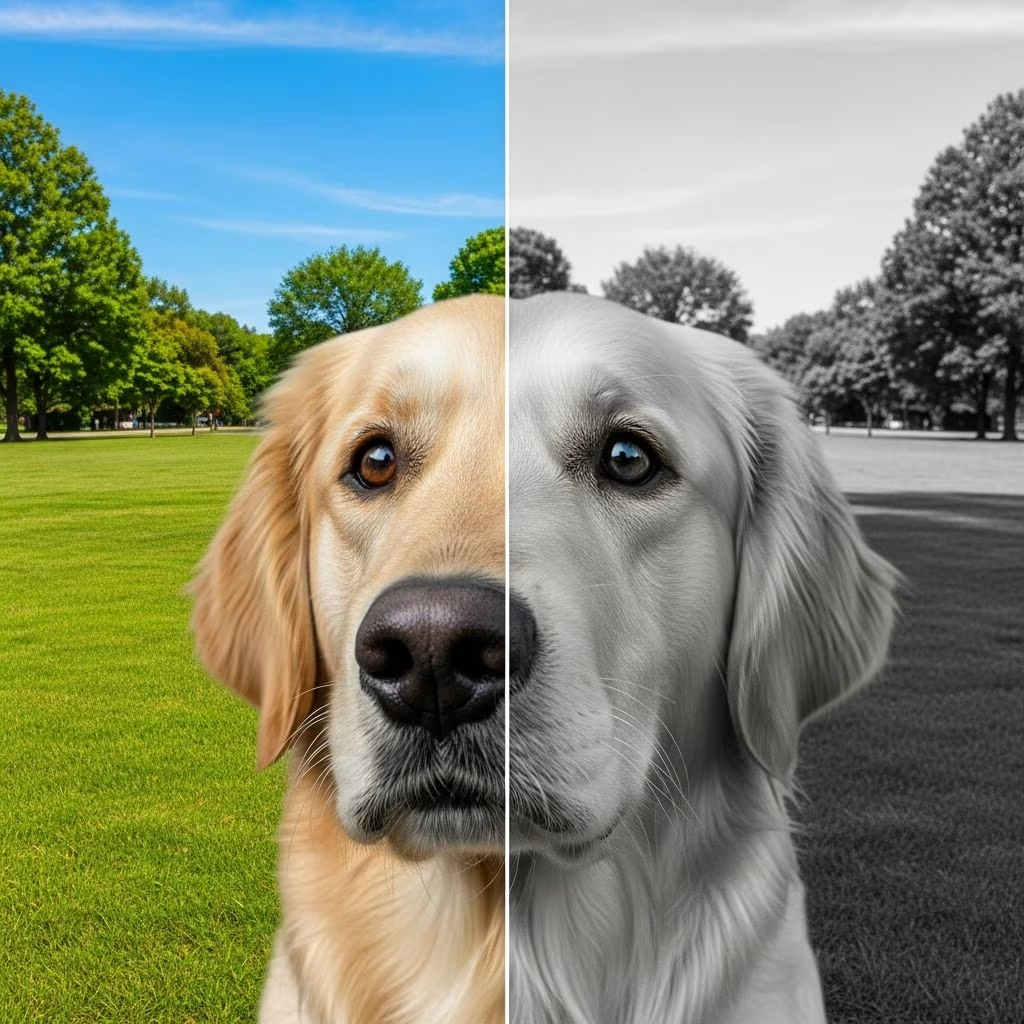
Dogs experience vision in a fundamentally different way from humans, shaped by evolutionary adaptations for hunting, navigation, and survival. Their eyes prioritize motion detection and low-light performance over sharp detail and color richness. This article delves into the anatomy of the canine eye, visual capabilities, and practical insights for pet owners, drawing from veterinary science to explain these differences.
Understanding Canine Eye Anatomy
The canine eye is a sophisticated organ housed within the orbit, a bony socket formed by multiple skull bones that also shelters muscles, nerves, blood vessels, and tear-producing glands. Key components include the cornea, which shields the front and refracts light onto the retina; the iris, a colored ring controlling light entry via pupil dilation or constriction; and the lens, which adjusts shape through ciliary muscles to focus images, though with limited range in dogs.
Behind the lens lies the retina, packed with photoreceptors: rods for dim light and motion, and cones for color and detail. Dogs possess a tapetum lucidum, a reflective layer boosting low-light vision by redirecting light to photoreceptors. Unlike human fovea-centralized vision, dogs feature a visual streak—an oval area of high photoreceptor density superior and temporal to the optic nerve—for enhanced acuity in specific zones.
- Cornea: Transparent dome focusing light rays.
- Iris and Pupil: Regulate light intake; pupils enlarge in dark, shrink in bright conditions.
- Lens: Biconvex structure with modest accommodation power (2-3 diopters).
- Retina: Houses rods (motion/low light) and cones (color/detail).
- Tapetum Lucidum: Zinc-rich layer for night vision amplification.
Visual Field and Binocular Overlap in Dogs
Dogs boast a panoramic visual field of about 250 degrees, far wider than the human 180 degrees, thanks to forward-facing eyes with lateral positioning. This aids in scanning environments but results in modest binocular overlap of 30-60 degrees, depending on breed—mesocephalic dogs like German Shepherds average 60 degrees, supporting basic depth perception straight ahead.
Blind spots exist posteriorly (around 120 degrees) and near the nose, minimized by head movement. The tall, narrow binocular field enhances vertical depth cues, ideal for tracking ground-level prey or obstacles.
| Species | Total Field | Binocular Overlap | Key Adaptation |
|---|---|---|---|
| Dog | 250° | 30-60° | Wide monocular fields for surveillance |
| Human | 180° | 140° | Foveal detail and color |
| Cat | 200° | 140° | Balanced overlap for pouncing |
Color Perception: What Shades Do Dogs Discern?
Humans rely on three cone types for millions of colors, but dogs have two—sensitive to blue-violet and yellow-green—rendering them dichromats. They distinguish blue, yellow, and shades thereof but confuse green with red, perceiving the latter as dim yellow or gray. Studies confirm dogs detect wavelengths around 429-530 nm effectively, with yellow/blue discrimination superior to red/green.
This limited palette stems from fewer cones and no dedicated red-sensitive photopigments. Yet, dogs navigate colorful worlds adeptly, prioritizing brightness and motion over hue. Training experiments show dogs respond to blue/yellow stimuli but falter with red-green distinctions.
Night Vision Superiority and the Tapetum Role
Dogs excel in low light due to abundant rods (20x more than human cones) and the tapetum lucidum, a 9-20 layer cellular reflector rich in zinc and cysteine. This structure scatters unabsorbed light back through the retina, amplifying photon capture—explaining the ‘glow’ in headlight-reflecting eyes.
In twilight, dogs see 3-4 times better than humans, with rod-dominated retinas favoring sensitivity over acuity. Ganglion cell convergence (multiple rods per cell) further boosts dim-light performance, though at detail’s expense.
Visual Acuity and Focus Limitations
Dog acuity approximates 20/75 human vision—identifying at 20 feet what humans see at 75. Lacking a fovea, they rely on the visual streak for peak resolution, where ganglion cells are densest (alpha cells smallest in central streak). Breeds vary: wolf-like dogs (e.g., German Shepherds) show pronounced streaks for horizon scanning; others like Beagles have moderate ones.
Accommodation is weak (2-3 diopters), sharpening objects 33-50 cm away but blurring closer items—dogs supplement with smell/touch. Peripheral vision trades sharpness for breadth, with higher convergence ratios reducing detail.

Breed Variations in Eyesight Abilities
Head shape influences vision: brachycephalic (short-nosed, e.g., Pugs) have more human-like forward eyes and better overlap but prominent blind spots; dolichocephalic (long-nosed, e.g., Greyhounds) enjoy wider fields; mesocephalic balance both. Visual streak prominence correlates with predatory heritage—stronger in hunting breeds.
- Brachycephalic: Enhanced binocular vision, prone to eye issues.
- Dolichocephalic: Expansive fields, superior motion tracking.
- Mesocephalic: Versatile for most tasks.
Implications for Daily Dog Life and Training
Dogs detect motion at lower thresholds, making them alert sentinels but easily distracted by peripherals. For training, use high-contrast toys (blue/yellow) in dim light; avoid red/green cues. Night walks benefit from their prowess, but close inspection relies on olfaction.
Eye health impacts vision: cataracts blur focus; retinal degeneration dims night sight. Regular vet checks preserve capabilities.
Frequently Asked Questions
Are dogs fully colorblind?
No, dogs see blues and yellows but not reds/greens distinctly.
Can dogs see in complete darkness?
No, but far better than humans in low light due to rods and tapetum.
How far can dogs see clearly?
Acuity limits crisp vision beyond 20/75 equivalent; motion detectable farther.
Do all dog breeds see the same?
No, skull shape and streak development vary acuity and field.
Why do dog eyes glow at night?
Tapetum lucidum reflects light for enhanced photoreceptor stimulation.
References
- Eye Structure and Function in Dogs – Dog Owners — Merck Veterinary Manual. 2023-10-15. https://www.merckvetmanual.com/dog-owners/eye-disorders-of-dogs/eye-structure-and-function-in-dogs
- Structure and Function of the Eye — Veterian Key. 2022-05-20. https://veteriankey.com/structure-and-function-of-the-eye/
- Vision in Dogs — Journal of the American Veterinary Medical Association (via RCTN). 1995-01-01. https://www.rctn.org/bruno/animal-eyes/dog-vision-miller-murphy.pdf
- Dog Vision and Eye Anatomy: How Dogs See — PetMD. 2024-08-12. https://www.petmd.com/dog/general-health/how-do-dogs-see-world
- Carnivore Anatomy Lab 24 Introduction — University of Minnesota (vanat.ahc.umn.edu). 2023-02-10. https://vanat.ahc.umn.edu/carnLabs/Lab24/Lab24.html



