

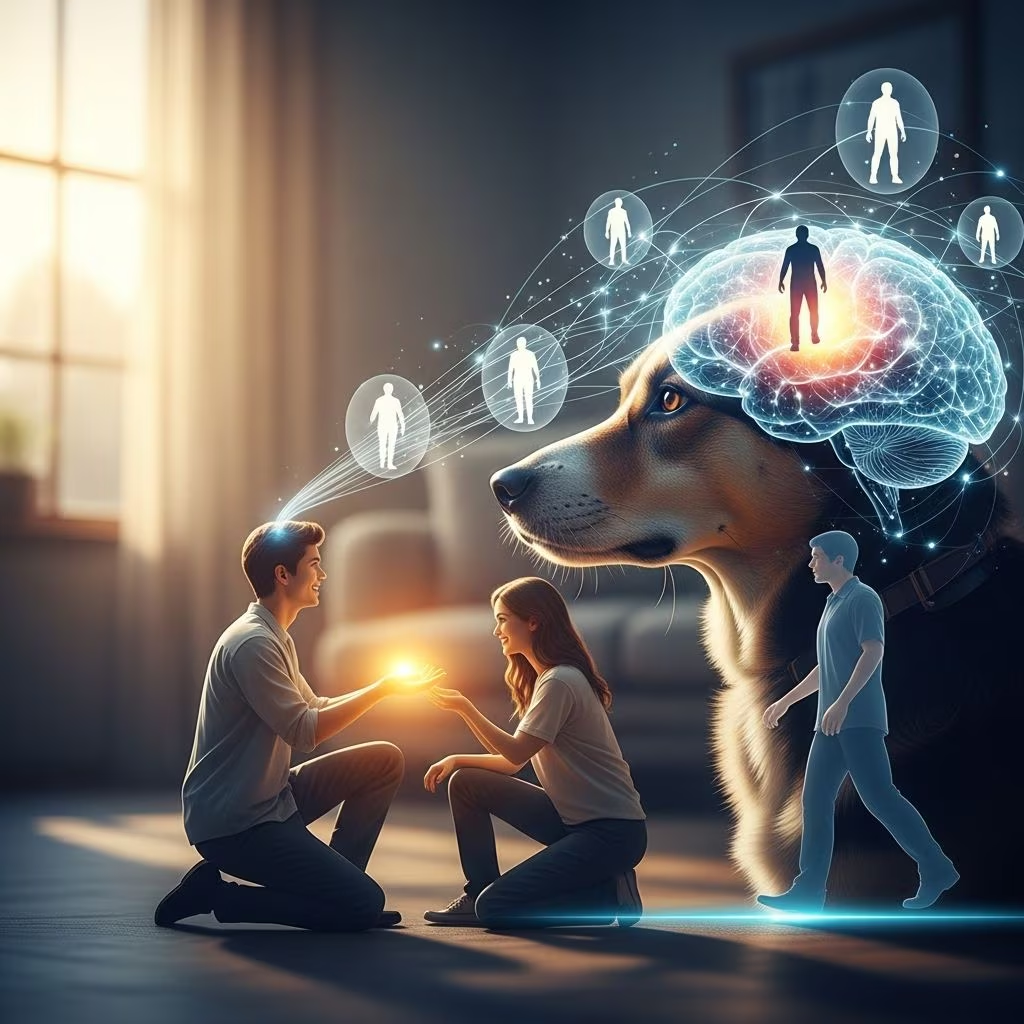
The question of whether dogs remember the people they encounter has intrigued pet owners and scientists alike for generations. Beyond simple anecdotal observations of excited reunions after long absences, emerging research demonstrates that canine memory is far more sophisticated than previously believed. Dogs don’t merely recognize familiar faces or respond to routine patterns; they possess a complex memory system that allows them to recall specific interactions, people’s mannerisms, and the emotional context of their encounters.
The Science of Canine Memory Systems
Modern neuroscience has revealed that dogs possess multiple layers of memory that work in concert to form impressions of the people in their lives. Unlike the once-popular belief that animals operate purely on instinct and conditioned responses, contemporary research demonstrates that dogs exhibit episodic-like memory, similar to human autobiographical memory. This means dogs can recall specific events and the actions people performed during those events, not just learned behavioral patterns.
In groundbreaking research conducted by scientists at the Comparative Ethology Research Group, dogs trained using the “Do as I Do” method—where they learn to imitate human actions—were able to recall what their owners did even when they had no expectation of being tested or rewarded. The dogs successfully demonstrated remembered actions in 33 of 35 trials, both one minute and one hour after observing the actions. This ability represents a fundamental shift in how scientists understand animal cognition.
The implications are significant: dogs don’t simply remember people as abstract concepts attached to rewards or punishments. Instead, they maintain detailed records of specific interactions, similar to how humans recall personal experiences rather than just generalizations about people they know.
Visual Recognition: Beyond Simple Face Detection
While humans rely heavily on visual information to recognize others, dogs’ approach to remembering people involves a more nuanced integration of sensory data. Dogs do recognize faces and facial expressions, but their visual processing works differently from ours.
The canine eye perceives the world with distinct limitations compared to human vision. Dogs see the world primarily in shades of blue and yellow, with red and green appearing muted or “muddy” to their perception. This color blindness means that visual identification alone cannot be the primary method by which dogs recognize people. Instead, their brains have evolved to compensate by developing exceptional sensitivity to other sensory cues that may be more reliable indicators of a person’s identity across varying conditions and environments.
The fact that dogs can recognize people despite these visual constraints speaks to the redundancy built into their memory systems. Even when lighting conditions change, when people wear different clothing, or when familiar individuals appear from unexpected angles, dogs can still identify them. This suggests that visual recognition serves as one component of a larger, multisensory identification system rather than the primary method.
The Dominant Role of Auditory Memory
Sound recognition plays a remarkably powerful role in how dogs encode and retrieve memories of people. Voice recognition significantly influences a dog’s ability to remember individuals, with each person’s unique vocal characteristics becoming part of the dog’s multisensory profile.
Dogs possess auditory capabilities that far exceed human abilities. Their ears can detect frequencies well beyond what humans perceive, and they can identify subtle variations in pitch, rhythm, accent, and emotional tone that characterize individual speakers. When a dog hears a familiar person speak, the neural pathways associated with that individual activate. Over time, with repeated exposure, these neural connections strengthen, making the recognition faster and more automatic.
Interestingly, dogs don’t just remember voices as sounds; they learn to recognize familiar words and phrases. The semantic content combined with the unique vocal signature creates a powerful memory anchor. This explains why dogs often respond more dramatically to their owner’s voice than to that of a stranger, even when both say identical commands or words. The combination of acoustic and linguistic information creates a redundant memory system that remains intact even when visual cues are unavailable.
Olfactory Memory: The Primary Identification System
While less obvious to human observers, scent likely represents the most fundamental and reliable method by which dogs remember people. The canine olfactory system is extraordinarily sophisticated, with dogs possessing approximately 300 million olfactory receptors compared to approximately 6 million in humans. Each person emits a unique chemical signature that remains remarkably consistent over time, making smell an ideal basis for long-term identification.
Unlike vision, which can be obscured or altered, and unlike voice, which can be disguised or absent, a person’s scent provides stable information about their identity. Dogs can detect the chemical compounds produced by human skin, breath, and microbial flora. These compounds create an individual olfactory profile that serves as a biological fingerprint. When dogs encounter someone familiar, their brains recognize this olfactory signature and retrieve associated memories and emotions.
Emotional Bonds and Memory Consolidation
Perhaps the most powerful determinant of whether a dog remembers someone is the quality of emotional experience associated with that person. Dogs form stronger memories with people who create positive emotional experiences, as these interactions trigger the release of oxytocin, a neurochemical that strengthens memory encoding.
When a person consistently treats a dog with warmth, gentleness, and affection, the dog’s brain associates that individual with safety, comfort, and well-being. This emotional context acts as a powerful memory enhancer, ensuring that the neural pathways connecting to that person remain robust and easily accessible. Conversely, negative experiences with someone can create equally strong memories, though these may be characterized by wariness or avoidance rather than enthusiasm.
The warm tone and friendly demeanor that a person displays during their first meeting with a dog can establish lasting impressions that persist through considerable time intervals. This explains why some dogs seem to remember people from years past, while other individuals the dogs encounter regularly might not create the same strong memory imprints. The emotional quality of interaction matters more than mere frequency of contact.
Dogs distinguish between people based on how those individuals treat them and the emotional responses they elicit. A person who consistently makes a dog feel anxious or uncomfortable will be remembered differently than someone who creates feelings of joy and security. Dogs learn by association and consequence, and their memory systems encode both the factual information about a person and the emotional valence of the relationship.
The Decay of Memory Over Time
While dogs possess the capacity for long-term memory of people and events, their memory for specific details does fade over extended periods when those memories haven’t been reinforced. Dogs’ episodic memory shows similar decay patterns to human memory, with recall becoming less precise as time passes.
In research testing recall after both short intervals and longer delays, dogs demonstrated progressively reduced accuracy as the time gap increased. However, the memory didn’t disappear entirely; rather, it became less detailed and less readily accessible. This mirrors the human experience, where we retain the general essence of an important event but lose specific details over years without rehearsal or reinforcement.
The implications for dog owners are important: repeated, positive interactions with people reinforce and strengthen those memory traces, making them more resistant to decay. A person who interacts with a dog consistently over time creates a robust memory that can withstand longer periods between encounters. Conversely, a single brief positive interaction, while memorable initially, may become less distinct without reinforcement.
Individual Differences in Recognition Abilities
Not all dogs exhibit identical memory capabilities for people. Factors including breed, age, previous socialization experiences, and individual temperament influence how well a dog remembers specific individuals. Some dogs demonstrate exceptional ability to recall people from years past, while others may require reacquaintance periods even after moderate separations.
Dogs with more extensive early socialization tend to develop stronger discrimination abilities among different people. Dogs that have been exposed to diverse individuals during critical developmental periods show enhanced capacity for recognizing and remembering specific people. Conversely, dogs with limited social exposure may struggle to distinguish between individuals, treating many people as relatively interchangeable category members rather than distinct individuals.
Practical Implications for Dog Owners
Understanding how dogs remember people provides valuable guidance for dog owners and those seeking to build strong relationships with canine companions:
- Consistency matters significantly—regular, positive interactions create stronger memories than occasional contact
- Emotional quality supersedes quantity—warm, caring interactions leave more lasting impressions than frequent neutral encounters
- Multimodal engagement strengthens memory—using distinctive voices, consistent touch, and positive association creates multiple memory pathways
- Time without interaction causes gradual memory degradation—dogs maintain memories better when relationships involve periodic reinforcement
- Individual differences exist—some dogs naturally excel at remembering people while others require more relationship investment
Frequently Asked Questions
Do dogs remember specific people after years apart?
Research suggests that dogs can retain memories of people across extended time intervals, though memory clarity diminishes without reinforcement. The emotional quality of the original relationship and the dog’s individual memory abilities influence whether recognition occurs after years of separation.
How long does a dog typically remember someone?
Dogs’ episodic memory for specific interactions typically remains strong for hours to days, with details fading over weeks and months without reinforcement. However, the general impression and emotional association with a person can persist for years.
Can dogs recognize people in photographs?
While dogs can process visual images, their ability to recognize specific people from photographs is limited. Their reliance on multisensory information means they require the actual presence of a person—with their voice, scent, and mannerisms—for reliable recognition.
Do all dog breeds remember people equally well?
Individual variation exists across dogs regardless of breed, though some breeds have been selectively bred for tasks requiring strong human-recognition abilities. Socialization history and individual temperament play equally important roles in memory formation.
The Multisensory Nature of Canine Memory
The most important takeaway from contemporary research is that dogs don’t rely on a single sensory channel to remember people. Instead, their brains integrate information from multiple sources—visual, auditory, olfactory, and tactile—to create rich, multidimensional memories. This redundancy makes dog memory systems remarkably resilient; even if one sensory channel is unavailable or unreliable, others can still provide recognition and recall.
This multisensory integration explains why dogs can recognize their owners across widely varying contexts: in different clothing, in different lighting, when silent, or when partially hidden. The brain has encoded a person as a complex pattern across multiple sensory domains rather than as a simple, isolated stimulus. This sophisticated memory architecture allows dogs to maintain persistent and detailed knowledge of the people important to them.
The scientific evidence demonstrates that dogs possess genuine episodic memory capabilities, challenging earlier assumptions about the nature of animal cognition. Dogs remember not just that they know someone, but what that person did, how they treated the dog, and the emotional context of their interactions. This realization enriches our understanding of our companions and highlights the depth of the relationships we share with our dogs.
References
- Your dog remembers what you did — ScienceDaily. 2016. https://www.sciencedaily.com/releases/2016/11/161123141547.htm
- Your dog remembers more than you think — Science (AAAS). https://www.science.org/content/article/your-dog-remembers-more-you-think
- Do Dogs Remember People? What Science Says — Kinship. https://www.kinship.com/dog-behavior/do-dogs-remember-people



