

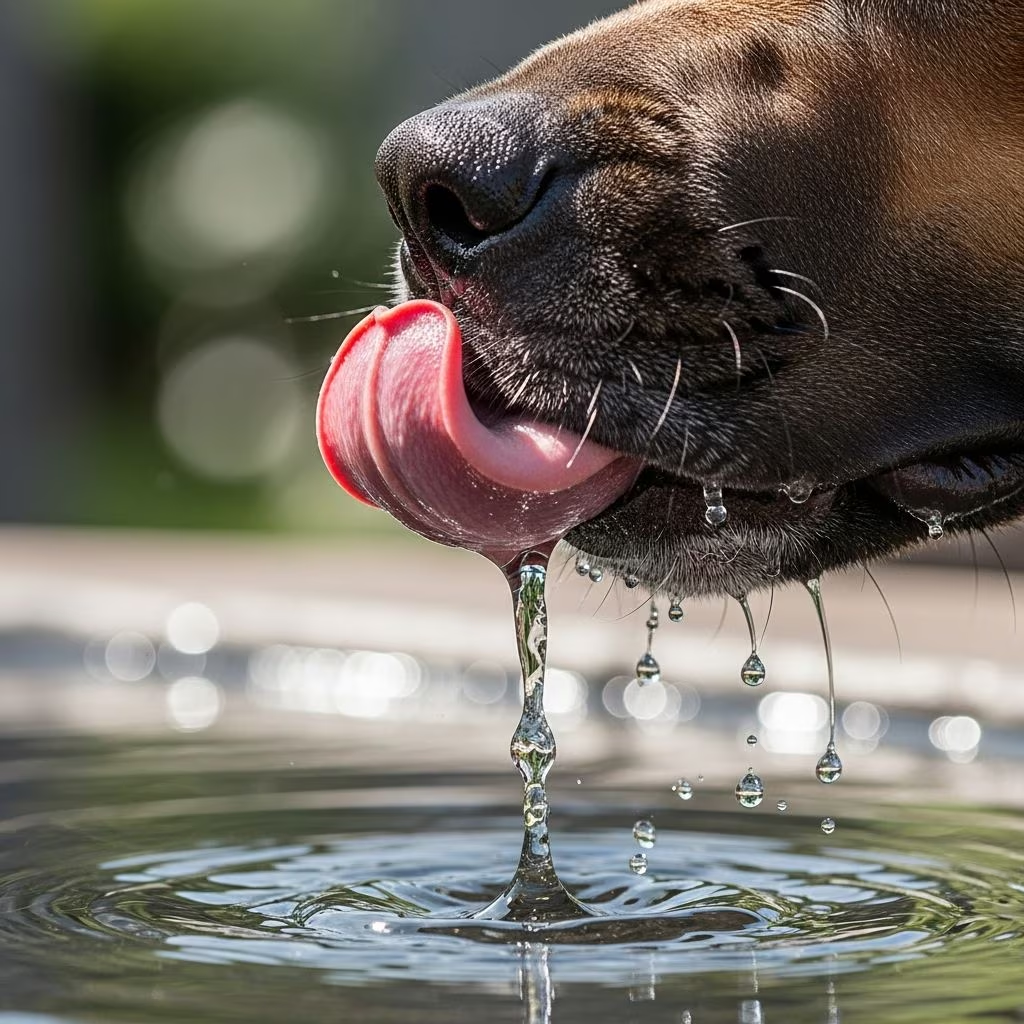
A Scientific Look at How Dogs Drink Water
If you’ve ever watched your dog drink from their water bowl, you’ve likely noticed the splashing, the mess, and the apparent sloppiness of the entire process. Water ends up on the floor, on their face, and everywhere except seemingly in their mouth. However, behind this chaotic scene lies sophisticated physics and remarkably precise biomechanics. What appears to be clumsy drinking is actually an optimized system that allows dogs to efficiently extract water from their bowls. Researchers from Virginia Tech, led by Dr. Sunghwan Jung, have spent years studying the fluid dynamics of canine drinking, revealing that dogs employ advanced physics to maximize their water intake per lap.
Understanding the Basics of Dog Drinking
Unlike humans who can create suction with their cheeks to draw water into their mouths, dogs lack the facial anatomy necessary for this method. Instead, dogs and cats must move fluid against gravity through alternative mechanisms using their tongues. This fundamental difference in anatomy drives the distinctive drinking behavior we observe in our canine companions.
The basic process appears simple: a dog plunges their snout into a water bowl, their tongue makes contact with the water, and they withdraw it back into their mouth. However, this seemingly straightforward action involves multiple stages of precise coordination and takes advantage of complex fluid dynamics principles.
The Mechanics of Dog Tongue Movement
Tongue Curling and Water Scooping
The first key to understanding dog drinking lies in how their tongues are shaped and manipulated. According to Dr. Sunghwan Jung, the lead researcher studying canine drinking mechanics, “Dogs curl their tongues backward, shaping like a ladle,” which is a crucial adaptation for their drinking strategy. This backward curl creates a concave surface that can hold water, similar to a spoon or ladle.
When dogs immerse their tongues into water, they scoop up liquid in this curved formation. However, research has revealed something surprising: most of the water that appears to be scooped up never actually makes it into the dog’s mouth. Instead, this scooped water falls back into the water bowl, contributing to the splashing and mess we observe.
Acceleration and Water Column Formation
The most critical aspect of dog drinking involves the rapid acceleration of the tongue as it exits the water. When dogs withdraw their tongues from water, they do so with extraordinary speed and force. This withdrawal creates an acceleration measured at approximately five times the force of gravity, generating what researchers call a “water column” – a column of water that rises upward in front of the tongue due to the pressure differential created by this rapid movement.
This water column formation is the key to efficient drinking. The tongue’s high acceleration suspends the water column in the air just long enough for the dog to snap their jaws shut and capture it. The faster the tongue accelerates, the larger and more stable the water column becomes, allowing more water to be extracted per lap.
The Physics Behind the Splash
Why Dogs Are Messy Drinkers
The splashing behavior that characterizes dog drinking is not a sign of clumsiness but rather a direct consequence of their drinking mechanism. When dogs accelerate their tongues upward at high speeds, water doesn’t simply rise neatly into their mouths. Instead, water is displaced in multiple directions, creating splashes both around and away from the bowl.
The backward curl of the tongue, while effective for creating larger water columns, also increases the size of the surface area that impacts the water. This larger impact area generates more disturbance in the water, leading to greater splashing. Paradoxically, this apparent messiness is actually a feature, not a bug – the larger water column created by this method enables dogs to drink more water per lap than they could with a straight-tongued approach.
Comparison with Cat Drinking
To better understand dog drinking, researchers compared it with feline drinking behavior. Despite cats and dogs having structurally similar mouths, their drinking approaches are fundamentally different. Cats employ a more delicate technique, lightly touching the water surface with their tongues and using steady inertia to draw water upward. They curl the underside of their tongues to create a tiny ladle of water that adheres to the upper surface of their tongue through surface tension.
Dogs, by contrast, use acceleration-driven open pumping, creating rapid, forceful movements that generate larger water columns. Dogs splash more and create more disturbance because they are exploiting a different set of fluid dynamics principles compared to cats. As Dr. Jung explained, “Cats employ steady inertia, whereas dogs use unsteady inertia and acceleration to draw water upward.”
The Precise Timing of Dog Drinking
Optimal Bite Timing
One of the most remarkable findings in canine drinking research is that dogs demonstrate extraordinary precision in timing their bite to capture the water column at the optimal moment. Researchers discovered that dogs bite down almost exactly at the moment the water column detaches from the water’s surface – a moment researchers call the “pinch-off” time.
This timing is not accidental or instinctive guesswork; it’s precisely calibrated to maximize water intake. The pinch-off time is when the water column becomes unstable and begins to collapse back into the bowl due to gravity. By timing their bite to coincide with this moment, dogs capture the maximum amount of water possible. Laboratory experiments using glass tubes to simulate dog tongues confirmed that when objects are retracted at dog speeds, the pinch-off time closely matches actual dogs’ bite times.
The Water Intake Formula
Research has quantified exactly how much water dogs can extract per lap through this optimized mechanism. Dogs can take in approximately 1 to 2 milliliters of water per lap, or roughly 300 milliliters (about 10 fluid ounces) in one minute of continuous lapping. This efficiency is remarkable and demonstrates that despite appearing messy and chaotic, the dog drinking mechanism is highly optimized for extracting and consuming water.
Body Size and Drinking Efficiency
Research has also revealed an interesting relationship between a dog’s body size and their drinking efficiency. Heavier dogs drink water with a larger wetted area of the tongue, indicating an allometric relationship between water contact area and body weight. This means that the volume of water a dog’s tongue can move increases exponentially relative to their body size.
Larger dogs create proportionally larger water columns and extract more water per lap than smaller dogs. This adaptation makes biological sense – bigger dogs have greater metabolic needs and require more water intake, so their anatomy and drinking mechanics have evolved to accommodate this requirement.
How Researchers Studied Dog Drinking
Research Methodology
Understanding the mechanics of dog drinking required innovative research approaches. Dr. Jung’s team employed high-speed photography to capture the rapid movements involved in dog drinking. They used specialized high-speed cameras that could record thousands of frames per second, allowing them to visualize movements that are too fast for the human eye to perceive.
Researchers placed cameras under the surface of water troughs to map the total surface area of dogs’ tongues that contacted the water during drinking. They also used X-ray imaging to observe what happens inside the mouth during the drinking process, revealing how water is captured and swallowed.
Laboratory Simulations
To validate their findings and understand the underlying physics, researchers created laboratory models using glass tubes to simulate a dog’s tongue. By dunking these rounded glass rods into water at speeds matching actual dog tongues, scientists could measure the volume of water extracted and identify the precise pinch-off time when water columns became unstable. These controlled experiments allowed researchers to isolate specific variables and understand the fundamental physics principles at work.
The Role of Tongue Grooves
Additional research has revealed another important component of the dog drinking mechanism. Dogs trap liquid in grooves on the roofs of their mouths, holding it there with the backs of their tongues even as they extend their tongues for a second drink. The tongue essentially functions as a conveyor belt, drawing water up into the mouth, trapping it against the roof, and then pushing it back further with each lap. Research has shown that it takes three or more cycles of this process before a dog swallows an allotment of liquid.
Key Facts About Dog Drinking
Several important facts have emerged from scientific research on canine drinking behavior:
- Dogs accelerate their tongues at up to 5 times the force of gravity when withdrawing from water
- Dog tongues exit water at speeds up to 4 mph (1.8 meters per second)
- Dogs extract 1-2 milliliters of water per lap, or 300 ml per minute of lapping
- Heavier dogs create larger water columns and extract proportionally more water
- Dogs bite at precisely the moment the water column detaches from the water surface
- The backward curl of a dog’s tongue increases water column size and splashing
- Dogs use their tongues as a conveyor belt system with multiple intake cycles
- The splashing associated with dog drinking is a feature of their efficient mechanism, not a sign of poor technique
Daily Water Intake Guidelines
While understanding the mechanics of how dogs drink is fascinating, it’s equally important to ensure dogs receive adequate water daily. A general guideline is that dogs should drink approximately 50 milliliters of water per kilogram of body weight daily. This means a 10-kilogram dog should drink about half a liter per day, while a 20-kilogram dog should consume approximately one liter daily. These guidelines can vary based on activity level, diet, climate, and individual health conditions.
Frequently Asked Questions (FAQs)
Q: Why do dogs splash water everywhere when they drink?
A: Dogs splash because they curl their tongues backward and accelerate them upward at extremely high speeds – roughly five times the force of gravity. This rapid acceleration creates a large water column that displaces water in multiple directions. The splashing is actually a feature of their efficient drinking mechanism, not poor technique.
Q: How much water can a dog drink in one lap?
A: Dogs can extract approximately 1 to 2 milliliters of water per lap, or roughly 300 milliliters (about 10 fluid ounces) in one minute of continuous lapping. This efficiency varies based on the dog’s size and the speed of their tongue acceleration.
Q: Is there a difference between how dogs and cats drink?
A: Yes, despite having structurally similar mouths, dogs and cats use fundamentally different drinking techniques. Dogs use acceleration-driven open pumping with rapid, forceful movements, while cats employ steady inertia with gentle, delicate movements. This is why cats appear neater drinkers while dogs are splashier.
Q: How do dogs know exactly when to bite the water column?
A: Dogs demonstrate remarkable precision in timing their bite to coincide with the pinch-off moment – when the water column detaches from the water’s surface and becomes unstable. This timing is calibrated to maximize water intake per lap, capturing the most water possible.
Q: Does a dog’s size affect how they drink?
A: Yes, larger dogs create proportionally larger water columns and extract more water per lap than smaller dogs. There is an allometric relationship between a dog’s body weight and the wetted area of their tongue that contacts water during drinking.
Q: How much water should my dog drink daily?
A: A general guideline is that dogs should drink approximately 50 milliliters of water per kilogram of body weight daily. A 10-kilogram dog should drink about half a liter per day, while a 20-kilogram dog should consume approximately one liter daily. Individual needs vary based on activity level, diet, and health conditions.
Q: What role do tongue grooves play in dog drinking?
A: Dogs have grooves on the roofs of their mouths that trap liquid. Their tongues act as a conveyor belt, trapping water against the roof of the mouth and pushing it back further with each lap. It typically takes three or more drinking cycles before a dog swallows water.
References
- Physicists Explain Why Dogs are Sloppy Drinkers — Sci.News. 2014-11-25. https://www.sci.news/physics/science-why-dogs-sloppy-drinkers-02299.html
- Engineers discover precise mechanism underlies the sloppy way dogs drink — Virginia Tech News. 2015-12-15. https://news.vt.edu/articles/2015/12/121515-engineering-dogresearch.html
- Fluid dynamics on four legs: The brilliance of how dogs drink — Los Angeles Times. 2015-12-15. https://www.latimes.com/science/sciencenow/la-sci-sn-how-dogs-drink-20151215-story.html
- Dogs lap using acceleration-driven open pumping — National Institutes of Health, National Center for Biotechnology Information. 2015. https://pmc.ncbi.nlm.nih.gov/articles/PMC4703018/
- A Scientific Look at How Dogs Drink Water — Chewy Education. https://www.chewy.com/education/dog/general/behavior-pet-facts-a-scientific-look-at-how-dogs-drink-water
- No cheeks, no problem — Harvard Gazette. 2011-06. https://news.harvard.edu/gazette/story/2011/06/no-cheeks-no-problem/
- Importance of drinking water in dogs — Fokker Petfood. https://www.fokkerpetfood.com/en/blog/importance-of-drinking-water-in-dogs.html



