

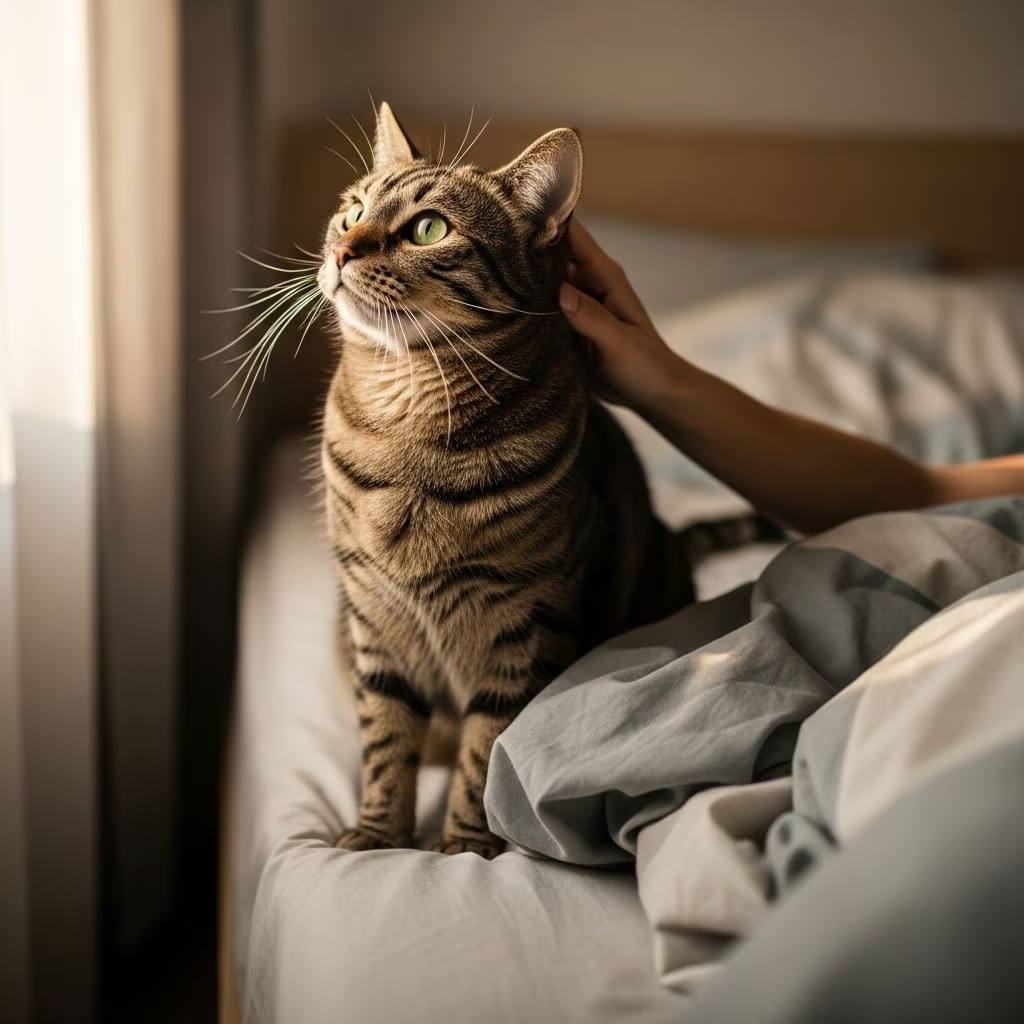
Your cat’s uncanny ability to detect the exact moment you stir from sleep often feels like mind-reading. This phenomenon stems from their evolved senses honed for survival as hunters, allowing them to pick up on subtle cues like the slightest shift in your breathing, a twitch of sheets, or even changes in your body heat. Cats are crepuscular animals, most active at dawn and dusk, which aligns with their natural tendency to rouse when you do in the early morning.
Understanding this helps explain why your feline friend leaps onto the bed or meows insistently just as your eyes flutter open. It’s not magic—it’s a combination of acute hearing, vibration sensitivity, olfactory prowess, and visual acuity in low light. This article dives deep into the mechanisms behind your cat’s sixth sense for your wakefulness, backed by insights into feline biology and behavior.
Why Do Cats Seem to Know Exactly When You Wake Up?
Cats possess sensory capabilities far superior to humans, enabling them to perceive changes in their environment that we overlook. When you wake up, your body undergoes subtle physiological shifts: heart rate increases slightly, breathing patterns change from deep and rhythmic to shallower, and muscle movements create micro-vibrations. Cats, as obligate predators, are wired to detect these signals, which in the wild would indicate prey or danger.
Their crepuscular nature plays a key role too. Unlike nocturnal animals active all night, cats nap during the day and peak in energy around twilight hours. If you’re an early riser, your schedule syncs perfectly with their dawn activity window, prompting them to ‘join’ you. Studies on feline circadian rhythms confirm this pattern, showing cats anticipate human routines based on repeated cues.
How Cats Sense That You’re Awake: The Science
Hearing: The Primary Wake-Up Trigger
A cat’s hearing is their most powerful tool for detecting wakefulness. They can hear frequencies up to 64 kHz—five times higher than humans (20 kHz max)—picking up ultrasonic sounds like the rustle of sheets or your yawn. Even the softest sigh or eyelid flutter produces air movement that their mobile outer ears, which swivel 180 degrees, capture precisely.
Veterinarians note that cats distinguish between sleeping and waking breaths; the transition from slow, steady inhales to quicker ones alerts them instantly. In one veterinary blog, experts explain how this hyper-acute hearing evolved for hunting small rodents, whose high-pitched squeaks mimic human sleep disruptions.
Vibration Detection: Feeling Your Every Move
Cats sense vibrations through their whiskers (vibrissae) and paw pads, which act as seismic detectors. When you shift position, the bed frame vibrates subtly—imperceptible to us but a clear signal to your cat, often lounging nearby. These specialized hairs transmit signals directly to the brain’s somatosensory cortex, creating a ‘touch map’ of their surroundings.
This explains why cats positioned at the foot of the bed react first; they’re tuned into the mattress’s micro-tremors from your stirring muscles. Research from animal behaviorists highlights how this sensitivity helps cats navigate in total darkness, extending to monitoring sleeping humans.
Smell: Detecting Biochemical Changes
Your cat’s nose has 200 million odor receptors (humans have 5 million), allowing them to smell shifts in your pheromones or sweat as you wake. Adrenaline from emerging wakefulness alters your scent profile slightly, which cats associate with activity time. They also detect carbon dioxide changes in your breath, a cue linked to arousal.
In multi-cat households, this olfactory radar helps differentiate between family members’ wake-ups, with bonded cats responding preferentially to their primary human. This scent-based awareness reinforces their perception of you as colony leader.
Vision in Low Light: Seeing Subtle Shifts
Cats’ eyes have a high density of rod cells for low-light vision, plus a tapetum lucidum layer that reflects light for enhanced night sight. They spot your eye opening or head lift in pre-dawn gloom, where humans see nothing. Their visual field spans 200 degrees, broader than our 180, ensuring no movement escapes.
Combined with a third eyelid (nictitating membrane) that keeps eyes moist without full closure, cats maintain semi-vigilant sleep, ready to pounce at your first twitch.
Thermoreception: Feeling Your Heat Change
Cats detect infrared heat via facial pits and whiskers. As you wake, your body temperature rises fractionally from metabolic activity, drawing them closer. This thermoreceptive ability, akin to pit vipers, helps them locate warm spots—or waking humans—for cuddles or demands.
Your Cat’s Circadian Rhythm and Sleep Patterns
Cats sleep 12-16 hours daily but in short bursts, aligning with crepuscular peaks. They nap lightly, entering REM sleep briefly, so they’re primed to notice your wake-up during their active phases around 4-6 AM. Misaligned human-cat schedules exacerbate this; indoor cats without dawn hunts default to owner-dependent activity.
- Crepuscular peaks: Dawn (4-7 AM) and dusk (5-8 PM) drive 70% of activity.
- Polyphasic sleep: 20-30 minute naps prevent deep synchronization with human nights.
- Anticipation learning: Cats predict routines, ‘waking’ you preemptively after weeks of pattern observation.
Reasons Cats Wake You Up Early (Even If You’re Not Awake Yet)
Beyond sensing true wakefulness, cats may rouse you due to:
- Hunger: Conditioned to associate your stirring with breakfast meows.
- Boredom: Insufficient daytime stimulation leads to night zoomies.
- Affection: Viewing humans as colony mates, they seek midnight cuddles.
- Medical issues: Hyperthyroidism or pain can disrupt sleep; vet check recommended.
How to Stop Your Cat from Waking You Too Early
Sync schedules with targeted strategies:
- Evening play sessions: 30-60 minutes with wand toys to mimic hunting, tiring them pre-bed.
- Scheduled feeding: Last meal before your bedtime; use puzzle feeders for mental drain.
- Ignore demands: No attention at 3 AM reinforces waiting; consistency key.
- Cozy sleep spots: Designated warm beds away from yours encourage independent rest.
- Door policy: Temporarily exclude from bedroom, gradually reintroduce.
| Problem | Solution | Expected Timeline |
|---|---|---|
| Hunger wakes | Pre-bed meal + auto-feeder | 1-2 weeks |
| Play deficit | Evening hunts | 3-7 days |
| Attention seeking | Ignore + daytime bonding | 2-4 weeks |
Frequently Asked Questions (FAQs)
Why does my cat stare at me while I sleep?
Cats monitor breathing and movements for safety cues, a remnant of wild vigilance. It’s affection too—they bond by ‘watching over’ you.
Can cats tell time?
Not precisely, but they learn routines via circadian cues and your habits, anticipating wake-ups accurately.
Is it okay to lock my cat out at night?
Temporarily yes, combined with enrichment; provide litter, water, toys. Long-term, address root causes.
What if my senior cat wakes me more?
Age-related cognitive decline or arthritis; consult vet for sundowning or pain management.
Do all cats do this?
Most crepuscular ones yes, but breeds like Siamese are vocalizers; lifestyle impacts severity.
This comprehensive look reveals your cat’s ‘superpowers’ make them expert wake-up detectors. By leveraging their biology and adjusting routines, you can enjoy restful nights together.
References
- 5 Common Reasons Cats Wake You Up at Night — Orijen Pet Foods Blog. 2023. https://blog.orijenpetfoods.com/5-common-reasons-cats-wake-you-up-at-night/
- Does Your Cat Often Wake You Up Between 2-4 AM? Here Is What … — Feline Fanatics (YouTube Transcript). 2025-03-02. https://www.youtube.com/watch?v=TSAZeU6XXFY
- How To Stop Cats Waking You Up Early — Walkerville Vet. Accessed 2026. https://www.walkervillevet.com.au/blog/stop-cat-waking-up-early/
- Stop My Cat From Waking Me Up — Liz’s Kitty Bootcamp. 2023-02-20. https://lizskittybootcamp.com/2023/02/20/stop-cat-waking/
- Cat keeping you awake? How to manage night activity — Animal Humane Society. Accessed 2026. https://www.animalhumanesociety.org/resource/cat-keeping-you-awake-how-manage-night-activity



