

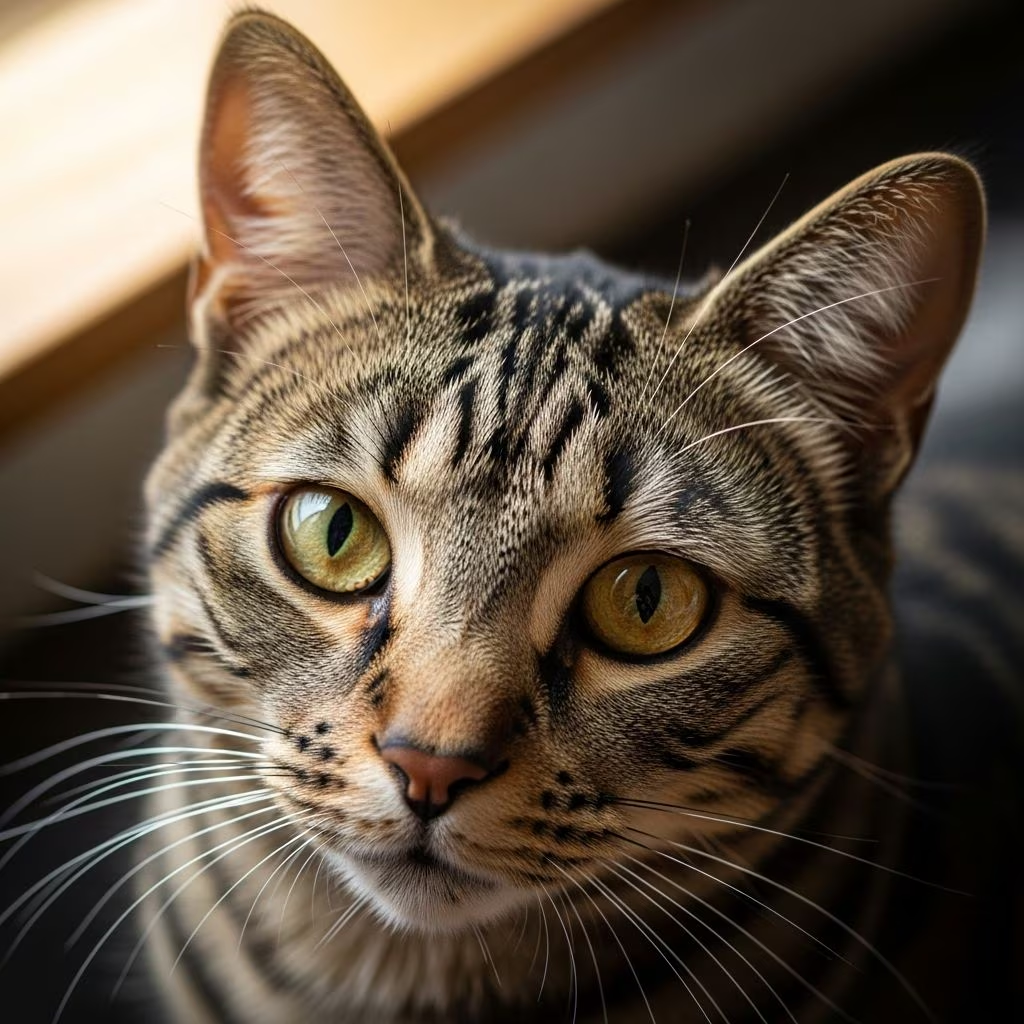
Tabby cats are among the most recognizable feline varieties, known for their bold stripes, spots, and swirls that adorn their coats. But how do these patterns form? The answer lies in a fascinating interplay of genetics, embryonic development, and evolutionary biology. Scientists have decoded key genes and molecular mechanisms that create these iconic markings, drawing from studies on domestic cats and wild felids like cheetahs.
This article delves into the science behind tabby stripes, covering pattern types, genetic culprits, the role of Turing’s reaction-diffusion theory, and how patterns emerge in the womb. Understanding this not only satisfies cat lovers’ curiosity but also sheds light on broader principles of animal patterning.
What Is a Tabby Cat?
A tabby cat isn’t a breed but a coat pattern found across many breeds and mixed cats. The term “tabby” originates from an Arabic word for a silk cloth with stripes, later applied to cats in Europe. Nearly all cats carry tabby genes, masked only in solid-colored varieties.
Tabby patterns result from the interaction of multiple genes controlling pigment distribution in hair follicles. The agouti gene (A) allows banded hairs, creating the tabby effect, while the tabby gene (Taqpep or related) dictates stripe arrangement. Without these, cats display uniform color.
Tabby cats dominate feral populations worldwide, suggesting stripes offer camouflage advantages in natural settings. Domestic selection has favored varied patterns, from wild-like stripes to ornate blotches.
Tabby Cat Coat Patterns
Tabby coats feature four main patterns, each with distinct markings:
- Mackerel Tabby: The classic “tiger” stripes—narrow, parallel lines running vertically along the body, with thinner lines on legs and tail. A dark “M” marks the forehead, and “necklaces” circle the chest. This is the most common wild-type pattern.
- Classic (Blotched) Tabby: Bold, swirling whorls and marbled patches instead of stripes. Dark areas form thick, cloudy bullseyes on the sides. Popular in show cats, this pattern arises from mutations in pattern-forming genes.
- Spotted Tabby: Round spots instead of stripes or swirls, often seen in breeds like the Egyptian Mau. Spots align in rows, mimicking wild African cats.
- Ticked Tabby: No stripes or spots; hairs are banded with color, giving a shimmering, uniform glow like Abyssinian cats. Subtle banding creates the effect.
All patterns share traits: outlining “ticked” hairs (alternating light/dark bands), pale undersides, and facial markings like the “M” and oyster-shaped eye lines.
Genetics of Tabby Stripes
The stripes form through genes regulating melanin—eumelanin (black/brown) and phaeomelanin (red/yellow)—deposition in hairs. Key players include:
- Agouti (A) Locus: Dominant A allows banded hairs essential for tabby visibility. Recessive a/a yields solid color.
- Tabby (Ta) Locus / Taqpep Gene: Controls mackerel vs. classic. Mutations in transmembrane aminopeptidase Q (Taqpep) turn stripes into blotches in domestic cats and spots into stripes in king cheetahs. Researchers sequenced feral cat genomes, pinpointing Taqpep via association mapping.
- Dkk4 Gene: Encodes an inhibitor protein that diffuses to create pale stripe areas by suppressing Wnt signaling, which promotes pigment. Active in thickened embryonic skin ridges, Dkk4 patterns form before hair follicles. Mutations cause tiny, indistinct spots in breeds like Abyssinian.
- Tabby Gene (Original): Early-identified gene; mutations cause blotches. Works in the same pathway as Dkk4.
These genes interact: Taqpep influences early pattern setup, Dkk4 refines stripes via diffusion, and agouti adds texture. Multiple independent mutations across felids highlight evolutionary flexibility.
How Tabby Patterns Develop in Embryos
Stripes emerge surprisingly early, before birth. In tabby fetuses, patterns appear as soon as melanocytes (pigment cells) produce color in hair follicles—often by late gestation.
Key stages:
- Prepattern Formation (Epidermal Ridges): Around the equivalent of 7 weeks in human pregnancy, cat embryo epidermis thickens into stripe-shaped ridges. Single-cell RNA analysis of feral cat fetuses revealed cells predestined for dark/light hairs before melanocytes arrive.
- Molecular Activation: Wnt signaling activates pigment in ridges; Dkk4 diffuses faster into inter-ridge areas, inhibiting it and creating pale stripes. This matches Alan Turing’s 1952 reaction-diffusion model: activators and inhibitors diffuse at different rates to form patterns.
- Hair Follicle Lock-In: Stem cells in follicles inherit “pattern element identity”—dark or light—via hormone signals like Endothelin3 (Edn3). This template persists lifelong; shed hairs regrow matching color. Cheetahs are born with adult spot counts, just scaled up.
This “establishment” phase precedes follicle maturation, guiding melanocyte placement. Patterns are fixed; cats don’t “fade” stripes with age.
Turing’s Reaction-Diffusion and Cat Stripes
Alan Turing’s mathematical model proposed patterns from chemical morphogens: slow activators promote pigment, fast inhibitors suppress it nearby, yielding stripes/spots.
In cats, Wnt (activator) and Dkk4 (inhibitor) embody this. Dkk4 halts Wnt in pale zones, forming stripes before follicles. Prior mouse studies showed Wnt-Dkk4 patterns follicles, but cats reveal color pre-patterning. This mechanism likely applies to cheetahs, tigers, and other mammals.
Validation came from single-cell genomics on cat fetuses from trap-neuter programs, confirming molecular tango.
Tabby Patterns in Wild Cats
Domestic tabby genes echo wild felids. Taqpep mutations cause king cheetah blotches; Dkk4 affects spot size. Mackerel resembles tiger stripes, spotted mimics servals.
Evolution favored camouflage: stripes blend into grass, spots into dappled light. Domestic blotched patterns may result from relaxed selection. Hybrids between domestic and wild cats could reveal more.
Health and Breeding Implications
Tabby genes are generally benign, but some patterns link to Tailless Manx or health traits indirectly. Blotched Taqpep mutations occurred multiply, possibly tying to immune functions. Breeders select for patterns, but ethical focus is health.
Understanding genes aids conservation, like tracking cheetah variants.
Frequently Asked Questions (FAQs)
What causes a tabby cat’s stripes?
Stripes arise from genes like Taqpep and Dkk4, which pattern pigment via Turing’s reaction-diffusion in embryos.
Can a solid-colored cat have tabby kittens?
Yes, if carrying recessive tabby genes, paired with an agouti mate.
Do tabby patterns change with age?
No, patterns lock in embryonically and persist lifelong.
Why do some tabbies have spots instead of stripes?
Spotted is a tabby variant; genes modify stripes into spots.
Are tabby cats healthier?
No direct link, but diverse genetics in mixed tabbies promote vigor.
Conclusion
Tabby stripes blend ancient evolution, precise genetics, and elegant developmental biology. From Turing’s vision realized in Dkk4-Wnt dances to Taqpep’s pattern switches, science unveils nature’s artistry. Next time you pet a tabby, marvel at the molecular symphony beneath those stripes.
References
- How cats get their stripes — Science | AAAS. 2021-11-16. https://www.science.org/content/article/how-cats-get-their-stripes
- How the Tabby Got Its Stripes — DNA Science – PLOS. 2021-09-23. https://dnascience.plos.org/2021/09/23/how-the-tabby-got-its-stripes/
- How the tabby cat got its stripes — EveryCat Health Foundation. N/A. https://everycat.org/cat-health/how-the-tabby-cat-got-its-stripes/
- Spots, Stripes, Blotches: Cat Fur Color Patterns Tied to a Gene — Stanford Medicine. 2021-09. https://med.stanford.edu/news/all-news/2021/09/cat-fur-color-patterns.html
- Feline Find: How the Tabby Cat Got Its Stripes — Live Science. 2012. https://www.livescience.com/23348-how-the-tabby-cat-got-its-stripes.html
- HudsonAlpha Researchers Discover Cat Fur Color Pattern Mechanism — HudsonAlpha Institute. N/A. https://www.hudsonalpha.org/hudsonalpha-researchers-discover-mechanism-of-cat-fur-color-pattern-establishment/
- The Ultimate Guide to Tabby Cats — WoPet. N/A. https://wopet.com/cats/tabby-cats/



