

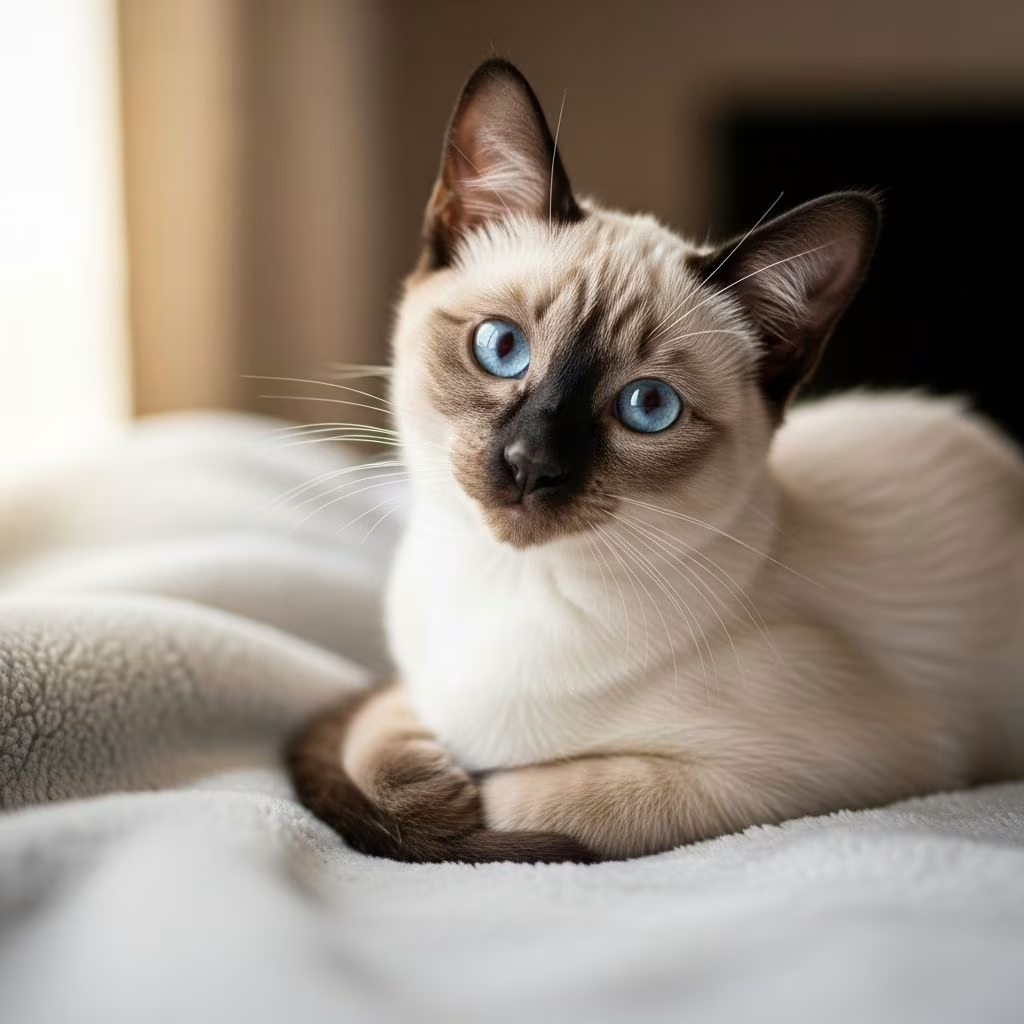
Siamese kittens are born with a cream or white coat that gradually develops the signature dark points on their ears, face, paws, and tail as they grow. This unique coloration results from a temperature-sensitive genetic mutation in the tyrosinase (TYR) gene, causing melanin production only in cooler body areas.
The Genetics Behind Siamese Coloration
The striking pointed pattern of Siamese cats stems from acromelanism, a condition where pigmentation is restricted to cooler extremities due to a recessive mutation in the TYR gene (c.940G>A for Siamese). This enzyme is crucial for melanin synthesis, but in Siamese cats, it functions inefficiently at normal body temperature (around 38.5°C), producing little pigment on the warm trunk while activating in cooler areas like paws and ears (below 36°C).
Genetically, the colorpoint restriction is autosomal recessive. The wild-type allele (C) produces full color, while the Siamese allele (c^s) restricts it to points. Kittens must inherit two c^s alleles (c^s/c^s) to express the phenotype; carriers (C/c^s) appear full-colored but pass the gene. Siamese cats are genetically black, chocolate, or other base colors, but the mutation creates partial albinism, masking body color while revealing it at points.
Why Are Siamese Kittens Born Cream-Colored?
Siamese kittens emerge from the womb nearly white or cream because the uterus maintains a uniform warm temperature (about 38-39°C), inhibiting tyrosinase activity everywhere. No melanin develops in utero, resulting in a light coat at birth regardless of adult point color.
As kittens leave the warm environment and nurse, their extremities cool slightly, allowing pigment to form. Points begin darkening within weeks: ears and nose first, then paws and tail. Full coloration matures by 1-2 years, influenced by environment—cooler climates yield darker points.
- Birth (0-2 weeks): Cream/white body, minimal points.
- 4-8 weeks: Nose leather and paw pads darken; faint ear/tail shading.
- 3-6 months: Clear points emerge; body remains light.
- 1+ years: Mature points; color may intensify with age or cold exposure.
The Himalayan or Colorpoint Pattern Explained
The Siamese pattern, also called Himalayan or colorpoint, is a form of partial albinism shared with breeds like Himalayans, Persians, and even some rabbits or mice. It overrides base coat genes: a seal point is black-based (genetically), chocolate point is brown-based, blue point is dilute black, etc.
Temperature gradient dictates pigment: trunk (warmest) stays pale; face, ears, paws, tail (coolest) darken most. Stress, fever, or bandaging can lighten points temporarily by raising local temperature.
| Point Color | Base Genetics | Description |
|---|---|---|
| Seal Point | Black (non-dilute) | Dark brown-black points on ivory body. |
| Chocolate Point | Brown | Milk-chocolate points. |
| Blue Point | Dilute black (gray) | Steely blue-gray points. |
| Lilac Point | Dilute brown (lavender) | Pale frosty pinkish-gray points. |
| Flame/Red Point | Red/orange | Bright red points (rarer in traditional Siamese). |
Siamese Gene Inheritance and Breeding
The Siamese color gene (c^s) is part of the C locus series: C (full color, dominant), c^b (Burmese, intermediate), c^s (Siamese, recessive). Two Siamese parents (c^s/c^s) produce only Siamese kittens. Oriental/Siamese crosses can yield both, depending on carrier status.
Key breeding outcomes:
- Two non-carrier Orientals: 100% Oriental kittens.
- One carrier Oriental x one carrier: 75% Oriental (25% carriers), 25% Siamese.
- Carrier Oriental x Siamese: 50% Oriental (all carriers), 50% Siamese.
- Two Siamese: 100% Siamese.
Genetic testing via labs like UC Davis confirms carrier status, preventing unexpected litters.
Eye Color in Siamese Cats
Siamese cats’ blue eyes result from the same mutation reducing iris melanin, scattering light to appear blue (like human albinos). Shades vary from ice-blue to deep sapphire based on underlying copper/green pigments inactivated by albinism. Non-pointed cats with the gene don’t show blue eyes.
Environmental Factors Affecting Color Development
Color intensity depends on temperature: Siamese in cold areas develop darker points than those in tropics. Shaving reveals underlying color; regrowth darkens if kept cool. Heat packs or illness can fade points temporarily.
Common Myths About Siamese Colors
Myth: Siamese kittens change color completely. Reality: They develop latent points; base genetics are fixed.
Myth: All pointed kittens are Siamese breed. Reality: The mutation occurs in domestic cats; true Siamese requires pedigree.
Myth: Color darkens indefinitely. Reality: Stabilizes by adulthood, though cold exposure can deepen it slightly.
Frequently Asked Questions (FAQs)
What age do Siamese kittens get their points?
Points start appearing at 4-6 weeks, fully developing by 1-2 years.
Why is my Siamese kitten still light-colored at 3 months?
Development varies; cooler extremities trigger slower pigment. Patience—full color takes time.
Can Siamese cats have non-pointed kittens?
No, pure Siamese (c^s/c^s) only produce pointed offspring. Crosses may vary.
Do Siamese points get darker with age?
Yes, often intensifying into adulthood, especially with cooler climates.
Is the Siamese color pattern unhealthy?
The mutation is benign; associated issues (e.g., in Persians) relate to breed, not color gene.
Can environment change a Siamese cat’s color?
Yes, sustained cold darkens points; heat fades them.
Conclusion
The mesmerizing color development of Siamese kittens showcases evolutionary genetics at work, blending temperature sensitivity with recessive inheritance for one of nature’s most elegant patterns. Understanding this empowers better breeding and appreciation of these vocal, affectionate companions.
References
- We are Siamese if you Please — Geophysical Institute, University of Alaska. 2023-05-15. https://www.gi.alaska.edu/alaska-science-forum/we-are-siamese-if-you-please
- Genotypic and Phenotypic Analysis of Coloration in Oriental and Siamese Cats — Cat Aristocrat. 2022-10-01. https://cataristocrat.com/genotypic-and-phenotypic-analysis-of-coloration-in-oriental-and-siamese-cats/
- Tyrosinase mutations associated with Siamese and Burmese cat coat colours — PubMed (J Hered). 2005-03-01. https://pubmed.ncbi.nlm.nih.gov/15771720/
- Siamese Genetics: Why That Cute Pointed Kitten May Not Be One — Vibes from a Veterinary Nurse. 2018-05-03. https://vibesfromaveterinarynurse.com/2018/05/03/siamese-genetics/
- Colorpoint Restriction — Veterinary Genetics Laboratory, UC Davis. 2024-01-10. https://vgl.ucdavis.edu/test/colorpoint-restriction
- The Delightful Mutation Behind Siamese Cats — SciShow (YouTube). 2020-06-12. https://www.youtube.com/watch?v=uHC1XTF6b58



