

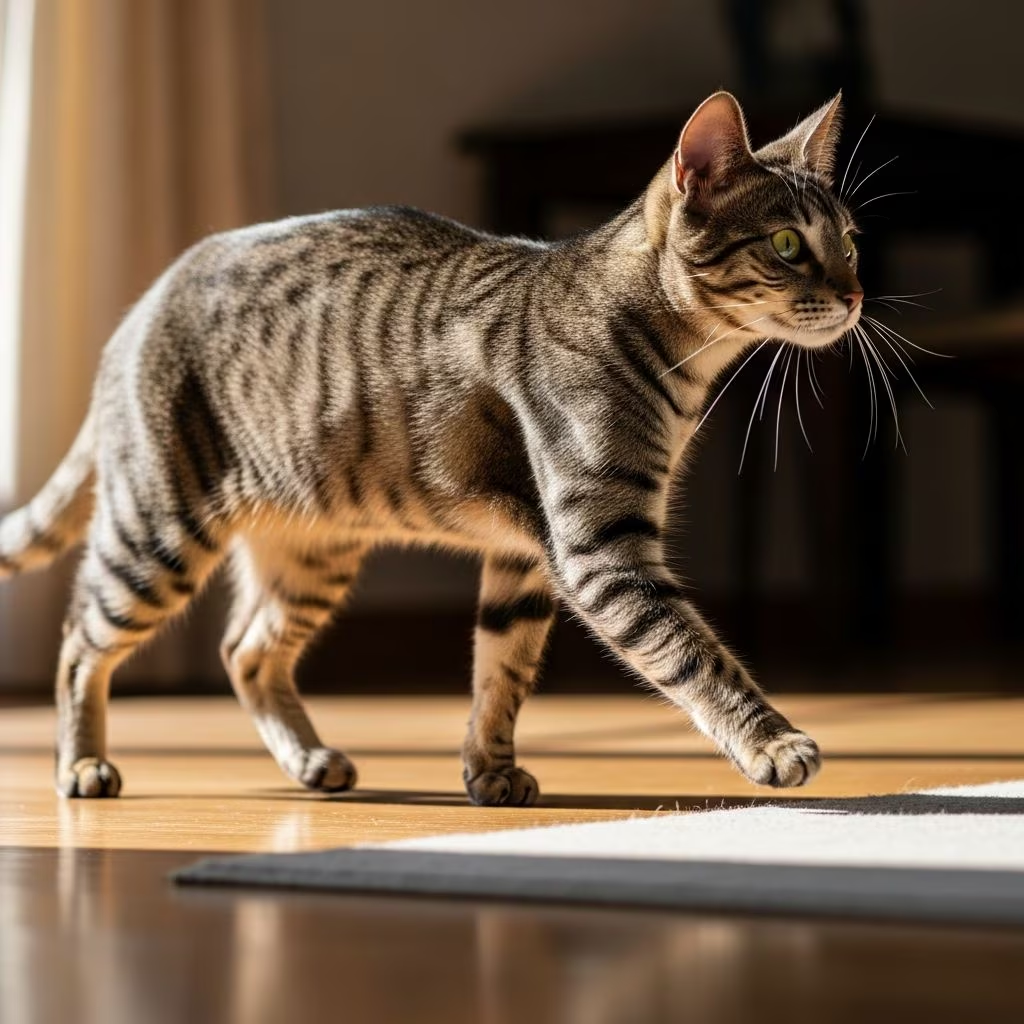
Cats are renowned for their graceful, silent movement, a product of evolutionary adaptations for hunting and survival. Understanding how cats walk reveals the biomechanics behind their stealthy prowl, agile leaps, and tree-climbing feats. This article delves into feline gaits, anatomical features enabling precise locomotion, variations in movement patterns, and how gait changes can signal health concerns. From the slow stalking walk to explosive gallops, cats exhibit remarkable versatility in motion.
Understanding Cat Gaits: The Basics of Feline Locomotion
A gait refers to the pattern of limb movements during locomotion. Cats primarily use a four-beat gait in walking, where each paw hits the ground at distinct intervals, ensuring stability with at least two feet always in contact. This contrasts with faster gaits involving suspension phases where all feet are airborne. Feline gaits are symmetrical, distributing weight evenly between front and hind limbs, which is key to their balance and efficiency.
Observing a cat’s gait provides insights into its physical health. Normal cat walking is fluid and purposeful, with paws placed deliberately to minimize noise—a trait from their predatory ancestry. Deviations like limping or hesitation often indicate pain masked by cats’ stoic nature.
The Anatomy Behind How Cats Walk
Cat locomotion relies on specialized anatomy. Their spine is highly flexible, with extra vertebrae allowing significant extension and flexion during strides, effectively lengthening steps by inches. This suppleness is crucial for speed and agility.
Paws and legs feature retractable claws for grip without sound, shock-absorbing pads for silent steps, and elastic tendons storing energy like springs. Forelimbs are structured for landing impacts during jumps, bearing four to five times more force than in walking. The muscular hindquarters provide propulsion, especially in leaps.
Key anatomical features include:
- Flexible vertebral column: Enables stride extension and turning mid-air.
- Retractable claws: Provide traction for climbing and running without wear.
- Digital pads: Cushion impacts and muffle sounds.
- Long, elastic Achilles tendon: Stores and releases energy for efficient movement.
- Scapula (shoulder blade): Loosely attached for wide range of motion in forelimbs.
This design makes cats masters of stealth and acrobatics.
Different Ways Cats Walk: Exploring Feline Gaits
Cats employ several gaits, each suited to speed, terrain, or intent. Here’s a breakdown:
The Classic Walk: A Four-Beat Masterpiece
The standard walk is a four-beat gait: left hind, left fore, right hind, right fore—or vice versa. In slow walks like stalking, three or four feet contact the ground simultaneously for stability. No suspension phase occurs, keeping the cat grounded and quiet. Video analysis shows one foot off at a time in precise sequence.
Ambling and Pacing: Lateral Sequence Variations
Ambling, also called slow pace or running walk, maintains a four-beat pattern but groups limbs on the same side nearly simultaneously, creating a rolling motion. Pacing is a two-beat gait where ipsilateral (same-side) legs move together: right fore and hind, then left. This faster variant aids quick directional changes but is less stable than trotting.
Trotting: Diagonal Coordination
Though less common in cats than dogs, trotting involves diagonal pairs (left fore/right hind, then right fore/left hind) hitting together. It’s a two-beat gait used for steady speeds, maintaining balance on uneven surfaces.
Cantering: The Rhythmic Three-Beat Gait
Canter features a lead foot—typically opposite fore and hind for overreaching. At least one paw is always grounded, transitioning to suspension with speed. The spine flexes post-push-off, propelling forward.
Galloping: Full-Speed Pursuit
Gallop is cats’ top gear, with two suspension phases: after hind push and forelimb contact. Hind legs propel powerfully, forelimbs land sequentially (second forward as lead). Up to 80% of stride is airborne at peak speed, spine extension adding stride length. This gait showcases their explosive athleticism.
| Gait Type | Beat Pattern | Ground Contacts | Typical Use |
|---|---|---|---|
| Walk | 4-beat | 2-4 feet | Stalking, slow movement |
| Amble/Pace | 4/2-beat | 2-3 feet | Moderate speed, turns |
| Trot | 2-beat (diagonal) | 2 feet | Steady travel |
| Canter | 3-beat | 1-3 feet + suspension | Moderate acceleration |
| Gallop | 4-beat + suspension | Brief fore/hind | Chasing, escaping |
How Cats Climb: Vertical Locomotion Experts
Climbing uses the walk’s four-beat rhythm but accelerates to gallop-like patterns when hurried. Claws dig in for ascent; descent involves gripping bark hind-first. Forelimbs pull up, hind push. Clawless cats adapt but slower. Siamese breeds excel at heights.
Jumping and Leaping: Explosive Power
Jumps mimic half-bound gallop: hind propulsion launches, forelimbs land one-by-one, second as lead. Limb force multiplies 4-5x walking levels. Righting reflex via inner ear and eyes ensures mid-air corrections.
Gaze and Stride Coordination in Walking Cats
Cats synchronize eye movements with strides for navigation. On flat surfaces, gaze shifts forward during forelimb swings, fixations stabilize views. Complex terrains (ladders, stones) tighten coordination, with closer focus and ‘gaze stepping’: shift-fixate cycles. Even in dark, patterns persist, shifting later at higher speeds.
Why Is My Cat Walking Weird? Gait Changes and Health
Gait anomalies signal issues. Causes include:
- Pain/Injury: Limping, short strides from arthritis, sprains.
- Neurological: Ataxia, pacing from vestibular disease.
- Anxiety: Pacing, restlessness from stress.
- Age/Mobility: Slower, careful steps in seniors.
- Obesity: Waddling, reduced jumps.
Careful walking pairs with lethargy, appetite loss. Vet checks via gait analysis detect early musculoskeletal/neurologic problems.
Frequently Asked Questions (FAQs)
What is a cat’s normal walking gait?
A four-beat pattern with paws hitting sequentially, always 2+ feet grounded.
Why do cats walk so quietly?
Soft pads and retractable claws minimize noise.
Can you tell if a cat is in pain by how it walks?
Yes, limping or uneven strides indicate issues like arthritis.
How does a cat’s spine help in walking?
Flexion/extension lengthens strides, boosts speed.
Why is my cat pacing instead of walking normally?
Often anxiety or routine changes; check for health issues.
Do all cats climb the same way?
Most use four-beat rhythm; breeds like Siamese are naturals.
Mastering cat gaits enhances bonding and early health detection. Watch your feline’s steps closely.
References
- Feline Locomotive Behavior — Veterian Key. 2016-10-25. https://veteriankey.com/feline-locomotive-behavior/
- Gaze coordination with strides during walking in the cat — PMC (NCBI). 2022-06-22. https://pmc.ncbi.nlm.nih.gov/articles/PMC9260858/
- Cat from walk to pacing — YouTube (Care Animal Clinic Brookfield). 2011-03-22. https://www.youtube.com/watch?v=wQsmsr0oR6c
- What Your Cat’s Gait Reveals About Their Health and Happiness — Animal Wellness Magazine. 2023. https://animalwellnessmagazine.com/cats-gait/



