

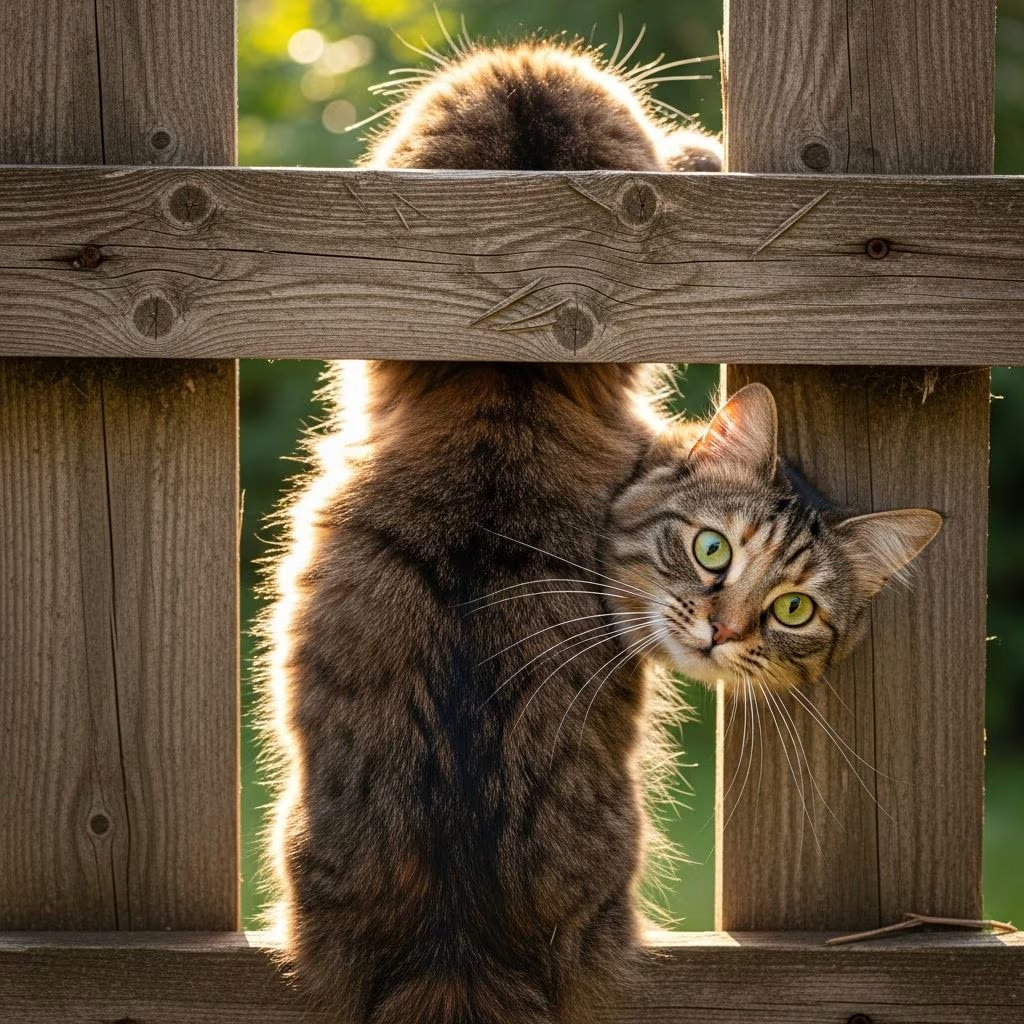
Cats possess remarkable flexibility that allows them to squeeze into incredibly small spaces, such as boxes, sinks, or tight gaps, due to their unique skeletal structure, elastic spinal discs, free-floating collarbones, and sensory whiskers.
Why Do Cats Squeeze Into Small Spaces?
Cats are instinctively drawn to small, enclosed spaces because these spots provide a profound sense of security and safety, mimicking the protective dens they would seek in the wild to hide from predators or rest undisturbed.
This behavior stems from their evolutionary history as both predators and prey. In the wild, a cat squeezing into a narrow crevice could evade larger threats while lying in wait for smaller prey like mice. Domesticated cats retain this trait, often choosing tight spaces like under beds, inside cabinets, or even Amazon boxes to reduce stress and feel enclosed on all sides.
Additionally, small spaces offer privacy, temperature regulation, and comfort. The pressure from surrounding surfaces creates a soothing, swaddled sensation that helps cats relax and sleep deeply. Veterinarians note that this is normal behavior unless accompanied by signs of illness, such as lethargy or refusal to eat.
- Security: Enclosed areas make cats feel hidden and protected.
- Stress Relief: Compression reduces anxiety in overwhelming environments.
- Hunting Instinct: Prepares them for ambushing prey in tight spots.
- Comfort: Provides warmth and a cozy napping spot.
How Do Cats Squeeze Into Small Spaces?
The secret to a cat’s ability to contort into tiny spaces lies in their specialized anatomy, which prioritizes flexibility, agility, and compressibility over rigid structure. Unlike humans or dogs, cats have evolved a loose skeletal framework that allows extreme bending and squeezing.
A Cat’s Highly Flexible Spine
A cat’s spine is the cornerstone of their flexibility, featuring approximately 53 vertebrae—nearly double the 33 found in humans—allowing for a rotation of up to 180 degrees.
Between these vertebrae are intervertebral discs with extra elastic, spongy cushioning that absorbs shock and enables extreme extension during strides or contortions. This hyper-elastic spine permits cats to arch dramatically, curl into balls, twist mid-air, and elongate their bodies to slip through narrow openings.
The lumbar vertebrae in the lower back provide additional bendiness, while caudal vertebrae form the tail, which acts as a counterbalance for stability during squeezes or jumps. This spinal design not only aids in fitting into spaces but also enhances predatory prowess and righting reflex for landing on feet.
Free-Floating Collarbones and Shoulder Blades
Cats’ collarbones (clavicles) are tiny, free-floating structures connected only by muscles, not rigidly attached to the sternum or scapula like in humans.
Similarly, their shoulder blades (scapulae) are muscle-attached and highly mobile, allowing the front half of the body to compress and pivot independently. A cat can push its head and shoulders through a gap narrower than its chest, then wriggle the rest through, as the shoulders flatten and slide.
This adaptation maximizes stride length for bursts up to 30 mph and enables flattening into crouching or squeezing postures.
Soft, Elastic Ribcage and Musculature
A cat’s ribcage is narrower and more compressible, with flexible muscles that contract to reduce the body’s effective width. Their soft abdomen lacks the rigidity of other animals, allowing further deflation during squeezes.
Coordinated muscle groups work in tandem with the skeleton for fluid movements, making cats appear “liquid-like” in their ability to flow through obstacles.
Whiskers as Space Sensors
Whiskers (vibrissae) are thick, specialized hairs embedded deep in follicles packed with nerve endings, functioning as tactile sensors to map spaces.
Twice as thick as regular fur and three times deeper-rooted, whiskers detect air currents, edges, and distances, helping cats gauge if a space is navigable before committing. They prevent cats from entering too-tight spots that could trap them.
Other Adaptations: Tail and Paws
The tail, with its flexible caudal vertebrae, provides balance and acts as a rudder during maneuvers. Paws with retractable claws grip surfaces for leverage when squeezing through irregular gaps.
Is It Safe for Cats to Squeeze Into Small Spaces?
Generally, yes—cats are expert self-assessors thanks to their whiskers and body awareness, rarely getting stuck unless overweight, injured, or the space is hazardous.
A 2024 study in iScience confirmed cats slow down and adjust for short or narrow holes, relying on internal body size mapping. However, monitor for risks:
- Trapped or Stuck: If a cat cries or struggles, gently assist without force.
- Toxins/Objects: Avoid areas with chemicals, sharp items, or small ingestible parts.
- Overweight Cats: Obesity limits flexibility; encourage diet and play.
- Stress Signals: Prolonged hiding may indicate health issues—consult a vet.
Provide safe alternatives like cat tunnels, boxes, or caves to satisfy instincts without danger.
Fun Facts About Cats Squeezing Into Small Spaces
- Cats can fit through any opening larger than their head, as the rest compresses accordingly.
- The “liquid cat” meme stems from a 2014 study joking about feline fluid dynamics.
- Wild cats use crevices for hunting; domestics box into boxes for the same thrill.
- Shoulder mobility lets cats turn heads 180° while grooming or scanning.
- Whiskers can detect gaps as small as millimeters.
Frequently Asked Questions (FAQs)
Can all cats fit into the same small spaces?
No, size, age, and health affect ability. Kittens are most flexible; seniors or obese cats less so.
Why do cats slow down in very short spaces?
They assess height using body awareness, unlike width which shoulders handle.
Do cats ever get stuck squeezing into spaces?
Rarely, due to whiskers; but check overweight or multi-cat homes.
Is it bad if my cat hides in small spaces a lot?
Normal for comfort, but excess may signal stress or illness—vet check advised.
How does a cat’s spine help them land on their feet?
Extra vertebrae and rotation allow mid-air twists for paws-down landing.
References
- Feline Flexibility — NC DNA Day Blog. 2020-09-03. https://ncdnadayblog.org/2020/09/03/feline-flexibility/
- Are Cats Liquid? Explaining Feline Flexibility — Noble Vet Clinic. N/A. https://noblevetclinic.com/blog/are-cats-liquid
- How do cats squeeze through small spaces? — Live Science. 2024. https://www.livescience.com/how-cats-squeeze-through-small-spaces
- Why Cats Are So Flexible? Ask Our Cat Veterinarian — Catonsville Cat Clinic. N/A. https://www.catonsvillecatclinic.com/holmes-corner/why-cats-are-so-flexible-ask-cat-veterinarian/



