

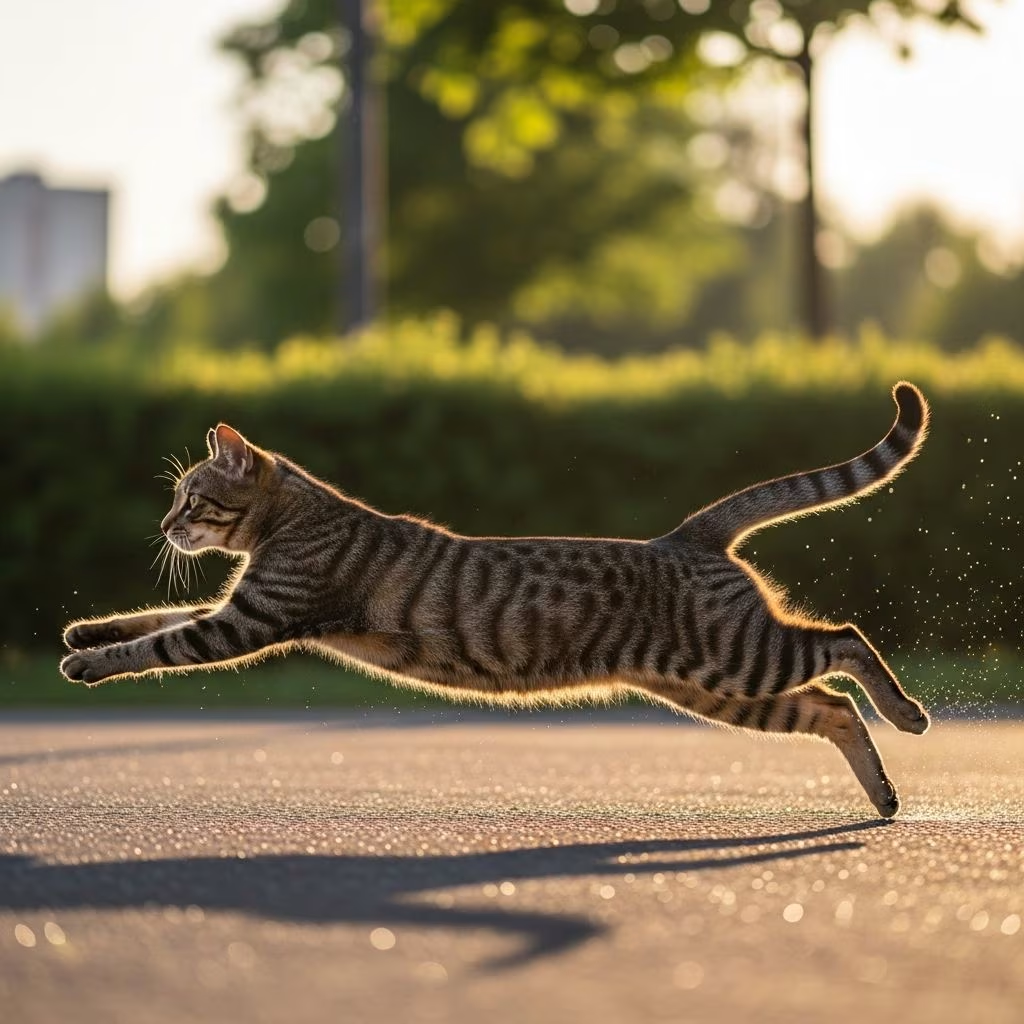
Cats are renowned for their graceful, efficient, and explosive movements. Whether stalking prey stealthily or sprinting at top speeds, their running mechanics showcase evolutionary adaptations for hunting and survival. This article dives into the biomechanics of how cats run, covering walking gaits, sprinting capabilities, jumping prowess, landing techniques, and factors influencing their speed.
Understanding Cat Gaits: Walking vs. Running
Cats employ distinct gaits for different situations. Walking involves a deliberate, energy-conscious pattern, while running unleashes bursts of power. In walking, cats often use a “stealthy” style with flexed limbs and a low center of mass to minimize noise and visibility. This crouched posture correlates with greater diagonality in footfalls, reducing mechanical energy recovery to about 17.6% on average, far lower than distance-running mammals.
Running shifts to symmetrical gaits like galloping, where hindlimbs drive propulsion. Cats’ flexible spine acts as a spring, storing and releasing energy for acceleration. Unlike humans, cats benefit from four legs, low drag due to their sleek build, and low inertia from lightweight frames, enabling rapid starts.
- Key differences: Walking prioritizes silence; running maximizes speed and agility.
- Cats naturally vary diagonality in walks, linking posture to energy efficiency.
- Forelimbs bear more weight, aiding stability in both gaits.
The Stealthy Walk: Mechanics and Tradeoffs
The stealthy walk defines feline predation. Cats keep their center of mass low, with highly flexed limbs that increase diagonality—fore and hind paws on opposite sides moving nearly together. This reduces vertical oscillations but disrupts the pendulum-like energy exchange where kinetic energy converts to potential energy and back.
Studies show cats achieve only 37.9% maximum energy recovery, versus higher in specialists like dogs, due to poor phase alignment between potential and kinetic energy fluctuations. Crouched postures demand more muscle work, trading efficiency for silence. Collisional losses may decrease slightly at certain diagonalities (around 25%), offering minor compensation.
This gait suits ambush hunting, where economy yields to stealth. Data from force plates and video confirm flexed limbs shorten effective leg length, minimizing ground clearance.
How Fast Can Cats Run? Sprinting Mechanics
Domestic cats reach speeds up to 30 mph (48 km/h) in short bursts, outaccelerating humans thanks to biomechanics. Powerful hindlegs provide explosive force, while the spine flexes to extend stride length. Air drag is low due to their horizontal posture; crouching doesn’t compromise breathing as it does in bipeds.
Inertia favors lighter cats, requiring less muscle force to initiate motion. Four legs distribute weight, enhancing stability at high speeds. Unlike endurance runners, cats excel in acceleration, covering ground in powerful bounds.
| Gait Type | Speed Range | Key Features |
|---|---|---|
| Walk (Stealthy) | 0.5-5 mph | Flexed limbs, high diagonality, low energy recovery |
| Trot | 5-15 mph | Diagonal pairs, moderate efficiency |
| Gallop/Sprint | 15-30 mph | Spine flexion, hindlimb drive, burst power |
The Cat Jump: Propulsion and Technique
Jumping showcases cats’ hindlimb dominance. They crouch deeply, coiling muscles like springs before exploding upward. Forelimbs stabilize, but hindlimbs generate primary force. Peak vertical forces (PVF) and vertical impulses (VI) are higher in forelimbs during some jumps, indicating their role in absorption.
Paw pads, rich in fat and elastic fibers, cushion impacts and provide grip. Cats measure jumps precisely, adjusting for distance. From heights, they propel with symmetric hindleg extension, achieving impressive vertical leaps up to six times body length horizontally.
- Hindlimb power: Acts as primary engine.
- Forelimb role: Higher force capacity for control.
- Paw adaptation: Five toes front, four rear for balance.
Landing Like a Cat: Shock Absorption and Righting
Cats’ righting reflex allows mid-air twists to land feet-first. Inner ear sensors (semicircular canals and otoliths) detect orientation changes. They rotate head first, then tuck/extend legs to manipulate moment of inertia—like a figure skater.
Front legs absorb initial impact with flexion, acting as buffers via muscle-tendon units. Hindlegs follow, distributing forces. Contact area (CA) is smaller in forepaws, but pads compress symmetrically left-right. From low heights (30-50 cm), muscle control dominates; higher falls engage neural reflexes.
Slow-motion analysis reveals sequenced leg extension: front paws under body to halt twist, then all legs brace. This minimizes injury, even from great heights.
Factors Affecting Cat Speed and Agility
Breed, age, health, and fitness influence performance. Abyssinians sprint faster; Persians prioritize stealth. Kittens develop gaits gradually, adults peak in prime years.
Training enhances explosiveness, but instincts drive natural prowess. Terrain matters: soft ground reduces speed but cushions landings.
- Breed variations: Sleek breeds faster; stocky ones stronger jumpers.
- Health factors: Obesity slows acceleration.
- Environmental: Slippery surfaces alter gait diagonality.
Why Cats’ Running Style Evolved This Way
Feline locomotion balances ambush hunting with evasion. Stealthy walks conserve surprise; sprints ensure kills or escapes. Low energy recovery suits short bursts over marathons. Righting reflex and limb buffering evolved for arboreal life and falls.
Compared to dogs, cats flex more, prioritizing agility over endurance. This highlights locomotor tradeoffs under evolutionary pressures.
Frequently Asked Questions (FAQs)
What is the fastest speed a cat can run?
Cats can sprint up to 30 mph in bursts, driven by hindleg power and spine flexion.
Why do cats walk so stealthily?
Flexed limbs and diagonal footfalls keep them silent, trading energy efficiency for predation advantage.
How do cats always land on their feet?
Using inner ear sensors, they twist mid-air by adjusting leg and tail positions to control rotation.
Do all cats run the same way?
No, breeds vary; wild cats like cheetahs adapt for sustained speed, domestics for bursts.
Can cats outrun humans?
Yes, in acceleration and short sprints due to biomechanics, low drag, and four legs.
Conclusion
Cats’ running mechanics blend stealth, speed, and resilience, rooted in biomechanics refined by evolution. From crouched walks to aerial twists, every motion optimizes survival.
References
- Whole Body Mechanics of Stealthy Walking in Cats — Blickhan R, et al. 2008-09-24. https://pmc.ncbi.nlm.nih.gov/articles/PMC2583958/
- How Fast Can A Cat Run? The Science Of Human Vs. Cat Speed — Stem Monsters. 2023 (accessed 2026). https://stemonsters.com/can-you-catch-a-cat/
- Kinetic analysis of felines landing from different heights — Wang X, et al. 2019-11-27. https://pmc.ncbi.nlm.nih.gov/articles/PMC6857581/
- How do cats land on their feet? — Live Science. 2023-10-29. https://www.livescience.com/animals/cats/how-do-cats-land-on-their-feet
- Slow Motion Flipping Cat Physics | Smarter Every Day 58 — Destin Sandlin. 2013-04-22. https://www.youtube.com/watch?v=RtWbpyjJqrU



