

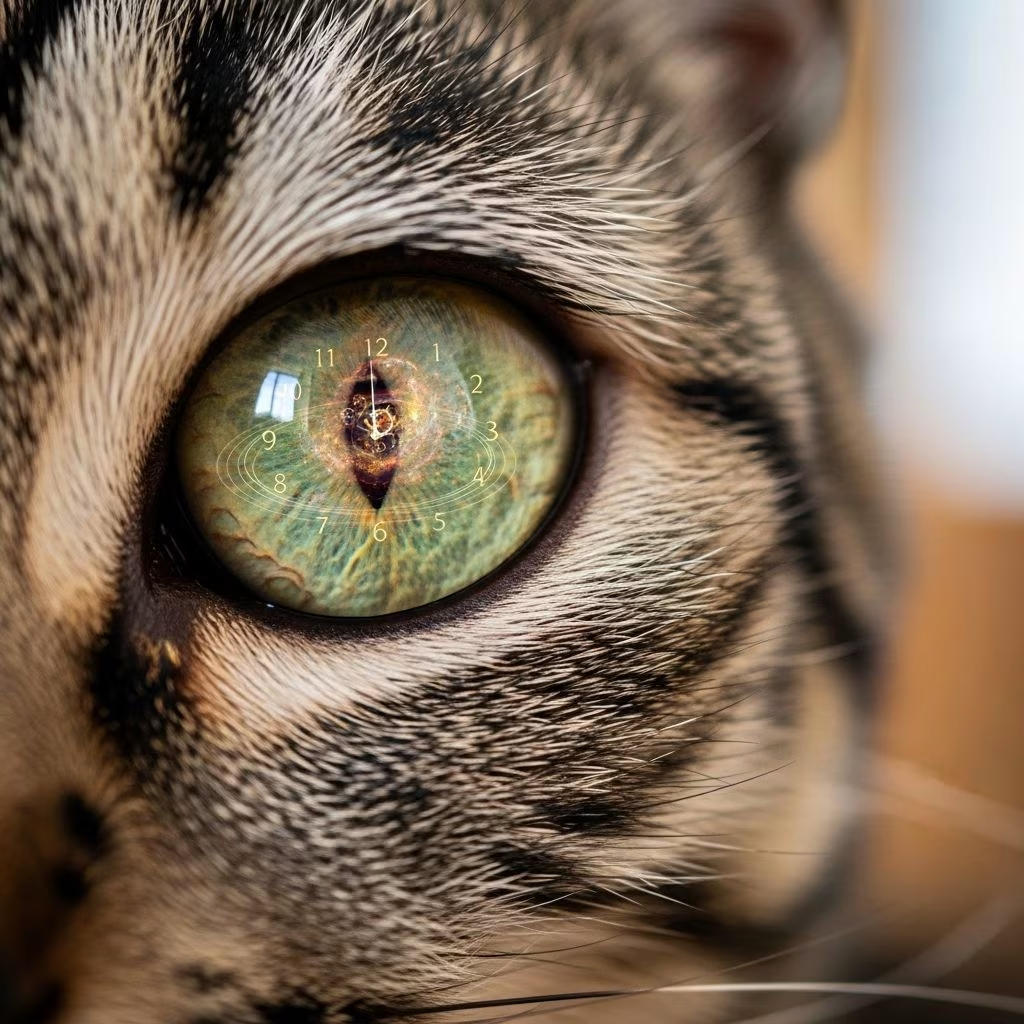
Cats perceive time differently from humans, relying on a combination of circadian rhythms, sensory cues like sunlight and darkness, owner routines, and internal biological clocks rather than abstract clocks or calendars. This perception allows them to anticipate feeding times with remarkable accuracy and adapt to daily cycles, as supported by veterinary research and behavioral studies.
Do Cats Perceive Time?
Yes, cats perceive the passing of time, though not in the linear, clock-based manner humans do. Research indicates that felines use multiple senses to track time intervals, including visual changes in light, environmental shifts, and their innate circadian rhythm—a 24-hour internal cycle that regulates sleep, activity, and feeding.
The cat brain employs mechanisms similar to the human prefrontal cortex for timing perception, enabling them to distinguish short intervals accurately. For instance, experiments have trained cats to differentiate between 5-second and 8- or 10-second durations with high precision, demonstrating a concrete sense of temporal passage.
Cat owners often observe this in practice: pets wake them at exact mealtimes daily, sometimes to the minute, highlighting how cats integrate memory and routine into their time awareness. This isn’t mere coincidence; it’s tied to associative learning where repeated events anchor expectations.
Can Cats Sense That Time Is Passing?
Cats can indeed sense time passing, evidenced by their ability to learn and anticipate scheduled events. In controlled experiments, cats accurately identified brief time spans, such as 5 seconds, and distinguished them from slightly longer ones, underscoring a reliable internal timing mechanism.
- Cats associate owner routines—like dinnertime—with specific intervals, prompting behaviors such as meowing or pawing at precise moments.
- Their circadian rhythm reinforces this, signaling shifts from day to night, influencing activity peaks around dusk or dawn.
- Studies on shelter cats confirm circadian locomotor patterns peaking at lights-on, independent of light intensity, showing robust time-sensing even in novel environments.
These abilities suggest cats possess episodic-like memory, allowing recall of ‘what’ and ‘where’ events after delays, comparable to dogs. Japanese researchers at Kyoto University found cats remembered food container locations after 15 minutes, indicating cognitive depth in temporal processing.
Does Time Move Faster, Slower, or the Same as Humans for Cats?
Science has not definitively determined if time feels faster, slower, or the same for cats compared to humans. Cats exhibit faster reaction times than humans, but this does not directly translate to altered time perception speed.
Key factors influencing feline time sense include:
- Circadian Rhythm: An internal clock ticking continuously, prompting wake-sleep cycles, often crepuscular (dawn/dusk active). Indoor cats adapt to human schedules, shifting from natural nocturnal patterns.
- Metabolic Rate: Smaller animals like cats may process visual flickers faster than humans, potentially perceiving motion in ‘slow motion’—a trait seen in flies or dogs.
- Memory Integration: Cats draw on past experiences to gauge durations, though without philosophical reflection.
Shelter studies reveal cats maintain ~22-23 hour circadian periods, adapting quickly to new light schedules, which influences stress and activity but not core time speed perception. Unlike humans, cats prioritize survival cues over precise chronometry.
| Aspect | Cats | Humans |
|---|---|---|
| Primary Time Cue | Circadian rhythm, light, routine | Clocks, calendars |
| Reaction Time | Faster | Slower |
| Circadian Period | ~22-24 hours, adaptable | 24 hours |
| Interval Discrimination | Accurate to seconds in training | Precise with tools |
This table summarizes perceptual differences, drawn from behavioral and neuroscientific data.
Can Cats Sense When the Time Zone Changes?
Cats can sense time zone changes through disruptions to their circadian rhythm, akin to human jet lag. Sudden shifts in light-dark cycles or feeding times confuse their internal clock, leading to temporary behavioral changes like increased vocalization or altered sleep.
- Adaptation occurs over days to weeks, as cats re-entrain to new environmental cues.
- Shelter cats showed reduced stress markers (e.g., cortisol, hiding) by day 3-5, with activity peaking at consistent lights-on times despite varied conditions.
- Light quality modulates this: dim, blue-depleted light lowered cortisol faster than standard lighting.
Proximity to humans and feeding schedules strongly entrain cats, overriding innate patterns. Thus, travel with cats requires gradual adjustment to minimize distress.
How Does a Cat’s Circadian Rhythm Work?
A cat’s circadian rhythm is a biological oscillator regulating ~24-hour cycles of activity, rest, hormone release, and metabolism. Controlled by the suprachiasmatic nucleus (SCN) in the hypothalamus, it’s synchronized by zeitgebers like light exposure.
Domestic cats show variable patterns: polyphasic (multiple activity bouts), crepuscular, or fully circadian, heavily influenced by environment. In shelters, all tested cats displayed rhythms of 21.5-24.83 hours, peaking at lights-on, suggesting entrainment to human activity over food timing.
- Light Influence: Dim light increased hiding but not rhythm disruption; blue-depleted light eased stress.
- Adaptation: Cats re-entrain rapidly, with shorter periods during adjustment.
- Health Implications: Disruptions elevate cortisol; optimal lighting supports welfare.
This rhythm helps cats anticipate meals, play, and sleep, optimizing energy use.
Cat Memory and Time Perception
Cats integrate memory into time perception, recalling event timings and locations. A Kyoto University study showed cats remembered food sources after 15-minute delays, rivaling dog episodic memory and challenging views of feline inferiority.
They encode ‘what-where-when’ details, aiding routine prediction. Combined with circadian cues, this creates a robust temporal framework.
Frequently Asked Questions (FAQs)
Q: Do cats have an internal clock?
A: Yes, cats possess a circadian rhythm acting as an internal clock, regulating daily cycles and helping them sense time passage through biological cues.
Q: Can cats tell time like humans?
A: No, cats don’t use abstract timekeeping but sense intervals via senses, memory, and rhythms, accurately anticipating routines.
Q: Why do cats know feeding time exactly?
A: Through circadian entrainment and associative memory, cats link routines to internal timing, waking owners precisely.
Q: Do cats experience jet lag?
A: Yes, time zone shifts disrupt their circadian rhythm, causing temporary disorientation, but they adapt within days to weeks.
Q: Does time feel slower to cats?
A: Possibly, due to faster visual processing; smaller animals perceive flickers quicker, making events seem slower.
Final Thoughts
Cats perceive time through a sophisticated blend of circadian biology, sensory input, and memory, enabling precise routine anticipation despite lacking human-like clocks. Understanding this enhances bonding and care—maintain consistent schedules, optimize lighting, and respect their temporal world for happier felines.
References
- How Do Cats Perceive Time? Vet-Reviewed Science & Info — Catster. 2023. https://www.catster.com/lifestyle/how-do-cats-perceive-time/
- Cats Are Just as Smart as Dogs, Study Suggests — Time Magazine. 2017-06-15. https://time.com/4650638/cats-dogs-memory/
- Light quality and time in shelter modulate behavior and cortisol in shelter cats — PMC (NCBI). 2024. https://pmc.ncbi.nlm.nih.gov/articles/PMC12182317/
- Animals can experience time very differently to humans. Here’s why — BBC Science Focus Magazine. 2023. https://www.sciencefocus.com/science/animal-time-perception



