

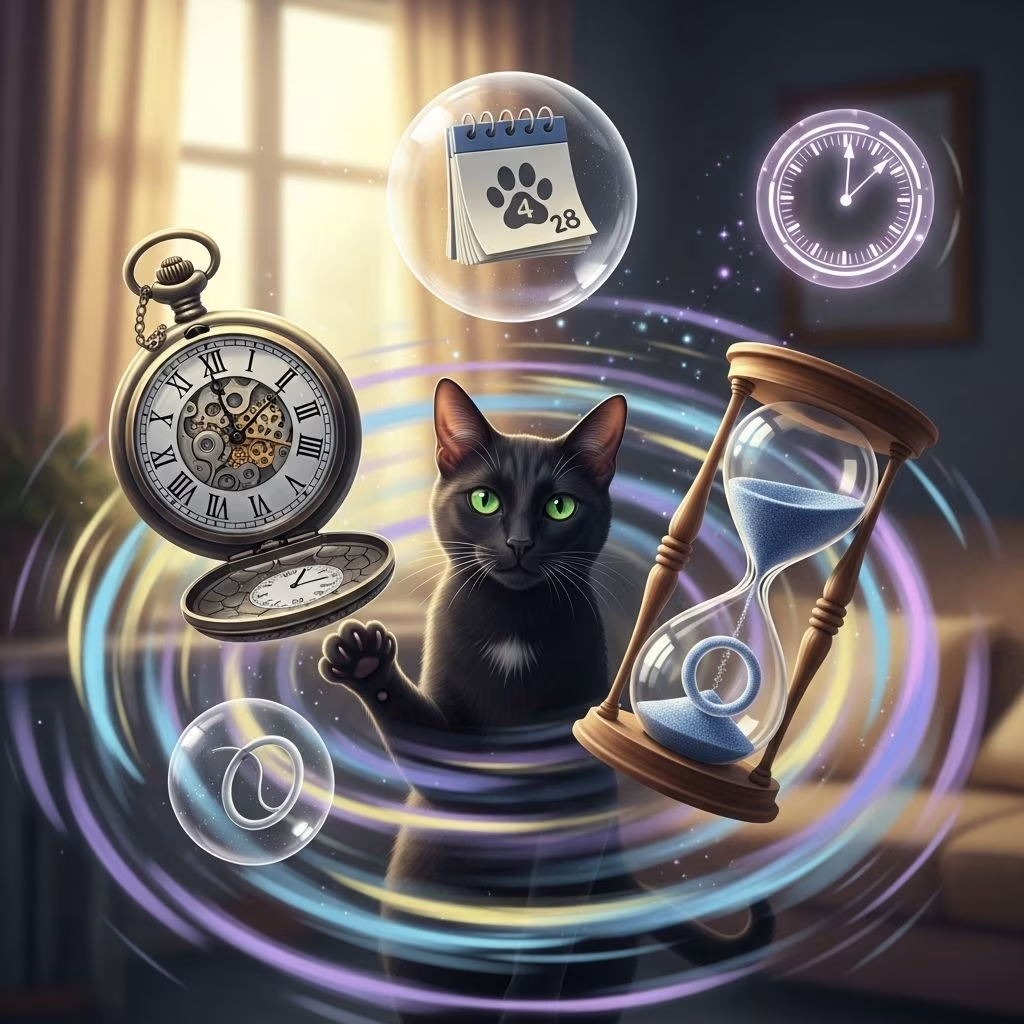
Cats perceive time differently from humans, relying on sensory cues, routines, internal biological clocks, and environmental changes like light cycles rather than abstract clocks. They possess a circadian rhythm that helps them anticipate daily events, such as mealtimes, with remarkable accuracy. Research demonstrates that felines can distinguish short time intervals and adjust to disruptions like time zone changes, showcasing a sophisticated temporal awareness tailored to their predatory lifestyle.
Do Cats Perceive Time?
Scientific evidence confirms that cats do perceive the passage of time, though their method diverges from human cognition. Unlike humans who use clocks and calendars, cats integrate visual signals, owner routines, internal physiological sensors, and environmental factors such as sunlight patterns and darkness. This multi-sensory approach allows them to track daily cycles effectively.
Central to this ability is the cat’s **circadian rhythm**, a roughly 24-hour internal clock regulated by the suprachiasmatic nucleus in the brain. This rhythm influences sleep-wake cycles, activity levels, and feeding behaviors, much like in humans. Studies show cats can be trained to differentiate brief intervals, such as 5 seconds from 8 or 10 seconds, indicating a precise temporal processing capability.
Behavioral observations support this: many cat owners report their pets waking them at exact times for food, accurate to the minute. This precision stems from learned associations with daily routines, reinforced by the circadian rhythm. The prefrontal cortex in cats, analogous to humans, plays a role in processing these temporal cues, enabling memory-based anticipation of events.
Can Cats Sense That Time Is Passing?
Yes, cats demonstrably sense time passing through experimental and observational evidence. In controlled studies, cats accurately distinguished 5-second intervals from longer ones, highlighting their ability to measure short durations. This skill extends to longer scales via circadian mechanisms, allowing them to predict recurring events like feeding times.
- Cats associate owner routines with specific times, meowing persistently when schedules deviate.
- They exhibit heightened activity at dusk (crepuscular nature), aligning with natural light shifts.
- Internal ‘clocks’ prompt consistent wake-sleep patterns, adjustable but rooted in biology.
Episodic memory further aids this perception. Japanese research tested 49 domestic cats’ ability to remember which container held food after a 15-minute delay, even if emptied. Cats retrieved ‘what’ and ‘where’ information from past events, performing comparably to dogs and suggesting self-awareness linked to temporal memory. This counters stereotypes of cats as less intelligent, affirming their cognitive parity in time-related tasks.
Does Time Move Faster, Slower, or the Same as Humans for Cats?
No definitive research concludes whether time subjectively passes faster, slower, or equivalently for cats compared to humans. Cats exhibit faster reaction times, processing visual stimuli more rapidly—up to 55 Hz flicker fusion rate versus humans’ 60 Hz—potentially making their world appear in ‘slow motion’. However, this perceptual speed does not directly equate to overall time passage experience.
The circadian rhythm provides a biological timer, ticking independently to regulate 24-hour cycles. Indoor cats adapt these cycles to household schedules, waking earlier or later as needed, similar to human shift workers. Brain aging studies reveal parallels with humans: cat brains atrophy gradually, with pet cats showing changes akin to human octogenarians, suggesting overlapping developmental timelines when age-adjusted.
| Aspect | Cats | Humans |
|---|---|---|
| Reaction Time | Faster (higher flicker fusion) | Slower baseline |
| Circadian Rhythm | ~24 hours, crepuscular peaks | ~24 hours, diurnal |
| Brain Atrophy Onset | 5-10 years (10% volume loss) | After 50 years |
| Memory for Events | 15-min episodic recall | Comparable in tests |
Pet cats mature slower than colony cats and live longer equivalents, making them ideal aging models. Normalized brain volume declines steadily, with sex differences emerging later—males show faster interthalamic adhesion changes. Dopamine influences may modulate perception, as in mice where stimulation speeds time sense, relevant to feline impulsivity.
Can Cats Sense When the Time Zone Changes?
Cats sense time zone changes through circadian disruption, akin to human jet lag. Sudden shifts confuse their internal clock, causing irregular sleep, increased vocalization, or altered feeding demands for days to weeks. Adaptation occurs gradually as they realign to new light-dark cycles and routines.
- Short-term effects: Disorientation, lethargy, or hyperactivity.
- Adaptation period: 3-14 days, faster in young or flexible cats.
- Helping tips: Maintain feeding/lighting schedules, use pheromone diffusers for stress.
Research on diverse cat populations (pet, colony, wild) shows environmental factors influence rhythm plasticity. Pet cats, exposed to varied stimuli, adapt better than lab-housed ones. This resilience underscores their evolutionary attunement to changing conditions.
Final Thoughts
Cats perceive time via an intricate blend of biology, senses, and memory, enabling survival in dynamic environments. Their circadian rhythm, interval discrimination, and episodic recall reveal cognitive depth beyond mere instinct. While subjective speed remains elusive, faster reactions and brain similarities to humans highlight unique temporal worlds. Understanding this fosters better care—consistent routines honor their internal clocks, enhancing welfare. As research advances, cats emerge as vital models for human aging and cognition studies.
Frequently Asked Questions (FAQs)
Do cats have an internal clock?
Yes, cats have a circadian rhythm acting as an internal clock, regulating 24-hour cycles of sleep, activity, and feeding based on light and routines.
Can cats tell time like humans?
Cats don’t use abstract timekeeping but sense passage through senses, memory, and biology, distinguishing intervals and anticipating events accurately.
Why do cats wake me up at the same time every day?
This reflects their circadian rhythm and learned routine association, prompting precise mealtime anticipation.
Do cats experience jet lag?
Yes, time zone changes disrupt their circadian rhythm, causing jet lag symptoms that resolve over days to weeks.
Is a cat’s sense of time faster than a human’s?
Not definitively proven, but faster reactions suggest slower perceptual motion; circadian cycles align similarly.
References
- How Do Cats Perceive Time? Vet-Reviewed Science & Info — Catster. 2023. https://www.catster.com/lifestyle/how-do-cats-perceive-time/
- Translating Time shows pet cats live to be natural models for human aging — PMC (NIH). 2025. https://pmc.ncbi.nlm.nih.gov/articles/PMC12324510/
- Cats Are Just as Smart as Dogs, Study Suggests — Time Magazine. 2017-05-22. https://time.com/4650638/cats-dogs-memory/
- Animals can experience time very differently to humans. Here’s why — BBC Science Focus. 2023. https://www.sciencefocus.com/science/animal-time-perception



