

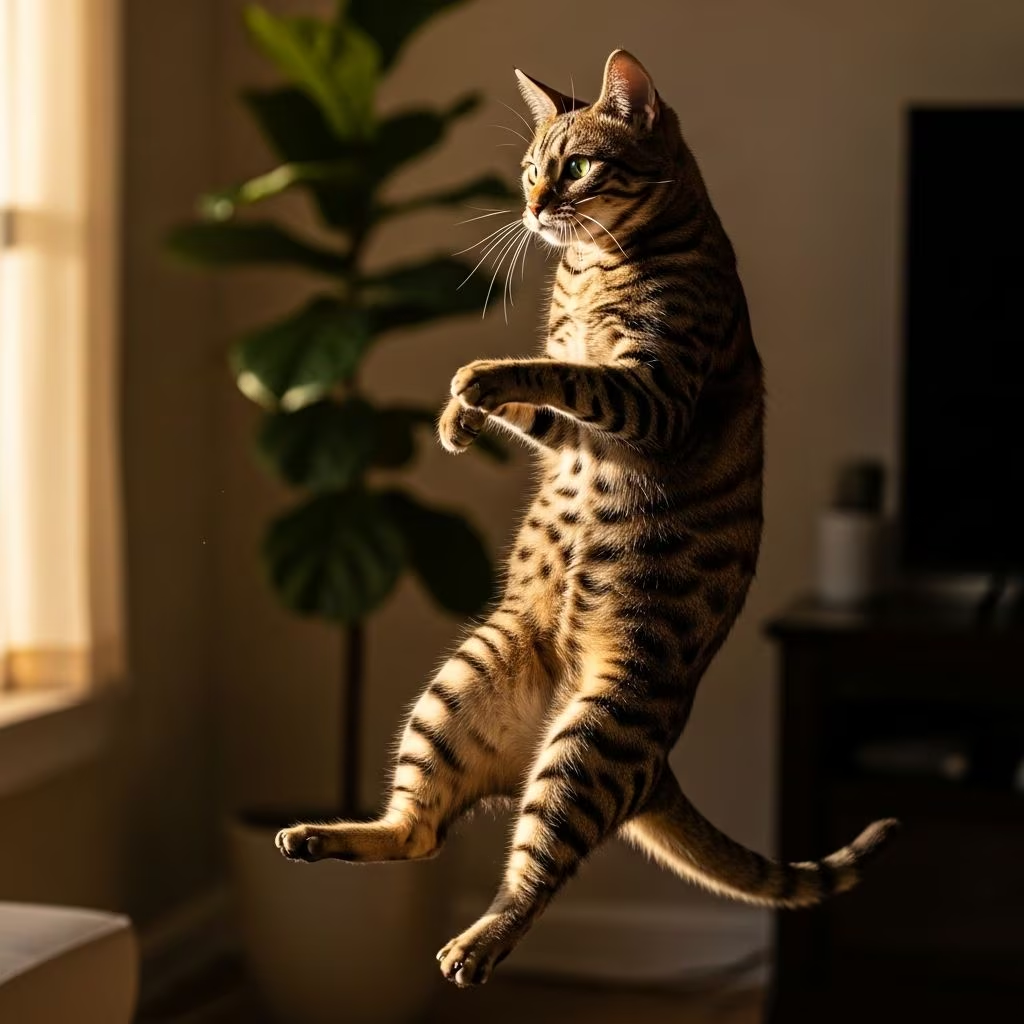
Cats possess remarkable jumping abilities, capable of leaping up to **six times their body height**, often reaching heights of about six feet for domestic cats. This feat combines powerful musculature, a flexible skeleton, and precise biomechanics, allowing them to scale counters, fences, and trees with ease.
How High Can Cats Jump?
Domestic cats can typically jump between **4 to 6 feet vertically**, equivalent to five to six times their shoulder height. For a standard cat measuring 9-10 inches at the shoulder, this means clearing obstacles over 5 feet tall effortlessly. Factors like age, health, breed, and training influence this; younger, athletic cats like Abyssinians or Bengals often exceed average heights, while seniors may jump lower.
Horizontal jumps can span **up to 25 feet** in a single bound, showcasing their explosive power. These abilities stem from evolutionary adaptations for hunting, escaping predators, and navigating vertical terrain in the wild.
Cat Anatomy for Jumping
Cats’ skeletons and muscles are optimized for agility. They have **over 500 muscles**—nearly twice as many as humans—concentrating power in the hindlimbs. Key anatomical features include:
- Flexible Spine: With 30 vertebrae (more articulated than humans’ 33), cats’ spines act like springs, compressing and extending for propulsion and shock absorption.
- Long Hindlimbs: Proportionally longer rear legs provide leverage; the femur and tibia form a powerful piston-like system.
- Elastic Tendons: Achilles tendons store and release energy like rubber bands during takeoff.
- Clawed Paws: Retractable claws grip surfaces for stability during launch and landing.
- Lightweight Skeleton: Hollow bones reduce weight while maintaining strength.
These traits enable cats to generate force rapidly. Studies show hindlimb extensors fully activate during maximal jumps.
How Do Cats Jump? The Physics Explained
Jumping involves converting **potential energy** (stored in crouched position) to **kinetic energy** (motion). Cats crouch low, coiling like springs, then explode upward using hindlegs.
The process unfolds in phases:
- Preparatory Phase: Cat tests surface, crouches, bends limbs, and aligns body—building momentum regardless of path.
- Launching Phase (150 ms): Proximal muscles (hip extensors) activate first, followed by distal ones (ankle). Hindlimbs generate peak vertical forces.
Physics principles like Newton’s Third Law apply: legs push ground down, ground pushes cat up equally. Flexible backs convert potential to kinetic energy mid-air.
Key Physics in Action
| Principle | How Cats Use It | Example |
|---|---|---|
| Conservation of Energy | Crouch stores potential energy; extension releases kinetic burst | Coiled spring uncoils for 6x height leap |
| Angular Momentum | Flexible body twists without external torque | Mid-air adjustments for landing |
| Force Absorption | Back curls distribute impact to knees/hips | Survives falls from heights injurious to humans |
Why Are Cats’ Back Legs So Strong?
Hindlegs bear 70-80% of propulsion force. Muscles like gluteals, quadriceps, and gastrocnemius provide explosive power. EMG studies confirm proximal extensors (e.g., hip) fire before distal, optimizing torque.
Tendons stretch 10-15% during loading, recoiling for efficiency. This ‘series elastic component’ amplifies force, akin to kangaroo legs.
The Cat Righting Reflex: Landing Safely
Cats’ **righting reflex** ensures they land on feet from falls over 90 cm, using conservation of angular momentum despite no external torque. Non-rigid body allows shape changes:
- Front/back halves rotate oppositely via waist bend.
- Extend front legs to slow rotation, tuck hindlegs to speed rear twist.
- Spine flexibility enables 180° torso twist.
Landing: Front paws hit first, back arches to store energy as potential, then curls to direct kinetic to compliant knees/hips—not brittle ankles. For heights >2m, hindlimbs absorb more force by rapid placement.
How Do Cats Jump So High Without Hurting Themselves?
Impact forces from 6-ft jumps could shatter human bones, but cats dissipate energy:
- Compliance: Elbows/hips flex deeply; ankles stay stiff.
- Back Arching: Increases potential energy storage before hindleg touchdown.
- Muscle Tuning: Hindlimbs stagger contact timing for heights >2m.
- Low Body Mass: Reduces peak forces (F=ma).
Evolution honed this for tree-dwelling ancestors, preventing injuries from leaps.
How to Encourage Your Cat to Jump
Boost your cat’s skills safely:
- Provide **cat trees** with varied heights/platforms.
- Use **interactive toys** like feather wands to entice leaps.
- Training Steps: Start low (1-2 ft), reward with treats; gradually increase.
- Maintain **diet/exercise** for muscle health; avoid obesity.
- Ensure **safe environment**—no slippery surfaces or hazards.
Kittens learn via play; seniors benefit from gentle encouragement.
FAQs
How high can the average cat jump?
The average domestic cat jumps **4-6 feet high**, or about six times its shoulder height.
Why do cats crouch before jumping?
Crouching loads muscles/tendons like a spring, maximizing energy for takeoff.
Can cats jump higher than dogs?
Yes, cats jump proportionally higher (6x height vs. dogs’ 3-4x), due to superior hindlimb power and flexibility.
Do all cats have the righting reflex?
Most do from ~90 cm falls, but effectiveness varies by height, age, and health.
How do cats land from high jumps without injury?
They arch backs to absorb shock via flexible limbs/spine, directing forces to knees/hips.
References
- Avoiding Cat-astrophe: How do Cats Land their Crazy Jumps? — University of Notre Dame Biomechanics in the Wild. 2023-10-30. https://sites.nd.edu/biomechanics-in-the-wild/2023/10/30/avoiding-cat-astrophe-how-do-cats-land-their-crazy-jumps/
- Hindlimb muscular activity, kinetics and kinematics of cats jumping. — PubMed (Journal of Experimental Biology). 1981. https://pubmed.ncbi.nlm.nih.gov/7241037/
- Falling cat problem. — Wikipedia (referencing primary physics research). N/A. https://en.wikipedia.org/wiki/Falling_cat_problem
- How Cats Can Jump High. — PetCareRx. N/A. https://www.petcarerx.com/article/how-cats-can-jump-high/3387
- How Do Cats Maneuver So Gracefully? — A-Z Animals. N/A. https://a-z-animals.com/articles/how-do-cats-maneuver-so-gracefully/
- Slow Motion Flipping Cat Physics | Smarter Every Day 58. — YouTube (Destin Sandlin). 2013. https://www.youtube.com/watch?v=RtWbpyjJqrU



