

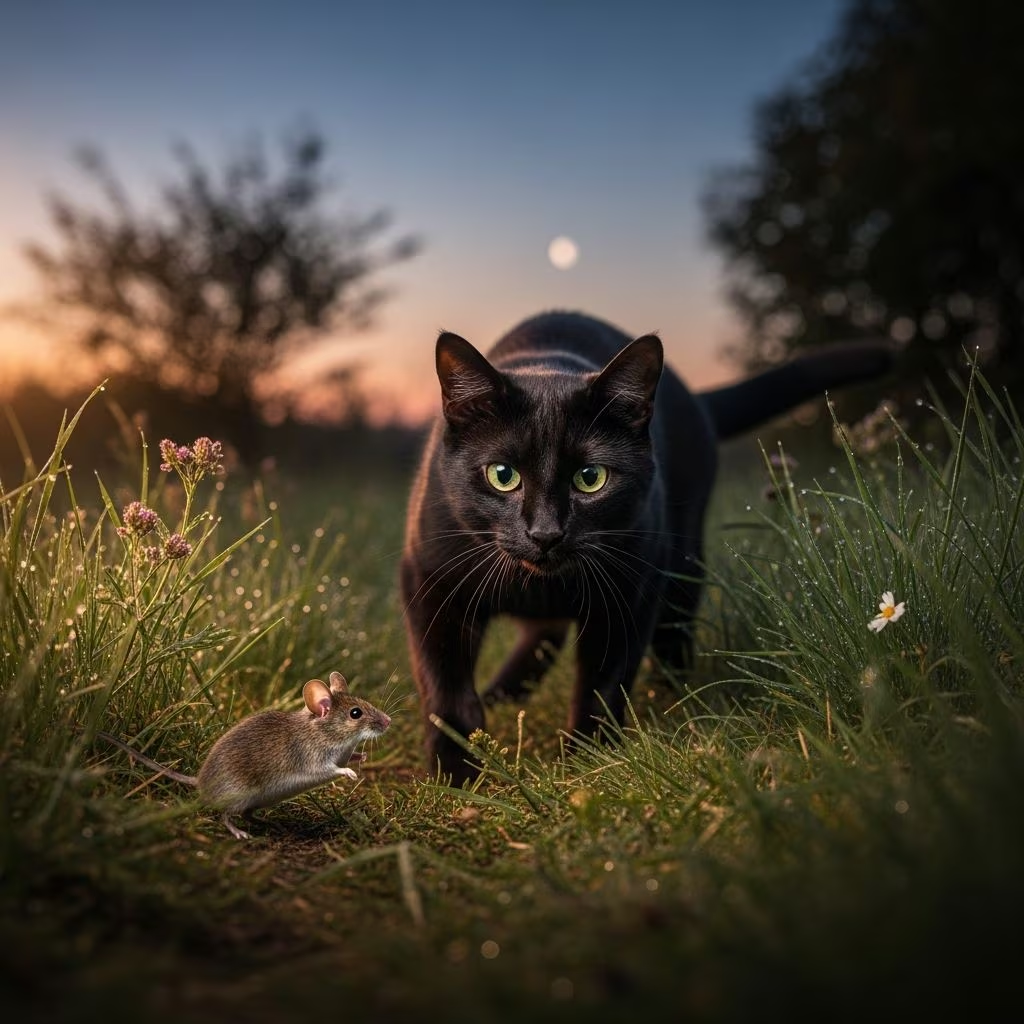
Cats are born hunters, retaining powerful instincts from their wild ancestors despite domestication. Even well-fed domestic cats exhibit hunting behaviors driven by an innate prey drive that involves sight, hearing, stalking, pouncing, and precise killing techniques.
Why Do Cats Hunt?
Domestic cats hunt not out of hunger but due to an ingrained predatory sequence honed through evolution. This behavior begins in kittenhood via play, helping them develop coordination, timing, and sensory skills for locating and capturing prey. Kittens practice running, jumping, pouncing, and chasing siblings or bugs, learning to gauge distances and adjust speeds to match moving targets. Adult cats spend 3-10 hours daily on hunting activities like locating prey, waiting, pouncing, and killing, even with toys. Hunger intensifies play, as hungrier cats engage longer with prey-like objects, treating them as real targets. This drive persists indoors, where cats ‘hunt’ toys, shadows, or feet, mimicking wild behaviors to satisfy instincts.
How Do Cats Hunt?
Cats employ a structured predatory sequence: searching, locating, approaching (stalking), capturing (pounce), killing, manipulating, and consuming. They rely primarily on **sight** and **hearing** over smell, detecting high-frequency sounds humans miss and pinpointing prey by sound alone at close range. Pupils dilate upon spotting targets, enhancing focus.
The Hunting Sequence
- Search: Cats scan environments, sniffing air or using ears to detect rustles.
- Locate: Visual cues lock on movement; ears swivel for acoustic discrimination.
- Approach (Stalk): Crouched posture with outstretched head, slow creeps, freezing mid-step.
- Capture: Brief sprint and paw strike or pounce.
- Kill: Neck bite severing vertebrae.
- Manipulate/Consume: Play with prey to assess danger, then eat.
Cat Hunting Techniques
Cats adapt strategies to prey type, showcasing versatility from solitary wild felines.
Stalk and Pounce
The most common method: locate prey, crouch low, creep silently one paw at a time, freeze (even mid-air), gather hind legs, then explode into leaps and final pounce. If prey flees, cats readjust for side/rear attacks with swipes to test responses. This demands patience and precision.
Ambush Hunting
Cats wait patiently at mouse holes, fish spots, or hides, eyes fixed until prey emerges. They return to successful sites repeatedly.
Fishing Technique
Bank-sitters scoop fish with paws or wade in shallow water for pounces. Visual distortion challenges some, but land cats mimic this for ground prey.
| Technique | Description | Best For |
|---|---|---|
| Stalk & Pounce | Creep, freeze, explosive pounce | Mice, birds, insects |
| Ambush | Wait and leap from cover | Rodents at holes |
| Fishing | Paw scoop or wade-grab | Fish in water |
How Do Cats Kill Their Prey?
Cats deliver a fatal **neck bite** at the skull-spine junction using dagger-like canines to sever vertebrae. They grasp, chatter jaws to align, then bite firmly. Frustrated indoor cats chatter at window prey, practicing the bite. Defensive swipes precede bites on reactive prey; timid cats approach repeatedly.
Why Do Cats Play with Their Food?
‘Playing’ tests prey danger via tosses, bats, and chases, building excitement absent in easy kills. Domestic cats inhibit bites from socialization but retain this to hone skills. Wild/feral cats kill quicker; domestics ‘play’ from pent-up instinct. Mothers bring live prey to teach kittens. Fabric licking or feather-plucking mimics skin/feather removal.
Why Do Cats Bring You Dead (or Half-Dead) Animals?
Cats share ‘gifts’ as maternal teaching or pack contributions. Mothers teach kittens by bringing prey; adults view owners/kittens as family needing hunting lessons. Half-dead prey allows practice. Indoor cats redirected to toys reduce this.
Post-Hunt Behaviors
Cats groom immediately after to recover from adrenaline, balancing emotions before eating. They mimic prey sounds pre-pounce (unexplained) and hide kills, retrieving later like stashed toys.
How to Satisfy Your Cat’s Hunting Instincts
Channel prey drive safely indoors:
- Use prey-like toys (feathers, strings) for intense play.
- Hide toys for ‘ambush’ retrieval.
- Interactive wands mimic stalk-pounce.
- Mealtimes: Scatter food or puzzle feeders simulate hunting.
- Multiple sessions daily match 3-10 hour natural behavior.
Avoid laser pointers without ‘catch’ to prevent frustration.
Frequently Asked Questions (FAQs)
Do all cats hunt?
Yes, all cats have innate hunting instincts, though success varies by practice and confidence. Even lazy indoor cats ‘hunt’ toys.
Why does my indoor cat hunt if well-fed?
Hunting fulfills evolutionary prey drive, not hunger. Play satisfies this need.
Can you stop a cat from hunting?
Redirect with toys and enrichment; instincts can’t be eliminated but managed indoors.
Why do cats chatter at birds?
It’s the killing bite practice on unreachable prey.
Is cat hunting cruel?
No, it’s natural; ‘play’ assesses danger, not malice.
References
- How Cats Hunt: Feline Hunting Behavior Explained — Amy Shojai. Accessed 2026. https://amyshojai.com/how-cats-hunt/
- Understanding the hunting behaviour of cats — International Cat Care. Accessed 2026. https://icatcare.org/articles/understanding-the-hunting-behaviour-of-cats
- Cat Hunting Behavior – Guide To Your Cat’s Prey Drive — Tractive. Accessed 2026. https://tractive.com/blog/en/good-to-know/cat-hunting-behavior-why-does-my-cat-hunt
- Hunting behaviour of the domestic cat — Western College of Veterinary Medicine, University of Saskatchewan. Accessed 2026. https://www.youtube.com/watch?v=OpiHZrV43NI
- Do All Cats Hunt? — Dezi & Roo. Accessed 2026. https://deziroo.com/blogs/pawsitive-connections/how-cats-hunt
- How Do Cats Hunt? Hunting Strategies & Techniques — Basepaws. Accessed 2026. https://basepaws.com/blog/how-do-cats-hunt
- Cats and Their Hunting Behaviour — FOUR PAWS International. Accessed 2026. https://www.four-paws.org/our-stories/publications-guides/cats-and-their-hunting-behaviour



