

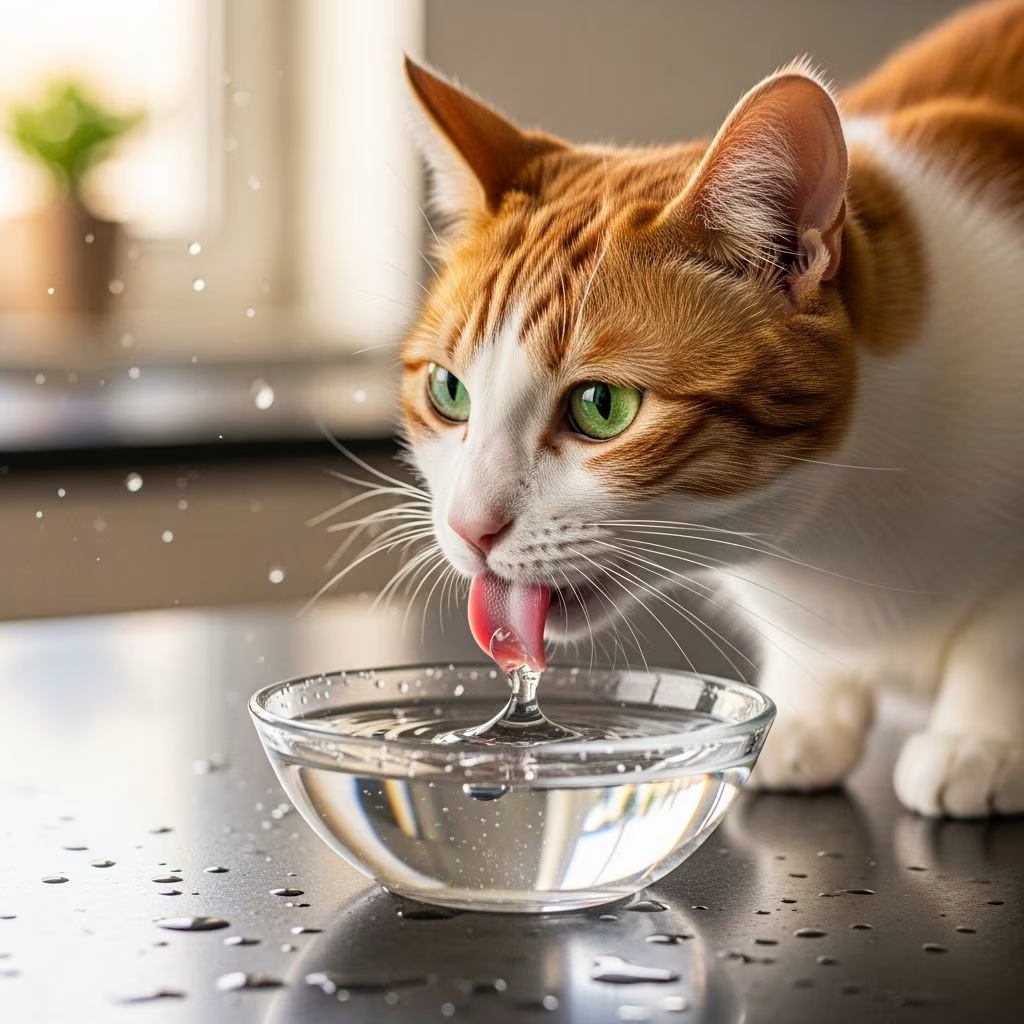
Cats drink water in a remarkably efficient and elegant manner, using a specialized tongue motion that leverages physics to lap up liquid without getting wet. This behavior, studied extensively by researchers, involves curling the tongue backward to touch the water surface lightly, forming a slender column of water that the cat snaps into its mouth before gravity pulls it back down.
The Physics of How Cats Drink Water
The feline drinking mechanism is a feat of evolutionary engineering, balancing inertia, gravity, and surface tension. Unlike dogs, which scoop water like ladles, cats extend their smooth tongue tip—just the uppermost surface—to barely touch the liquid. As the tongue retracts upward at high speed, adhesion causes water molecules to stick to the tongue, creating a vertical column upheld by inertia against gravity. The cat then swiftly closes its mouth around the column’s top, capturing about 3% of a teaspoon per lap in a fraction of a second.
High-speed cameras revealed this process in studies from MIT and Virginia Tech, published in Science, showing cats lap four times per second for domestic breeds. The tongue’s papillae—tiny, backward-facing spines—aid in drawing liquid efficiently without piercing the surface, keeping the chin dry. This Froude mechanism, governed by inertial forces rather than viscosity or capillarity, highlights cats’ precision despite using a flexible, non-rigid appendage like the tongue.
How Is This Different From Other Animals?
Cats’ method starkly contrasts with other animals. Dogs submerge their tongues fully, scooping water messily with broader laps reliant on viscosity. Horses and pigs use suction with complete cheeks, while cats, with incomplete cheeks, depend entirely on tongue action. Elephants and octopuses employ muscular trunks for similar fluid dynamics, but cats optimize for minimal mess and maximal speed. This adaptation suits their desert ancestry, where water conservation is key.
Why Do Cats Act Weird Around Water Bowls?
Cats often exhibit quirky behaviors around water bowls, pawing at them, avoiding them, or preferring alternative sources. This stems from instinctual wariness of stagnant water, which in the wild could harbor bacteria. Many cats dip a paw in first to test depth or freshness, or flick water out, possibly to check quality or due to whisker fatigue from narrow bowls. Multi-cat households see intimidation, where one cat blocks access, leading others to drink elsewhere.
Environmental factors amplify fussiness: bowls near food smell unappealing, as cats separate hunting from hydration. Stress from changes like moves or new pets disrupts routines. Temperature sensitivity plays a role—cats favor room-temperature water, avoiding cold shocks to sensitive teeth or overly hot liquid.
Why Are Cats Picky About Their Drinking Water?
Feline pickiness traces to heightened senses and evolutionary traits. Cats detect subtle tastes and smells better than humans, rejecting tap water with chlorine, minerals, or staleness. Their low thirst drive, inherited from arid-origin ancestors who derived 70-90% hydration from prey, means they drink sparingly unless prompted. Dry food diets exacerbate this, as cats self-regulate intake based on food moisture, drinking more with kibble but still finickily.
Preferences lean toward running water, mimicking streams for purity—fountains increase consumption by 20-50% in studies. Filtered or bottled water often appeals more than tap. Aging brings arthritis, making low bowls hard to access, or cognitive decline altering habits.
Reasons Cats May Not Drink Enough Water
- Diet Influence: Wet food provides ample moisture, reducing bowl visits; dry food demands more drinking, but cats may undervalue free water.
- Sensory Aversions: Off tastes from additives, staleness, or nearby food odors deter lapping.
- Bowl Issues: Plastic harbors bacteria and scratches; narrow designs cause whisker stress; dirty or low placement hinders access.
- Health Factors: Mild dehydration dulls thirst signals; dental pain, kidney disease, or UTIs alter patterns.
- Environmental Stress: New routines, competition, or location changes suppress drinking.
- Age-Related: Arthritis limits bending; cognitive dysfunction forgets routines.
Signs Your Cat Is Drinking Too Much Water (Polydipsia)
Excessive drinking signals potential issues. Normal intake is 50-100ml/kg body weight daily, varying by diet. Polydipsia—over 100ml/kg—warrants vet attention, often with polyuria (increased urination). Causes include:
- Diabetes Mellitus: High blood sugar prompts thirst to dilute glucose.
- Kidney Disease: Impaired concentration ability leads to more urine output, triggering thirst.
- Hyperthyroidism: Metabolic surge increases water needs.
- UTIs/Cystitis: Irritation causes frequent urination and compensatory drinking.
- Cushing’s Disease: Cortisol excess disrupts fluid balance.
Monitor by measuring intake; sudden changes, lethargy, or weight loss accompany true concerns.
How to Get Your Cat to Drink More Water
Boosting hydration prevents urinary issues like crystals or blockages. Strategies include:
- Water Fountains: Circulating water entices with freshness and movement.
- Multiple/Accessible Bowls: Elevate for seniors, place widely in quiet spots, use glass/stainless steel.
- Flavor Enhancers: Add tuna juice, chicken broth (low-sodium), or hydration supplements safely.
- Wet Food Transition: Increase moisture intake gradually.
- Freshness Maintenance: Daily changes, filtered water.
- Running Tap/Faucet: Supervised dripping appeals instinctively.
| Method | Pros | Cons |
|---|---|---|
| Cat Fountain | Increases intake significantly; mimics streams | Requires cleaning/electricity |
| Wet Food | High moisture (70-80%); palatable | Costlier; shorter shelf life |
| Flavor Additives | Tempts picky eaters | Calorie addition; allergies risk |
| Multiple Bowls | Reduces competition; accessibility | More cleaning |
Frequently Asked Questions (FAQs)
Why do cats dip their paw in water before drinking?
Cats paw at water to test freshness, depth, or temperature, or due to whisker sensitivity in bowls; it’s an instinctual check against contamination.
Is tap water safe for cats?
Generally yes, if fresh and palatable, but filter if chlorinated tastes deter; avoid contaminants.
Do cats prefer running water?
Yes, evolutionary instinct favors moving water as cleaner; fountains boost consumption.
How much water should a cat drink daily?
About 50-100ml per kg body weight, more on dry food; track for anomalies.
Why does my cat drink from the toilet or sink?
Fresh, running, or cooler water attracts; provide appealing alternatives.
Can cats get dehydrated easily?
Yes, low thirst drive and dry diets risk it; watch skin tent, dry gums.
References
- How Do Cats Drink Water? — Basepaws. 2023. https://basepaws.com/blog/how-do-cats-drink-water
- New research explains how domestic cats drink — JHU Newsletter. 2010-12-07. https://www.jhunewsletter.com/article/2010/12/new-research-explains-how-domestic-cats-drink-77702
- Why Are Cats So Quirky About Drinking? — UAH Pet Vet. 2024. https://www.uahpet.com/blogs/hydration-health/why-are-cats-so-quirky-about-drinking
- Understanding Your Cat’s Drinking Habits — Oralade. 2023. https://www.oralade.com/post/understanding-your-cat-s-drinking-habits
- The surprising physics of cats’ drinking — MIT News. 2010-11-12. https://news.mit.edu/2010/cat-lapping-1112
- Why are cats fussy about water? — The Cat Behavior Clinic. 2024. https://www.thecatbehaviorclinic.com/why-are-cats-fussy-about-water/
- Why Is My Cat Drinking So Much Water? — HowStuffWorks. 2023. https://animals.howstuffworks.com/pets/why-is-my-cat-drinking-so-much-water.htm



