

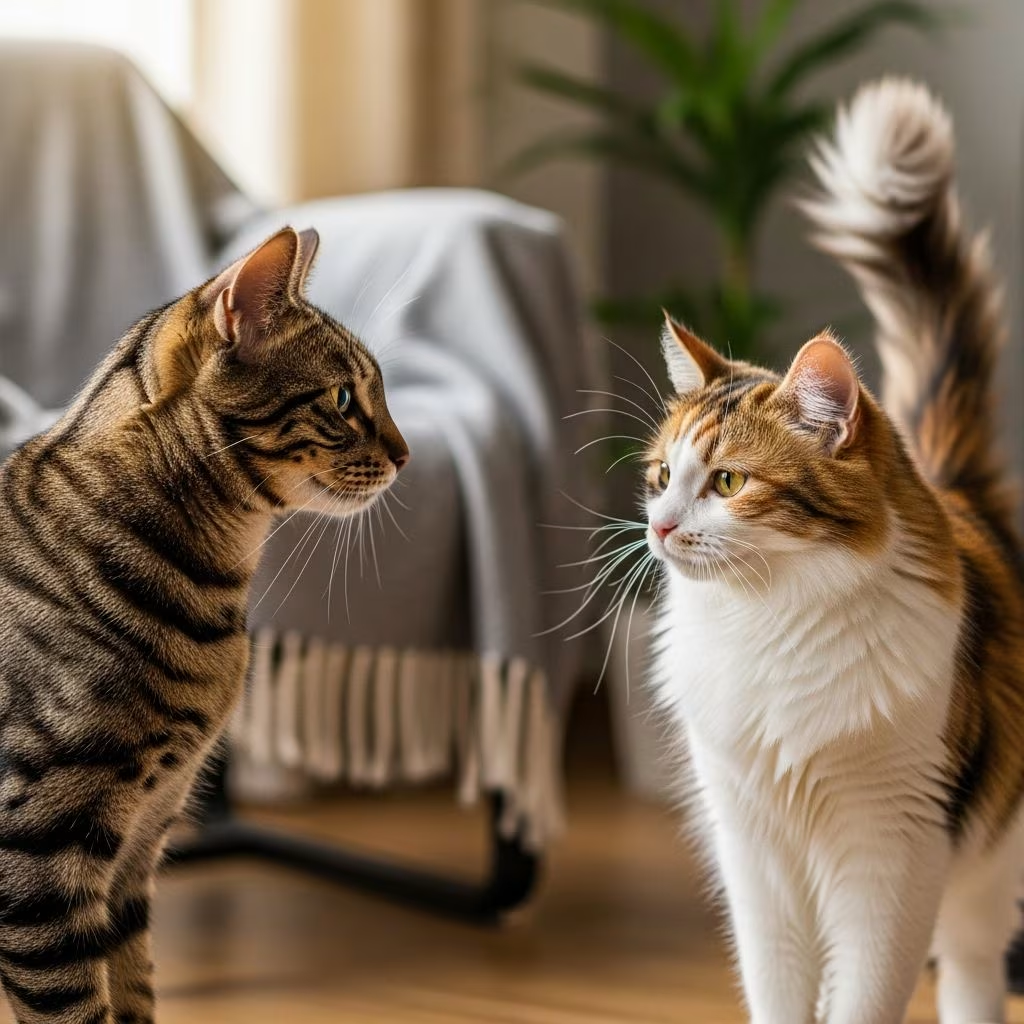
Cats are masterful communicators, employing a sophisticated blend of body language, vocalizations, physical touch, and chemical signals to interact with fellow felines. Unlike their interactions with humans, where meowing dominates, cats primarily rely on non-verbal cues when conversing with each other, allowing them to convey complex emotions, intentions, and social statuses silently and effectively. This multi-modal approach ensures clear messaging in their social groups, whether in the wild or domestic multi-cat households.
Understanding these methods not only deepens the bond between cats and their owners but also helps prevent misunderstandings that could lead to stress or conflict. From the twitch of a tail to the release of pheromones, every gesture serves a purpose in feline society.
Body Language in Cat Communication
Body language forms the cornerstone of how cats communicate with each other, providing instant visual feedback on mood and intent. Cats’ highly expressive bodies—ears, tails, eyes, whiskers—reveal emotions ranging from relaxation to aggression without a single sound.
Tail Positions
The tail is one of the most prominent indicators of a cat’s emotional state. A high, straight tail with a slight curl at the tip signals confidence, happiness, and a friendly greeting, often seen when cats approach familiar companions. Conversely, a tail lashing rapidly side-to-side denotes irritation or agitation, warning others to give space. A tucked tail under the body indicates fear or submission, while a puffed-up tail communicates threat or extreme fear, making the cat appear larger to intimidate rivals.
- High tail: Friendly, confident approach.
- Lashing tail: Annoyance or overstimulation.
- Tucked tail: Fear or submission.
- Puffed tail: Aggression or terror.
Ear Positions
Ears are incredibly mobile and reveal a cat’s alertness and emotions. Erect ears facing forward show interest or attentiveness, swiveling to track sounds or stimuli. Flattened ears against the head signal aggression, fear, or anger, preparing for defense. Sideways twisting ears indicate confusion or mild irritation.
- Forward ears: Curious and engaged.
- Flattened ears: Defensive or hostile.
- Swiveling ears: Listening or uncertain.
Eyes and Facial Expressions
Cats use their eyes to convey trust or challenge. Direct, unblinking stares can be territorial warnings, while slow blinks—known as ‘cat kisses’—signal relaxation and affection, inviting closer interaction. Dilated pupils often mean excitement, fear, or playfulness, whereas constricted pupils suggest confidence or aggression. Facial tension, like whiskers pulled back, accompanies negative states.
Whiskers and Posture
Forward-pointing whiskers indicate curiosity, while flattened against the face show fear. An arched back with fur standing on end (piloerection) is a defensive posture to appear larger, often paired with hissing. Relaxed posture with a loose body signals comfort.
Vocalizations: Sounds Cats Make to Each Other
Though less primary than body language, vocalizations play key roles in cat-to-cat talks, especially for long-distance or urgent messages. Cats reserve many sounds for specific contexts like mating or warnings, adapting from wild ancestors who favored silence to avoid predators.
Meowing is rare between adult cats, mostly a kitten-to-mother or human-directed behavior, but may occur in friendly adult interactions for attention.
- Purring: Conveys contentment, peaceful intent, or self-soothing during approach to avoid conflict.
- Trilling: High-pitched chirp for greeting, affection, or excitement, strengthening bonds.
- Chirping/Chattering: Excitement over prey, sharing hunting interest.
- Yowling: Mating calls or territorial disputes, audible over distances.
- Growling/Hissing: Threats demanding space, defensive warnings.
Physical Contact: Touch as Communication
Tactile interactions build and maintain social ties, expressing trust through grooming, rubbing, and more. These behaviors reinforce hierarchies and affiliations in cat groups.
Grooming and Snuggling
Allogrooming (mutual licking) is a profound sign of acceptance, reducing tension and distributing scents for group identity. Snuggling provides warmth and security.
Headbutting and Rubbing
Bunting—headbutting or cheek-rubbing—transfers facial pheromones, marking familiarity and affection. Tail hooking during greetings further bonds cats.
Nose Touching
A gentle nose-to-nose bump exchanges scents for recognition, akin to a feline handshake, common in harmonious multi-cat homes.
Chemical Signals: The Scent Language of Cats
Olfactory communication is subtle yet powerful, using pheromones from glands on face, paws, tail, and more to mark territory, identity, and emotions. Cats have around nine scent glands, depositing invisible messages that last days.
Scent Glands and Pheromones
Facial glands release ‘friendship’ pheromones during rubbing, signaling safety. Anal glands mark during spraying.
Rubbing and Scratching
Body rubs on objects or cats leave cheek pheromones for territory. Paw pads deposit scents while scratching, combining visual and chemical claims.
Urine Spraying
Vertical spraying, common in intact males, uses felinine to advertise status and boundaries, especially during breeding.
Why Understanding Cat Communication Matters
Deciphering these signals helps owners mediate multi-cat dynamics, spot stress early, and foster harmony. For instance, recognizing a lashing tail prevents unwanted petting, while mimicking slow blinks builds trust. In wild or feral colonies, these cues maintain complex social structures.
Domestic cats retain solitary instincts but adapt socially, using communication to navigate shared spaces effectively.
Frequently Asked Questions (FAQs)
Do cats meow at other cats?
Rarely; meowing is mainly for humans. Cats prefer body language, scent, and other vocalizations like trills or growls with each other.
Do cats talk to each other silently?
Yes, primarily through body language, facial expressions, tail signals, and pheromones, minimizing noise to avoid predators.
What does a slow blink mean between cats?
It signals trust and affection, a ‘cat kiss’ inviting peaceful interaction.
Why do cats rub against each other?
To exchange scents, mark as friends, and communicate comfort via pheromones.
Is purring always happy?
No, it can also self-soothe during stress or approach peacefully.
References
- How Do Cats Communicate With Each Other? — PetMD. 2023-10-15. https://www.petmd.com/cat/behavior/how-do-cats-talk-to-each-other
- Cat communication — Wikipedia. 2024-01-10. https://en.wikipedia.org/wiki/Cat_communication
- 3 Ways Cats Communicate With Cats — YouTube (Jackson Galaxy). 2022-05-20. https://www.youtube.com/watch?v=jPx2oYYTtAM
- Cat Communication — SPCA of Northern Nevada (.org). 2023-08-05. https://spcanevada.org/services/pet-education/animal-ally/cat-communication/
- Cat language: How to Speak & Communicate with Your Cat — Fresh Step. 2024-02-12. https://www.freshstep.com/cat-care/how-to-communicate-with-your-cat/
- Cat communication, cracking the code — Cabbagetown Pet Clinic (.com clinic). 2020-12-01. https://www.cabbagetownpetclinic.com/blog/december-2020/cat-communication,-cracking-the-code



