

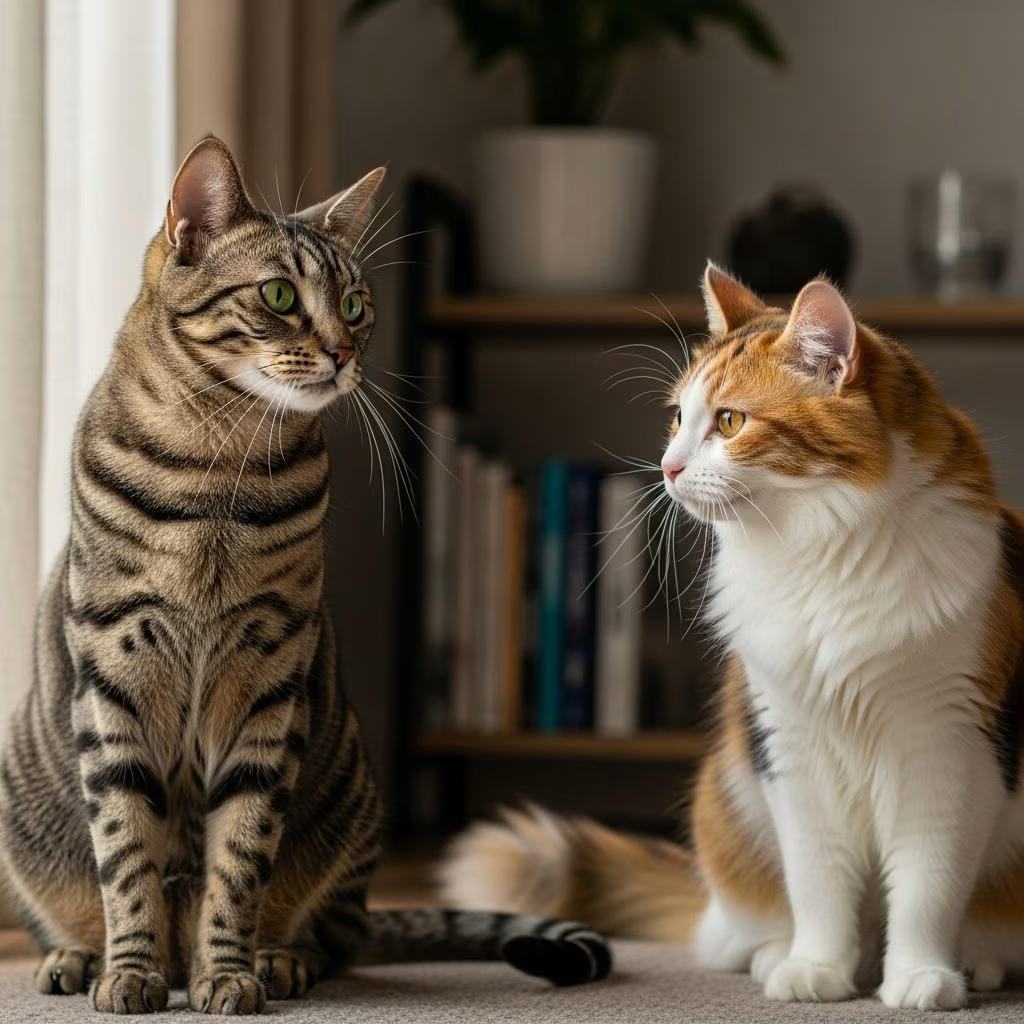
Cats are masterful communicators, employing a sophisticated blend of body language, vocalizations, physical touch, and chemical signals to interact with fellow felines. Unlike their vocal exchanges with humans, cats primarily rely on subtle, non-verbal cues to convey emotions, establish territories, form bonds, and resolve conflicts. This multi-modal approach allows them to navigate complex social dynamics in multi-cat households or feral colonies effectively.
Understanding these communication methods not only deepens the bond between cats and their owners but also helps prevent misunderstandings that could lead to stress or aggression. From the twitch of a tail to the release of pheromones, every gesture carries meaning honed by evolution. In this comprehensive guide, we’ll break down each category of cat communication, drawing from veterinary insights and behavioral studies to provide cat owners with actionable knowledge.
Key Takeaways
- Cats combine **body language**, **vocalizations**, **physical touch**, and **chemical signals** for rich inter-cat dialogue.
- Meowing is rare between cats, reserved mostly for humans; they prefer silent cues like scent and posture.
- **Pheromones** from scent glands are crucial for marking territory and signaling emotions without a sound.
- Tail positions, ear twitches, and slow blinks reveal a cat’s mood instantly to peers.
- Grooming and rubbing strengthen social ties, while hissing warns of boundaries.
Cat Body Language
Body language forms the cornerstone of feline communication, allowing cats to express everything from relaxation to rage without uttering a sound. Their highly expressive tails, ears, eyes, whiskers, and postures provide instant reads on their intentions.
Tail Signals
A cat’s tail is like a mood barometer. An upright tail with a slight curl at the tip signals confidence and friendliness, often seen when cats approach allies. A slow swish indicates contemplation, while rapid thrashing warns of irritation or aggression. Puffed-up tails signal fear or defensiveness, making the cat appear larger to deter threats. In greetings, tails may hook together, blending scents for group identification.
Ear Positions
Ears are dynamic indicators of a cat’s emotional state. Erect and forward ears denote alertness and interest. Flattened ears against the head scream aggression or fear, advising others to back off. Swiveling or rotating ears suggest curiosity or mild unease, tracking sounds without full commitment. Relaxed ears held naturally signal contentment.
Eyes and Facial Expressions
Cats use eyes to convey trust or challenge. Direct stares can be confrontational, asserting dominance. Conversely, slow blinking—narrowing eyes then closing them briefly—is a ‘cat kiss,’ signaling safety and affection. Dilated pupils indicate arousal, excitement, or fear, while constricted pupils show aggression or focus. Whiskers forward mean curiosity; pulled back signal distress.
Posture and Overall Body
An arched back with fur bristled enlarges the cat’s silhouette in defense. Crouching or hunching shows fear, while a playful stance—lowered front, wiggling rear—invites interaction. Relaxed cats lie with belly exposed, though this is trust, not invitation to touch.
Vocalizations
Though less primary than body language, vocalizations add nuance to cat conversations. Wild cats minimize noise to avoid predators, but domestics have adapted sounds for social and survival needs. Up to 21 distinct vocalizations exist, each with context.
- Purring: Often peace signals during approaches, reducing tension; also self-soothing.
- Trilling: High-pitched chirp for greetings, affection, or kitten calls, inviting interaction.
- Chirping/Chattering: Excited sounds at prey, sharing hunting alerts with colony mates.
- Yowling: Loud calls for mating or territory claims, carrying far.
- Growling/Hissing: Defensive warnings demanding space; hissing mimics snakes for intimidation.
- Meowing: Rare between adults; kittens meow for moms, but cats mostly meow at humans for attention.
In feral groups, soft chirps coordinate hunts, while mothers trill to kittens.
Physical Contact
Tactile interactions build and affirm bonds, conveying affection and hierarchy through touch.
Grooming and Snuggling
Allogrooming—licking another cat—strengthens ties, reduces stress, and shares scents. Snuggling provides warmth and security, common in litters or bonded pairs.
Headbutting and Rubbing
Bunting deposits facial pheromones, marking ‘family’ and showing familiarity. This cheek-rubbing claims ownership lovingly.
Nose Touching
A gentle nose bump exchanges scents for ID, like a feline handshake. Followed by head rubs or tail hooks in friends.
Play and Affectionate Biting
Light bites or swats during play teach boundaries; excessive force halts fun.
Chemical Signals (Scent Communication)
Olfactory cues are stealthy powerhouses, with cats possessing nine scent glands (face, paws, tail, anal). Pheromones convey identity, status, mood invisibly.
Scent Glands and Pheromones
Facial glands release ‘contentment pheromones’ via rubbing. Anal glands mark during spraying; paw glands via scratching.
Rubbing and Scratching
Body rubs on objects/cats leave messages: ‘This is mine, I’m relaxed’. Scratching combines visual, scent, and claw-sharpening.
Urine Spraying
Vertical spraying (not litterbox) by intact males signals sex/territory via felinine compound. Neutering reduces this.
Why Understanding Cat Communication Matters
Decoding these signals prevents fights in homes, aids introductions, and spots health issues (e.g., excessive yowling). Observe holistically—tail + ears + scent for full picture.
How to Respond to Cat Communication
Mimic slow blinks for trust; avoid stares. Use toys for play signals; respect hisses. Feliway mimics pheromones for calm.
| Signal | Meaning | Response |
|---|---|---|
| Upright tail | Happy greeting | Reciprocate gently |
| Flattened ears | Fear/aggression | Give space |
| Slow blink | Trust/affection | Blink back |
| Hissing | Warning | Retreat |
| Rubbing | Affection/marking | Allow it |
Frequently Asked Questions (FAQs)
Do cats meow at other cats?
Rarely; meowing is mainly for humans. Cats prefer body language, trills, hisses.
Do cats talk silently?
Yes, primarily via body language, scents, visuals over vocals.
What does purring mean between cats?
Peace, self-soothing, or bonding; not always content.
Why do cats rub against each other?
To share scents, affirm bonds, mark territory amicably.
Is tail wrapping a friendly sign?
Yes, wrapping tails shows familiarity and group unity.
References
- How Do Cats Communicate With Each Other? — PetMD. 2023-10-15. https://www.petmd.com/cat/behavior/how-do-cats-talk-to-each-other
- Cat Communication — Wikipedia (referencing primary studies). 2024-01-10. https://en.wikipedia.org/wiki/Cat_communication
- 3 Ways Cats Communicate With Cats — YouTube (Cat Education). 2022-05-20. https://www.youtube.com/watch?v=jPx2oYYTtAM
- Cat Communication — SPCA of Northern Nevada (.org). 2023-08-05. https://spcanevada.org/services/pet-education/animal-ally/cat-communication/
- Cat Language: How to Speak & Communicate with Your Cat — Fresh Step. 2024-02-12. https://www.freshstep.com/cat-care/how-to-communicate-with-your-cat/
- Cat Communication, Cracking the Code — Cabbagetown Pet Clinic. 2020-12-01. https://www.cabbagetownpetclinic.com/blog/december-2020/cat-communication,-cracking-the-code
- Cat Communication: A Guide to Feline Body Language — Dakin Humane Society (.org). 2023-11-18. https://www.dakinhumane.org/blog-full/cat-communication-a-guide-to-feline-body-language



