

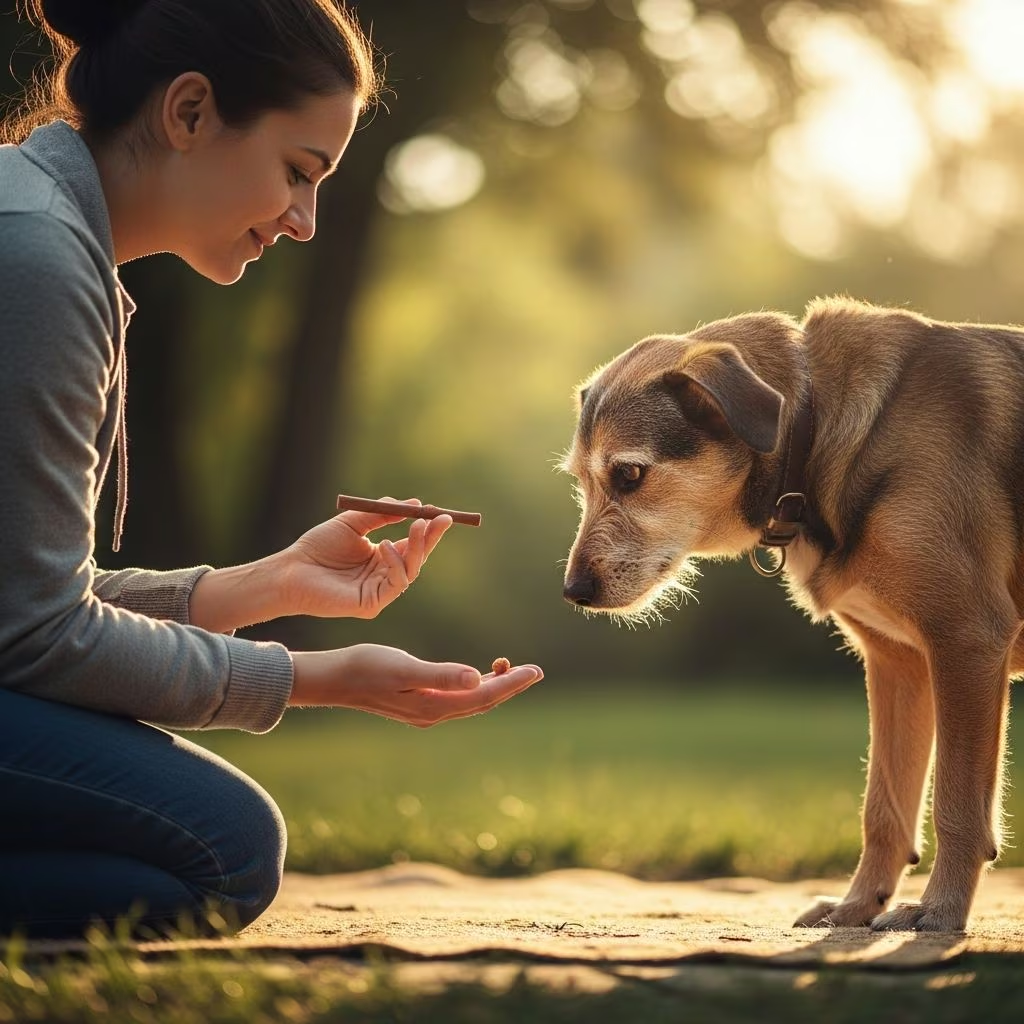
Skittish dogs often stem from past trauma, lack of socialisation, or genetic predispositions, making trust-building a gradual process rooted in patience and positive reinforcement. These fearful pups exhibit anxiety through subtle cues, requiring owners to prioritise their emotional comfort over rushed interactions.
Understanding Skittish Dog Behaviour
Recognising the **early warning signs** of fear is crucial to prevent escalation. Dogs communicate discomfort via body language: yawning signals emotional stress rather than boredom, excessive panting indicates anxiety even in cool conditions, lip-licking or ground-sniffing serves as displacement behaviour, tail-tucking and gaze aversion plead for space, while growling or lunging defends against perceived threats.
These signals underscore that skittish dogs process the world through a lens of caution. Forcing proximity amplifies fear, potentially leading to defensive bites. Instead, observe triggers—loud noises, strangers, or sudden movements—and intervene early by creating distance.
- Yawning: Emotional discomfort, not tiredness.
- Panting: Stress response independent of temperature.
- Lip-licking/Yawning: Requests for space.
- Tail-tuck/Gaze aversion: Clear ‘back off’ signals.
- Growling/Lunging: Fear-based defence.
Creating a Safe and Comfortable Environment
Establish a **safe space** like a crate or quiet room corner with bedding, toys, and water, allowing retreat without pressure. Implement routines for feeding, walks, and play to provide predictability, reducing anxiety triggers.
During initial days, let the dog drag a leash indoors to ease handling without collar-grabs, which evoke panic. Avoid overwhelming environments like busy parks; focus on calm home settings first. Leadership training, such as ‘Learn to Earn’—requiring sits for treats, meals, or pets—builds security through consistent, positive expectations.
Letting Your Dog Set the Pace
The cornerstone of bonding is **getting to know the dog on their time**. Sit nearby without eye contact or petting, observing reactions. Respect space if stress signals appear; retry later. When petting begins, target safe zones like the back or chest, avoiding head, paws, ears, or tail.
Prohibit unfamiliar people from approaching unless the dog initiates. This step-by-step trust accrual prevents setbacks, emphasising that progress hinges on the dog’s comfort level, not owner timelines.
Using Classical Conditioning and Desensitisation
**Classical conditioning** pairs your presence or movements with positives. Approach with high-value treats (chicken, cheese), dropping them near the dog while speaking soothingly, then walk away. Repeat until anticipation replaces fear.
Advance to **desensitisation and counterconditioning**: Expose below fear threshold (e.g., distant trigger), pairing with treats. Gradually intensify exposure as relaxation builds. This evidence-based method rewires associations, though time-intensive. Never punish or remove food mid-meal, as it erodes trust.
| Step | Action | Treat Pairing |
|---|---|---|
| 1. Distance | Observe trigger from afar | High-value treats |
| 2. Approach | Move closer slowly | Drop treats, soothe |
| 3. Proximity | Sit nearby post-treat | Verbal praise |
| 4. Interaction | Pet safe areas | Continuous rewards |
Leash Training and Positive Walks
Leash aversion is common; condition by attaching it pre-treat, then relaxing (e.g., TV time). Outdoors, start in quiet residential areas, carrying treats for surprises. Progress to busier spots as confidence grows, always associating outings positively.
Avoid noisy zones initially to prevent overload. Walks build world-confidence, with owner as safe anchor.
Socialisation with Careful Selection
Controlled **socialisation** boosts self-assurance. Skip chaotic dog parks; opt for one-on-one playdates with calm, dog-social role models. New people should sit sideways, avert eyes, and toss treats, letting the dog approach.
This mirrors natural learning: confident peers demonstrate safety. Monitor body language; end sessions at stress onset.
Rewards, Patience, and Management Strategies
**Reward generously**: Keep treats handy for calm behaviours, using low, soothing tones. Acknowledge efforts, as dogs read body language keenly. Interim coping skills like ‘rocket recalls’ redirect from triggers, buying time for long-term desensitisation.
Management prioritises safety: Block scary views (e.g., windows), intervene pre-threshold. Punishment exacerbates fear; patience yields reciprocated trust. Consistency across household members reinforces progress.
Common Challenges and Solutions
| Challenge | Solution |
|---|---|
| Leash resistance | Treat-pair attachment, indoor drag |
| Fear of strangers | Sideways sits, tossed treats |
| Reactive barking | Recall cues, distance management |
| Slow progress | Daily short sessions, routine |
Frequently Asked Questions (FAQs)
Q: How long does it take to bond with a skittish dog?
A: Varies by individual; weeks to months with daily consistency. Patience is key—rushing backfires.
Q: What if my dog growls during conditioning?
A: Increase distance, reduce intensity. Growling signals threshold exceedance; back off and rebuild.
Q: Can medication help fearful dogs?
A: Consult vets for severe cases alongside behaviour mods. Not first-line; training foundational.
Q: Is professional training necessary?
A: Beneficial for complexities, but basics succeed at home with resources.
Q: How to handle multi-dog homes?
A: Separate initially; supervised intros post-confidence gains.
Long-Term Confidence Building
Beyond basics, enrich with puzzle toys, scent games, and gradual novel exposures. Track progress in a journal to celebrate milestones. Most skittish dogs thrive, becoming loyal companions. Professional guidance accelerates if plateaus hit.
This comprehensive approach transforms fear into security, enriching lives mutually. Commit daily; rewards compound.
References
- Training Your Dog – Bonding With a Skittish Dog — Speak Dog!. N/A. https://speakdog.com/bonding-with-a-skittish-dog/
- Training a Dog With Anxiety: How to Train a Fearful Dog — American Kennel Club. N/A. https://www.akc.org/expert-advice/training/how-to-train-fearful-dog/
- Fearful Dogs — Nebraska Humane Society. N/A. https://nehumanesociety.org/services/pet-tips-behavior-help-and-resources/fearful-dogs/
- Living With and Loving a Fearful Dog — Upward Hound Dog Training. N/A. https://www.upwardhound.com/blog/living-with-and-loving-a-fearful-dog
- Fearful dogs — Cornell University College of Veterinary Medicine. N/A. https://www.vet.cornell.edu/departments-centers-and-institutes/riney-canine-health-center/canine-health-information/fearful-dogs
- Help your anxious or fearful dog gain confidence — Animal Humane Society. N/A. https://www.animalhumanesociety.org/resource/help-your-anxious-or-fearful-dog-gain-confidence



