

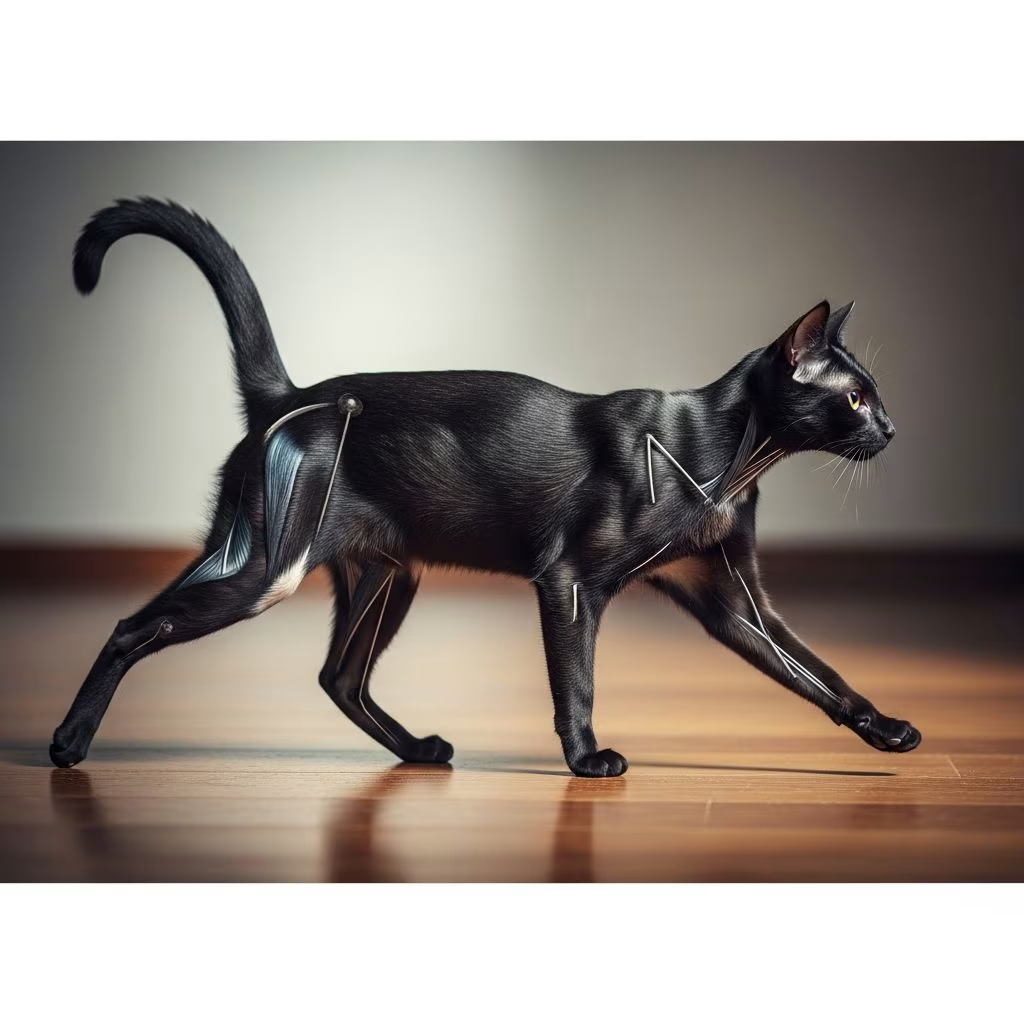
Cats are renowned for their graceful, silent movement, a trait honed by evolution for stealthy hunting. Understanding **how cats walk** reveals the biomechanics behind their digitigrade posture, diagonal gaits, and energy-efficient strides that allow them to navigate narrow ledges and stalk prey undetected.
The Digitigrade Design: Why Cats Walk on Their Toes
Cats are **digitigrade** animals, meaning they walk on their toes rather than the flats of their feet like humans (plantigrade). This posture elevates their body, keeping the center of mass low and enabling quick, quiet steps. The fleshy pads on their paws act as shock absorbers, muffling sound during movement.
Front paws have five toes, while hind paws have four, totaling 18 toes equipped with retractable claws for grip and balance. This toe-walking design provides spring-like propulsion, ideal for pouncing. Research shows this structure supports rapid acceleration, with forces up to four to five times greater than in walking during jumps.
The Catwalk: Diagonal Gait and Perfect Alignment
The classic **cat walk** is a four-beat gait where each paw hits the ground separately, creating a rhythmic sequence. Cats move diagonal limbs together: right foreleg with left hindleg, then left foreleg with right hindleg. This produces a diagonality often around 25%, spacing footfalls evenly for stability.
- During a standard walk, two or three paws contact the ground at once.
- Hindpaws land precisely where forepaws stepped, aligning all four paws on a single line—hence the term ‘catwalk.’
- This single-file path allows cats to traverse fences and branches effortlessly without widening their base.
About 60% of a cat’s weight rests on thoracic limbs due to the forward-shifted center of gravity. As they shift weight, it moves within the triangle formed by supporting limbs, maintaining balance.
Stealthy Walking: Crouched Posture and Low Energy Recovery
Cats’ **stealthy walk** involves slow, crouched movements with the center of mass close to the ground. Force plate studies on domestic cats (*Felis catus*) reveal lower mechanical energy recovery compared to distance-running mammals. A crouched posture correlates with higher diagonality (near 25%), reducing pendular energy exchange where kinetic energy converts to potential energy and back.
In typical walking, animals vault over stiff legs, recovering energy via pendulum-like motion. Cats sacrifice this for stealth: evenly spaced footfalls at 25% diagonality minimize center-of-mass oscillations, prioritizing silence over efficiency. A strong negative correlation exists between diagonality and energy recovery (r²=0.5417, p<0.001), and crouched postures increase diagonality for stability during prey approach.

Energy Tradeoffs in Feline Locomotion
The tradeoff between stealth and economy is evident. Cats tune gaits contextually: crouched, diagonal walks for hunting sacrifice efficiency, unlike canids’ amble with lower diagonality (~15%) and anterior mass bias for better recovery. Flexed limbs in cats further limit energy exchange, adapting them as ambush predators over endurance runners.
Whole-body mechanics data confirm: low recovery links to posture and footfall phase relationships, not just vertical oscillations. This highlights conflicting pressures—stability and silence versus energy savings.
Other Feline Gaits Beyond Walking
While walking dominates stealth, cats employ varied gaits:
| Gait | Beat Pattern | Key Features | Purpose |
|---|---|---|---|
| Walk | Four-beat | Diagonal limbs, 2-3 paws on ground | Stealth, balance |
| Trot | Two-beat | Diagonal pairs together; differs from walk alignment | Moderate speed |
| Canter/Gallop | Three/four-beat | Lead foot advances; always 1-3 paws grounded | Acceleration |
| Spring (Jump) | – | Rapid hindlimb extension; forelimbs land sequentially | Pouncing, leaping |
In canters, the last foot (lead) positions ahead. Springs use half-bound gallops with massive propulsion. The flexible spine compresses/extends for long strides, enabling overreaching in runs where hindlegs cross forelegs.
Why Cats Excel at Obstacle Courses
Cats dominate agility courses due to precise paw placement and balance. Their single-line gait, low center of mass, and sensory whiskers detect obstacles. Digitigrade legs provide bounce, while paw pads grip slick surfaces. Studies note quadrupeds like cats and horses share stable walks, but cats’ alignment adds precision.
Health Implications: Detecting Gait Abnormalities
Observing gait reveals health issues. Limping, asymmetry, or stiffness may signal arthritis, injury, or neurological problems. Normal walks show fluid diagonals; deviations warrant vet checks. Early detection via gait analysis improves outcomes.
Frequently Asked Questions (FAQs)
Why do cats walk so quietly?
Cats walk quietly due to digitigrade toes, soft paw pads, and stealthy crouched gaits that minimize impact noise.
Do all cats walk in a straight line?
Yes, healthy cats place all paws on the same line during walks, aiding balance on narrow surfaces.
What’s the difference between a cat’s walk and trot?
Walks are four-beat diagonal with precise alignment; trots are two-beat diagonal without single-line placement.
Why do cats crouch when stalking?
Crouching lowers the center of mass for stability and silence, using high-diagonality footfalls despite energy costs.
Can gait changes indicate illness in cats?
Yes, abnormal gaits like limping or dragging signal pain, joint issues, or neurological conditions.
Evolutionary Advantages of the Feline Walk
Evolution favored cats’ gait for ambush predation. Low-energy stealth walks prioritize hunting success over marathon efficiency, contrasting endurance specialists. This adaptation persists in domestic cats, enhancing their agility.
References
- Whole Body Mechanics of Stealthy Walking in Cats — PMC / Willy, D.Q. et al. 2008-09-24. https://pmc.ncbi.nlm.nih.gov/articles/PMC2583958/
- Feline Locomotive Behavior — Veterian Key. Accessed 2026. https://veteriankey.com/feline-locomotive-behavior/
- How Do Cats Walk? Our Vet Explains — Catster. 2023-10-15. https://www.catster.com/cat-behavior/how-do-cats-walk/
- What Movement and Gait Tell You About Your Cat — Fear Free Happy Homes. 2022-05-12. https://www.fearfreehappyhomes.com/what-movement-and-gait-tell-you-about-your-cat/
- Why Cats Are So Good At Obstacle Courses, According To Science — Kinship. 2024-08-01. https://www.kinship.com/uk/cat-behaviour/how-cats-walk



