

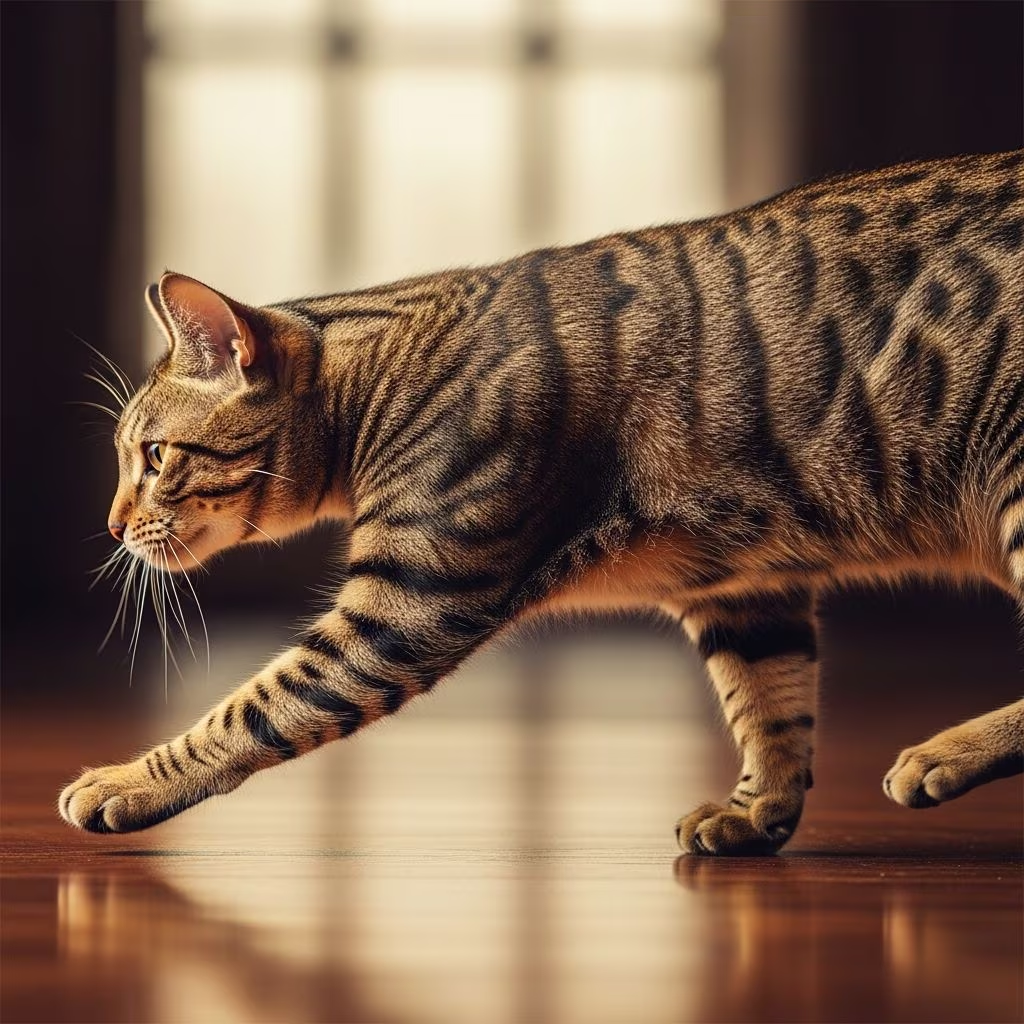
Cats possess an extraordinary ability to move with silent precision, gliding across surfaces as if weightless. This grace stems from unique biomechanical adaptations evolved for stealthy hunting. Domestic cats (Felis catus) employ a specialised walking gait that prioritises silence and stability over energy efficiency, allowing them to stalk prey undetected.
Understanding how cats walk reveals why they excel at navigating narrow ledges, jumping impossible distances, and vanishing into shadows. Their locomotion combines digitigrade posture, diagonal footfall patterns, and flexible spines, creating a “catwalk” that has inspired fashion runways. This article breaks down the mechanics, from everyday strolls to predatory prowls.
The Digitigrade Design: Why Cats Walk on Tiptoes
Cats are digitigrade animals, meaning they walk on their toes rather than flat-footed like humans (plantigrade) or heel-walking like dogs (unguligrade). This tiptoe stance elevates their body, keeping the centre of mass low and enabling quick, quiet movements. The fleshy pads on their paws—five toes on front paws, four on hind—act as shock absorbers, muffling sound and providing grip.
During walking, cats distribute about 60% of their body weight to the forelimbs, with the centre of gravity positioned forward. As they shift weight, it moves within a stable triangle formed by supporting limbs, ensuring balance even on uneven terrain. This design allows cats to place each hind paw precisely where the forepaw landed, creating a single-track path ideal for tight spaces like fences or branches.
- Front paws: Five toes for enhanced dexterity in climbing and grasping.
- Hind paws: Four toes optimised for propulsion and leaping.
- Claws: Retractable for silent steps; extend for traction.
- Pads: Sensitive for detecting vibrations, aiding navigation in the dark.
This toe-walking reduces noise, as only the padded tips contact the ground, explaining why cats seem to float silently.
The Catwalk Gait: A Four-Beat Masterpiece
The standard cat walk is a four-beat gait, where each paw hits the ground at distinct intervals: right fore, left hind, left fore, right hind. This diagonal pattern—foreleg with opposite hindleg—provides stability, with two or three paws always grounded. In slow, stalking walks, three or even four feet may touch simultaneously for maximum stealth.
Unlike trots (diagonality ~50%), cats often use higher diagonality near 25%, spacing footfalls evenly. This evens out centre of mass oscillations but sacrifices energy recovery, trading efficiency for silence and stability. Video analysis shows cats maintain a crouched posture during stealthy walks, compressing limbs to keep the body low.
| Gait Phase | Feet on Ground | Diagonality | Purpose |
|---|---|---|---|
| Slow Stalk | 3-4 feet | ~25% | Stealth, stability |
| Normal Walk | 2-3 feet | 15-25% | Balance on narrow paths |
| Trot | 2 feet (diagonal pair) | 50% | Faster movement |
The single-track foot placement—hind paws stepping in forepaw prints—minimises trail width, perfect for predators avoiding detection. Models mimic this linear stride on runways, hence “catwalk”.
Stealthy Walking: Crouched Postures and Energy Tradeoffs
Stealthy walking demands slow, crouched movements with the centre of mass hugging the ground. Cats flex their limbs more than distance-running mammals, reducing vertical oscillations but also mechanical energy recovery. Studies using force plates reveal a negative correlation between limb compression (crouched posture) and diagonality: more crouch means higher diagonality (~25%), which stabilises but lowers efficiency.
In pendulum-like walking, kinetic energy converts to potential energy as the body vaults over stiff legs. Cats’ crouched gaits disrupt this, with fore and hind ends oscillating oppositely, minimising centre of mass height changes and energy exchange. This tradeoff prioritises stealth over endurance—ideal for ambush hunters, not marathon runners.
“Cats tune their behaviour to different demands: crouched postures for stealth sacrifice energetic efficiency via altered footfall patterns.”
Compared to dogs (more anterior mass, lower diagonality ~15%), cats embrace inefficiency for predation.
Beyond Walking: Gaits for Speed and Agility
Cats seamlessly transition gaits. The amble or slow trot keeps diagonal pairs grounded. At higher speeds, they canter: hind paws land first (one ahead as “lead foot”), followed by forepaws, with the spine flexing for propulsion.
The gallop—for sprints and pounces—features all feet airborne, hind legs driving forward with massive force (4-5 times walking load). Forelegs land sequentially, spine compressing to tuck hindquarters, then extending for overreaching bounds. This suppleness allows leaps up to six times body length.
- Walk: Stealth and precision.
- Trot/Amble: Moderate speed.
- Canter: Controlled acceleration.
- Gallop: Explosive bursts.
Why Cats Excel at Obstacle Courses and Tight Spaces
Cats dominate agility courses due to their gait and anatomy. The single-track walk navigates rails effortlessly. Flexible spines (compressing/extending) enable tight turns and high jumps. Digitigrade legs provide spring-like energy storage in tendons.
Whiskers act as antennae, mapping spaces, while paw pads sense textures. Evolution honed these for arboreal hunting: silent stalks through underbrush, precise pounces from branches. Domestic cats retain wild prowess, acing obstacle courses.
Health Insights: When Gait Reveals Problems
Observing gait diagnoses issues. Limping signals injury; wobbling indicates neurological problems. Elderly cats may stiffen, losing crouch. Vets assess via slow-motion video: asymmetry or dragged toes warrant checks.
Maintain gait health with scratching posts (claw maintenance), climbing trees, and soft landings on varied textures.
Frequently Asked Questions (FAQs)
Why do cats walk so quietly?
Their digitigrade toes, padded paws, and retracted claws muffle sound, evolved for stealthy hunting.
Do all cats walk in a straight line?
Yes, hind paws follow forepaw tracks precisely, creating a narrow path for balance on slim surfaces.
Why is my cat’s walk stiff?
Arthritis, injury, or age may cause it. Consult a vet if gait changes persist.
Can cats change gaits mid-movement?
Absolutely—their flexible spine and strong muscles allow seamless shifts from walk to gallop.
Is cat walking energy-efficient?
No, stealth prioritises silence over efficiency, with crouched gaits reducing energy recovery.
References
- Whole Body Mechanics of Stealthy Walking in Cats — PMC/NIH. 2008-10-08. https://pmc.ncbi.nlm.nih.gov/articles/PMC2583958/
- Feline Locomotive Behavior — Veterian Key. 2023-05-15. https://veteriankey.com/feline-locomotive-behavior/
- How Do Cats Walk? Our Vet Explains — Catster. 2024-02-12. https://www.catster.com/cat-behavior/how-do-cats-walk/
- What Movement and Gait Tell You About Your Cat — Fear Free Happy Homes. 2022-11-01. https://www.fearfreehappyhomes.com/what-movement-and-gait-tell-you-about-your-cat/
- Why Cats Are So Good At Obstacle Courses, According To Science — Kinship. 2024-06-20. https://www.kinship.com/uk/cat-behaviour/how-cats-walk



