

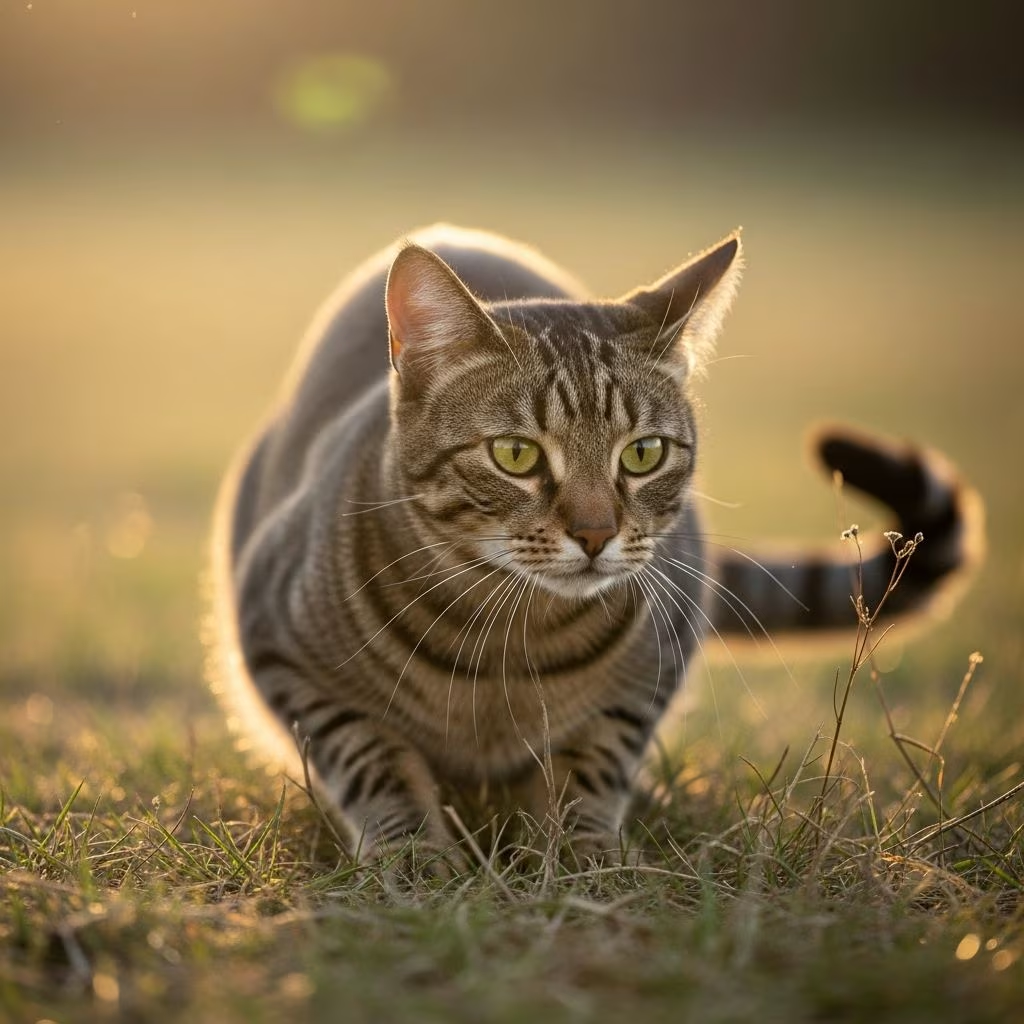
Domestic cats retain powerful hunting instincts from their wild ancestors, making them efficient solitary predators even when well-fed. Understanding this behaviour helps owners appreciate their pets’ natural drives and manage it appropriately.
Why Do Cats Hunt?
Cats are **obligate carnivores**, requiring meat for survival, with instincts honed over millennia as solitary hunters targeting small prey like mammals and birds. Pet cats descend from adept hunters selected for rodent control, preserving strong predatory drives despite minimal selective breeding.
Hunting motivation extends beyond hunger; cats hunt opportunistically to avoid starvation risks, as each attempt succeeds less than 50% of the time. Well-fed cats hunt about 3 hours daily versus 12 for feral cats, but still bring home prey. Studies link reduced hunting to complete commercial diets over scraps.
Owners often find ‘gifts’ of dead animals; hungry cats kill and eat prey, while sated ones may play with or leave it. Feeding doesn’t eliminate hunting, potentially leading to hyperpredation in high-density populations.
How Do Cats Hunt? The Hunting Sequence
Cats follow a structured **seven-stage hunting sequence** adapted for solitary predation on small prey, requiring multiple daily kills for sustenance.
- Searching: Cats scan environments actively, using heightened senses to detect movement or sound.
- Location: Pinpointing prey via visual, auditory, or whisker cues in grass, bushes, or indoors.
- Approach (Stalking): Crouched, slow advance with outstretched head, accelerating to a sprint near prey.
- Capture (Pounce): Tense pause, then explosive leap striking with front paws; 32% success rate.
- Kill: Neck bite with sharp canines if hungry; otherwise, play ensues.
- Manipulation: Batting or carrying prey, mimicking real hunts during play.
- Consume: Eating if needed, preferring rodents over birds.
This sequence mirrors kitten play, practicing skills from early age by chasing littermates or watching mothers hunt.
The Anatomy of a Hunter
Cats’ bodies are **perfectly engineered for predation**, with adaptations enhancing stealth, detection, and lethality.
- Hearing: Detects up to 64,000 Hz, including rustling or ultrasonic prey calls.
- Whiskers: Sense air currents and spatial limits for precise navigation in low light.
- Claws & Teeth: Curved retractable claws for grip; sharp canines for fatal throat strikes.
- Reflexes & Eyes: Lightning-fast pounces with binocular vision for depth perception; vertical pupils aid distance judgment.
- Silent Paws: Padded feet enable stealthy stalking.
| Adaptation | Function | Benefit in Hunting |
|---|---|---|
| Whiskers | Air current detection | Feels prey in darkness |
| Hearing Range | 64 kHz sensitivity | Locates hidden rodents |
| Canines/Claws | Fatal strikes | Quick kills |
| Padded Feet | Silent movement | Undetected approach |
Why Do Well-Fed Cats Still Hunt?
Instinct drives hunting independent of hunger; cats maintain skills opportunistically. Play with toys replicates hunting, intensifying with hunger or prey-like objects. Kittens hone skills through play, carrying into adulthood.
Research shows owned cats hunt less but selectively; young cats diverse prey profiles, influenced by age, sex, and environment. Males and younger cats hunt more; urban areas yield fewer prey due to human impact.
Insects attract via play-instinct, not nutrition. Cats prefer rodents, ambushing efficiently over stalking birds.
Do All Cats Hunt the Same Way?
No; **individual and environmental factors** vary behaviour. Young cats show diverse prey, focusing by age; spatial proximity clusters similar profiles.
Seasonal peaks occur; more mammals/birds northwest Europe, lizards southeast. Sit-and-wait for rodents beats active stalking for birds. Citizen science in France tracked 5048 cats over 8 years, confirming patterns.
Why Do Cats Bring Dead Animals Home?
This ‘gift’ behaviour stems from **teaching instincts**; mothers bring prey to kittens for learning. Sated adults mimic, sharing with ‘family’ (owners). Hunger determines killing; well-fed cats drop live or dead prey indoors.
How Can I Stop My Cat Hunting?
Complete nutrition and play reduce but don’t eliminate hunting. Strategies include:
- Enrich Environment: Toys mimicking prey for outlet.
- Indoor Living: Protects wildlife, safer for cats; use window perches.
- Bell Collars: Alert prey, though debated efficacy.
- Scheduled Feeding/Play: Tire cats, mimicking hunts.
- Neuter: May lower roaming/hunting.
Owners view hunting naturally, rarely intervening strongly. Balance welfare with wildlife impact.
Frequently Asked Questions
Why does my well-fed cat hunt?
Instinct drives hunting beyond hunger; opportunistic to maintain skills.
Is cat hunting harmful to wildlife?
Yes, especially birds; indoor keeping mitigates.
Can play replace real hunting?
Partially; prey-like toys intensify sessions.
Do all cats hunt equally?
No, varies by age, sex, location.
How to manage hunting gifts?
Clean discreetly; enrich play.
References
- Understanding the hunting behaviour of cats — International Cat Care. 2023. https://icatcare.org/articles/understanding-the-hunting-behaviour-of-cats
- Born to Hunt: Why Cats Are the Perfect Predators — Petcube. 2023. https://petcube.com/blog/why-cats-are-the-perfect-predators/
- Pet Science: A Comprehensive Analysis of Cats’ Insect Hunting Behavior — OreaTAI. 2024. https://www.oreateai.com/blog/pet-science-a-comprehensive-analysis-of-cats-insect-hunting-behavior/b534dd01ca840dbceabc1e4dd19e018f
- Biology & Behavior of Cats — Alley Cat Allies. 2023. https://www.alleycat.org/resources/biology-and-behavior-of-the-cat/
- Cat predation on wildlife — Wikipedia (informed by studies). 2024. https://en.wikipedia.org/wiki/Cat_predation_on_wildlife
- Cat Hunting Behaviour in France: Spatiotemporal & Individual Patterns — PMC/NCBI. 2023-10-25. https://pmc.ncbi.nlm.nih.gov/articles/PMC10668736/
- Cat Hunting Behaviour: Risk & Responsibility for Owners — British Ecological Society. 2023. https://besjournals.onlinelibrary.wiley.com/doi/full/10.1002/pan3.6



