How Birds Quench Their Thirst: 4 Ingenious Methods
Discover the unique ways birds drink water, from gravity-assisted gulps to sophisticated suction, adapted perfectly to their environments and beak shapes.
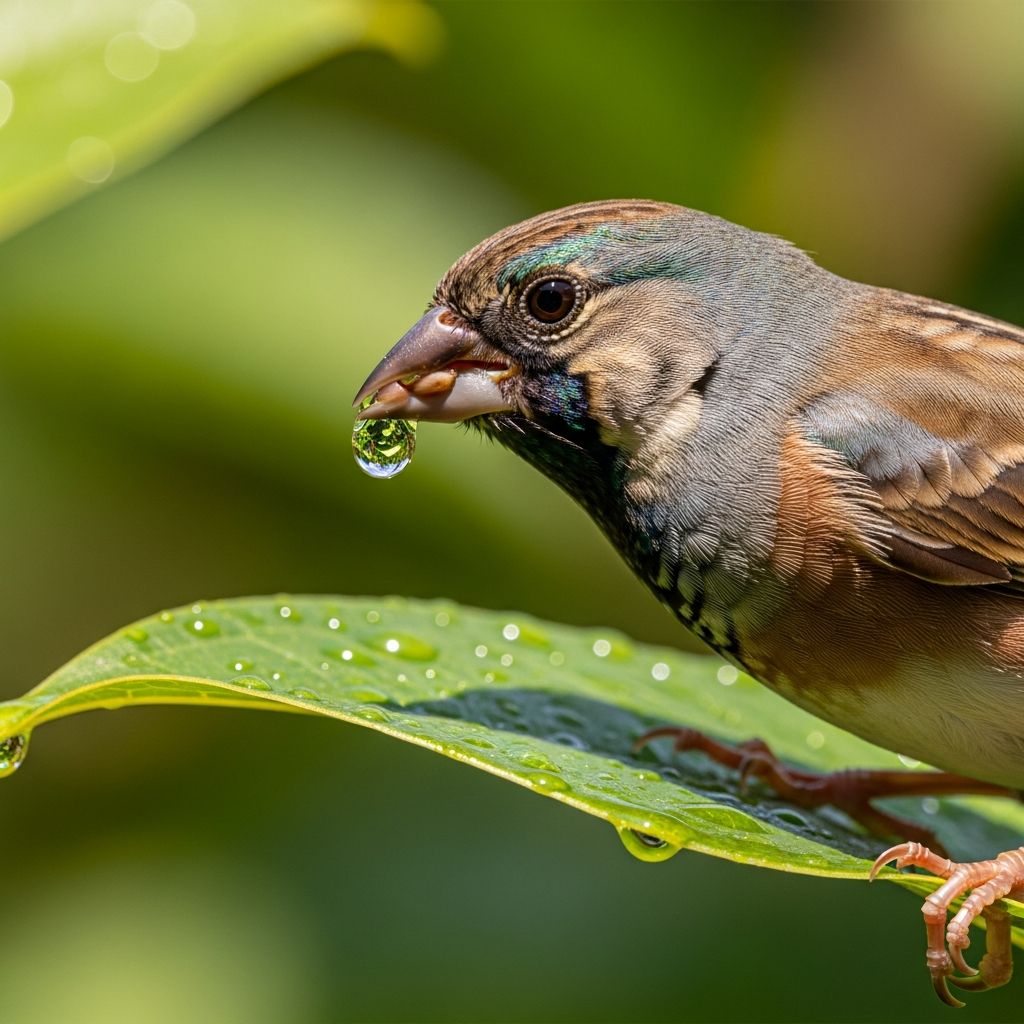
How Birds Quench Their Thirst
Birds rely on water for survival, yet their drinking habits differ markedly from mammals due to anatomical constraints like the absence of cheeks and lips. Most employ a gravity-based approach or suction mechanisms tailored to their beak structures and lifestyles.
The Primary Drinking Technique: Dipping and Tilting
The most widespread method among birds involves scooping water into the bill and tilting the head backward to let gravity carry it down the throat. This ‘dipping and tipping’ allows efficient intake without complex musculature.
- Small songbirds often collect morning dew from leaves, filling their bills quickly before swallowing.
- Waterfowl like mallards use capillary action alongside bill pressure to trap liquid before the tilt.
- Cockatoos scoop with their lower beak, demonstrating versatility in this basic technique.
This method suits stationary birds near ponds or birdbaths, where they can repeat the process rapidly.
Suction Drinking: A Specialized Adaptation
Unlike the gravity method, suction drinkers draw water directly into the throat without head tilting, mimicking a straw-like action. Pigeons and doves exemplify this with a ‘double-suction mechanism’: capillary forces draw water between slightly parted beak tips, then the tongue pistons it backward.
| Bird Group | Suction Style | Key Feature |
|---|---|---|
| Pigeons/Doves | Double-suction | Tongue as piston |
| Parakeets | Ladling | Tongue tip scoops |
| Parrots | Pure suction | Throat pressure drop |
These adaptations enable quick, discreet drinking, ideal for open areas.
Nectar Feeders and Unique Tongue Mechanics
Hummingbirds bypass traditional drinking; their forked tongues use capillary grooves to encircle and pump nectar, extending and retracting up to 13 times per second. This passive flow relies on tongue surface tension rather than suction or gravity.
Sunbirds similarly adjust intake based on nectar concentration, with kidneys fine-tuning reabsorption to handle excess water.
Aerial and Aquatic Drinking Strategies
Flying birds like swifts and swallows skim water surfaces mid-flight, capturing droplets in seconds. Pelicans collect rainwater or skim saltwater, desalinating via salt glands that excrete excess NaCl near the eyes or nostrils.
- Seabirds: Salt glands produce hypertonic fluid, conserving freshwater.
- Desert birds: Metabolize water from food, rarely drinking directly.
Why Birds Need Water and How They Conserve It
Birds lose water via evaporation, respiration, and excretion, with small species facing higher risks due to surface-to-volume ratios. They compensate through:
- Metabolic water: Produced during food oxidation.
- Food moisture: Fruits, insects, and seeds provide hydration.
- Kidney efficiency: Glomeruli filter blood; tubules reabsorb 98% of glucose and water.
- Cloacal reabsorption: Urine mixes with feces; lower gut reclaims NaCl and water via osmosis.
In arid zones, species like those in the Sonoran Desert eat water-rich saguaro fruit or flies.
Physiological Marvels: Kidneys and Salt Glands
Avian kidneys prioritize conservation: proximal tubules reclaim essentials, while sunbirds reduce reabsorption during high-water diets. The cloaca integrates renal and gut fluids, using reverse peristalsis for final water recovery.
Salt glands in marine birds yield hypertonic NaCl solution, freeing water from urine—more efficient than kidneys.
Attracting Birds with Water Features
Birdbaths draw more species than feeders; place shallow (2 inches max) with gentle drips to mimic streams.
- Clean weekly to prevent disease.
- Position near cover for safety.
- Add rocks for perching.
Seasonal and Habitat Variations
In winter, cold-climate birds melt snow; desert dwellers endure long droughts via conservation. Pelagic species desalinate seawater routinely.
FAQs
Do all birds tilt their heads to drink?
No, suction drinkers like pigeons do not; they use tongue and pressure.
Can birds drink saltwater?
Marine birds can via salt glands; others cannot without dehydration.
How much water do birds need daily?
Varies by size; small birds lose more proportionally and drink frequently.
Why don’t hummingbirds need birdbaths?
Nectar provides ample liquid; they avoid plain water.
Do birds drink while flying?
Yes, swifts and swallows skim surfaces.
Observing Bird Drinking Behaviors
Watch for rapid bill dips or subtle tongue flicks. High-speed videos reveal tongue pistons in pigeons. Understanding these boosts appreciation for avian ingenuity.
References
- Avian osmoregulation — Avesbiology.com. Accessed 2026. https://avesbiology.com/bird_excretion.html
- How Do Birds Drink Water? — BWD Magazine. Accessed 2026. https://bwdmagazine.com/tips-for-birders/faq/how-do-birds-drink-water/
- How do birds drink water? – YouTube — YouTube. Accessed 2026. https://www.youtube.com/watch?v=bhNUc2zWLAw
- Drinking — Stanford University. Accessed 2026. https://web.stanford.edu/group/stanfordbirds/text/uessays/earlier%20versions/Drinking.html
- How Do Birds Drink on the Fly? — National Audubon Society. Accessed 2026. https://www.audubon.org/magazine/how-do-birds-drink-fly
Similar Articles








Read full bio of Sneha Tete