

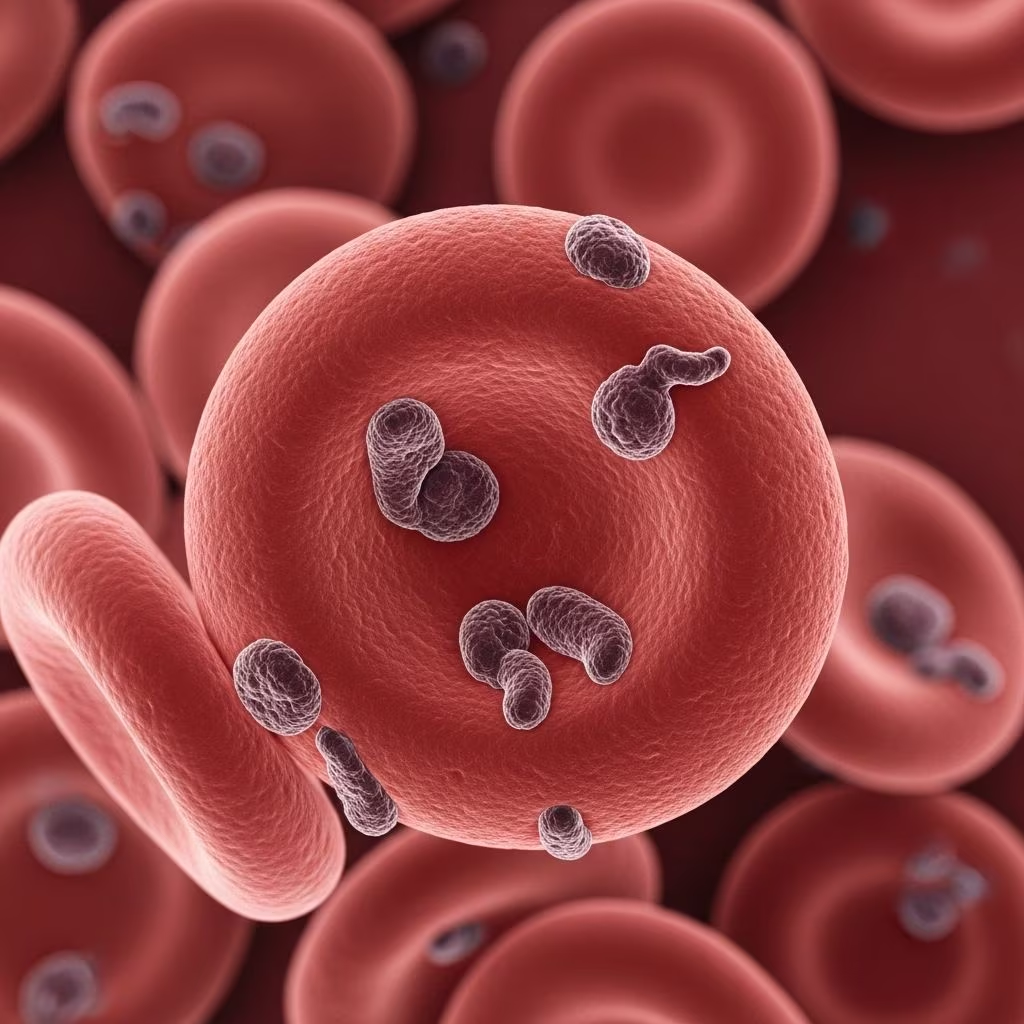
Hemotropic mycoplasmas, often referred to as hemoplasmas, are wall-less bacteria that adhere to the surface of red blood cells in a wide range of animal species. These pathogens can trigger hemolytic anemia through immune-mediated destruction of infected erythrocytes, though many infections remain subclinical. Understanding their biology, host range, and clinical implications is crucial for effective veterinary management.
Overview of Hemoplasma Pathogens
These organisms belong to the genus Mycoplasma and were previously classified under names like Haemobartonella or Eperythrozoon. Molecular techniques, particularly PCR targeting the 16S rRNA gene, have refined their taxonomy. Hemoplasmas exhibit varying degrees of pathogenicity depending on the species and host factors such as immune status or splenectomy.
Key characteristics include their epicellular attachment to erythrocytes, evasion of phagocytosis, and induction of oxidative damage leading to hemolysis. Transmission occurs via blood-sucking arthropods like fleas, ticks, and lice, or through direct blood contact during fights, transfusions, or vertical transmission.
Affected Animal Species and Pathogen Specificity
Hemoplasmas display host specificity, with distinct species infecting different animals. Here’s a breakdown:
- Cats: Primarily Mycoplasma haemofelis, ‘Candidatus Mycoplasma haemominutum‘, and ‘Candidatus Mycoplasma turicensis‘. M. haemofelis is the most virulent, causing feline infectious anemia (FIA).
- Dogs: Mycoplasma haemocanis, typically asymptomatic in intact animals but hemolytic in splenectomized dogs.
- Pigs: Mycoplasma suis, leading to icterus and anemia in piglets, sows, and growers.
- Cattle: Mycoplasma wenyonii, often subclinical but associated with edema and milk drop in heifers.
- Sheep and Goats: Mycoplasma ovis, causing mild anemia under stress.
- Llamas and Alpacas: Mycoplasma haemolamae, more severe in young camelids.
| Animal Species | Primary Hemoplasma | Typical Severity |
|---|---|---|
| Cats | M. haemofelis | High (acute anemia) |
| Dogs | M. haemocanis | Low (unless splenectomized) |
| Pigs | M. suis | Moderate to high |
| Cattle | M. wenyonii | Usually low |
| Sheep/Goats | M. ovis | Low |
| Camelids | M. haemolamae | Moderate in juveniles |
This table summarizes host-pathogen pairings and disease potential based on veterinary reports.
Transmission Mechanisms
Hemoplasmas spread through arthropod vectors, which acquire the bacteria during blood meals from infected hosts and transmit them mechanically or biologically. Fleas (Ctenocephalides felis) are key for feline transmission, while ticks and lice play roles in livestock. Direct routes include bite wounds, contaminated needles, and transplacental passage. In kennels or herds, prevalence can exceed 50% due to high vector density.
Vertical transmission occurs in pigs and cats, where piglets or kittens are born infected, contributing to chronic carrier states.
Clinical Manifestations Across Species
Most infections are asymptomatic, with clinical disease emerging under predisposing factors like immunosuppression (e.g., FeLV/FIV in cats), splenectomy, stress, or coinfections. Severity ranges from mild lethargy to life-threatening anemia.
Feline Infections
In cats, M. haemofelis induces acute FIA after a 2-30 day incubation. Signs include fever, anorexia, pallor, splenomegaly, and icterus. PCV drops cyclically with parasitemia peaks, resolving in 3-4 weeks but carriers may relapse under stress. Less pathogenic species like ‘C. M. haemominutum‘ cause issues mainly in compromised cats.
Canine and Porcine Cases
Dogs with M. haemocanis rarely show signs unless splenectomized, presenting with acute hemolysis, spherocytosis, and agglutination. In pigs, M. suis affects neonates with icterus and anemia, and adults with reproductive losses and poor growth.
Livestock and Camelid Syndromes
Cattle may develop limb/mammary edema, fever, and lymphadenopathy without anemia. Sheep/goats show fever and anemia during outbreaks. Camelids experience acute hemolytic crises in young animals.
Pathophysiology of Disease
Hemolysis is primarily immune-mediated and extravascular, with macrophages targeting antibody-coated infected RBCs. In acute phases, organisms are visible on smears (up to 90% parasitized cells), but chronic infections have low bacteremia. Coombs’ test positivity in cats confirms immune involvement. Anemia is regenerative, featuring reticulocytosis, polychromasia, and nucleated RBCs.
Diagnostic Approaches
Traditional cytology via Giemsa-stained blood smears detects organisms in acute cases but misses <20% of chronic infections due to low parasitemia and artifacts. PCR assays targeting 16S rRNA or species-specific genes offer superior sensitivity (95%+) and speciation, essential for carriers.
Supportive diagnostics include CBC (anemia, agglutination), biochemistry (hyperbilirubinemia), and Coombs’ test. In research settings, hemoplasma presence can confound anemia studies.
- Smear Examination: Quick but insensitive for subpatent infections.
- PCR: Gold standard for detection and identification.
- Serology: Limited availability and utility.
Treatment Protocols
Tetracyclines like doxycycline (5-10 mg/kg BID for 3-4 weeks) are first-line, achieving clinical remission in most cases. Fluoroquinolones (pradofloxacin, marbofloxacin) work for feline M. haemofelis. Severe hemolysis may require glucocorticoids to curb erythrophagocytosis and blood transfusions, monitored closely as parasites infect donor cells rapidly.
Treatment eliminates acute parasitemia but carriers persist, risking relapse. No vaccines exist, but immunity post-infection protects against reinfection with homologous strains.
Prevention and Control Measures
Vector control via flea/tick preventives is paramount. Avoid blood transfusions from untested donors and implement quarantine in high-risk settings like kennels or herds. Screen breeding animals, especially retrovirus-negative cats. In research colonies, routine PCR monitoring prevents experimental artifacts.
Zoonotic Potential and Human Relevance
While primarily veterinary concerns, hemoplasmas like M. ovis-like species and ‘Candidatus M. haematoparvum‘ have been PCR-detected in veterinarians with arthropod/animal exposure (4.7% prevalence vs. 0.7% controls). Often asymptomatic, but coinfections may exacerbate risks. Occupational hygiene is advised.
Research Frontiers and Future Directions
Ongoing studies focus on genomics for vaccine development, vector competence, and novel therapies. Prevalence surveys in wildlife highlight reservoirs. Improved point-of-care PCR could revolutionize field diagnostics.
Frequently Asked Questions (FAQs)
What are the first signs of hemoplasma infection in cats?
Lethargy, anorexia, fever, and pale gums indicating anemia.
Can hemoplasmas be cured completely?
Acute disease responds to antibiotics, but subclinical carriage often persists lifelong.
Is flea control enough to prevent spread?
It’s critical for cats and dogs but combine with hygiene and screening for comprehensive protection.
Do dogs need treatment if asymptomatic?
Usually not, unless splenectomized or clinical signs appear.
How reliable is blood smear diagnosis?
Useful acutely but PCR is preferred for accuracy.
References
- Hemotropic Mycoplasma Infections in Animals — Merck Veterinary Manual. 2023. https://www.merckvetmanual.com/circulatory-system/blood-parasites/hemotropic-mycoplasma-infections-in-animals
- Hemotropic Mycoplasma — PubMed (Vet Clin North Am Small Anim Pract). 2022-11-01. https://pubmed.ncbi.nlm.nih.gov/36336423/
- Infection with Hemotropic Mycoplasma Species in Patients — PMC/NCBI (Clin Microbiol Rev). 2013-10. https://pmc.ncbi.nlm.nih.gov/articles/PMC3811635/
- GUIDELINE for Haemoplasmosis in Cats — ABCD cats & vets (European Advisory Board on Cat Diseases). 2023. https://www.abcdcatsvets.org/guideline-for-haemoplasmosis-in-cats/
- Feline Hemotrophic Mycoplasmosis — VCA Animal Hospitals. 2023. https://vcahospitals.com/know-your-pet/feline-hemotrophic-mycoplasmosis
- Mycoplasma — eClinpath (Cornell University). 2023. https://eclinpath.com/hematology/infectious-agents/mycoplasma/



