

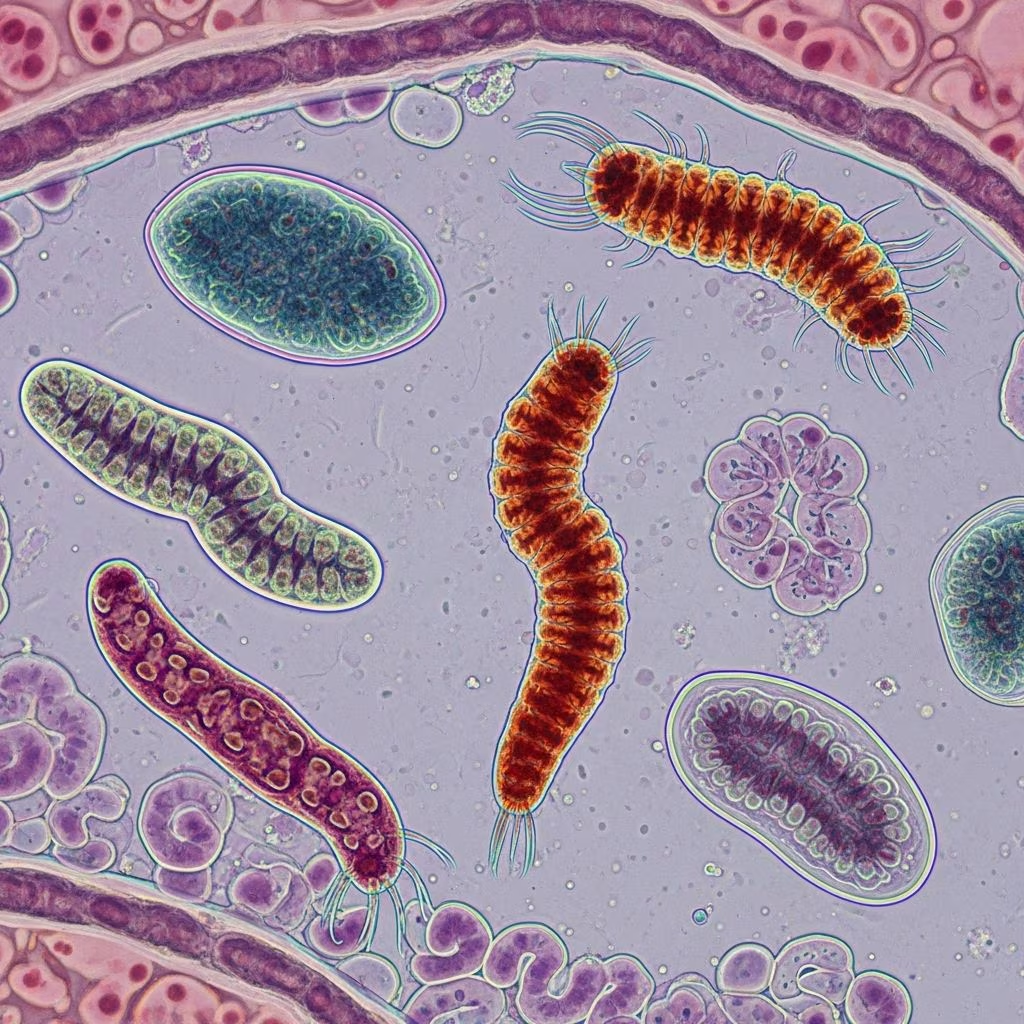
Gastrointestinal parasites pose a significant threat to ruminant livestock, including cattle, sheep, and goats, by causing reduced growth rates, weight loss, and increased susceptibility to other diseases. These organisms, primarily nematodes, disrupt normal digestion and nutrient absorption, leading to substantial economic losses in farming operations globally.
Why Gastrointestinal Parasites Matter in Ruminant Farming
Ruminants rely on a complex digestive system involving the rumen, abomasum, and intestines to ferment and process fibrous plant material. Parasites interfere with this process, particularly in young animals with developing immunity. In high-burden scenarios, parasitic gastroenteritis emerges, characterized by diarrhea, dehydration, and poor feed conversion efficiency.
- Productivity Losses: Infected animals show stunted growth and lower milk yields.
- Health Complications: Secondary infections arise due to weakened immune responses.
- Economic Impact: Treatment costs and mortality rates strain farm budgets.
Effective management requires understanding parasite biology, environmental factors, and host-parasite dynamics to implement targeted interventions.
Core Biology of Ruminant Gut Parasites
Most gastrointestinal parasites in ruminants are nematodes with direct life cycles adapted to pasture-based grazing systems. Eggs exit the host in feces, embryonate in the environment, and develop into infective third-stage larvae (L3) that climb pasture blades for ingestion.
Once consumed, L3 larvae penetrate the gut wall, molt through L4 and L5 stages, and mature into egg-laying adults. The prepatent period—the time from infection to egg production—varies by species, typically 15–42 days, allowing rapid pasture contamination during warm, moist conditions.
| Parasite Stage | Development Site | Duration |
|---|---|---|
| Unembryonated Egg | Feces | Immediate excretion |
| L1 to L3 Larvae | Faecal pat/pasture | 5–10 days |
| L3 (Infective) | Vegetation | Weeks (weather-dependent) |
| L4/L5 to Adult | Gut mucosa/lumen | 7–21 days |
This cycle perpetuates in temperate climates with overlapping grazing seasons, emphasizing the need for pasture hygiene.
Abomasal Parasites: Primary Pathogens in the Stomach
The abomasum, the ‘true stomach’ of ruminants, hosts several damaging nematodes that erode mucosa, reduce acid production, and induce anemia. Haemonchus contortus, known as the barber pole worm, is notorious in small ruminants for its blood-feeding habit, causing severe hypoproteinemia and bottle jaw edema.
In cattle, Ostertagia ostertagi and Trichostrongylus axei dominate, leading to Type I and Type II ostertagiosis. Type II involves arrested larvae overwintering in glands, emerging en masse to cause explosive diarrhea and weight loss.
- Symptoms: Lethargy, pale mucous membranes, reduced appetite.
- Risk Factors: High stocking density, continuous grazing.
These parasites thrive in subtropical regions with summer rainfall, where humidity supports larval survival.
Small Intestine Invaders and Their Effects
Small intestinal nematodes like Trichostrongylus species (T. colubriformis, T. vitrinus) cause protein-losing enteropathy, malabsorption, and watery diarrhea. In lambs and kids, heavy burdens lead to rapid emaciation.
Nematodirus battus is uniquely pathogenic to naive young ruminants. Its synchronous hatch from overwintered eggs coincides with spring grazing, overwhelming immature immune systems within two weeks. Low-rainfall areas favor other Nematodirus spp.
Tapeworms (cestodes) occasionally burden juveniles, contributing to ill thrift but rarely causing outbreaks.
Challenges from Large Intestine Parasites
Colon and cecal residents include Oesophagostomum spp (nodular worms) and Chabertia ovina. Larvae encyst in the wall, provoking nodules that calcify over time, potentially causing stenosis or intussusception.
Clinical signs emerge in acute phases: mucoid, blood-tinged diarrhea, weakness, and dehydration. Chronic infections manifest as intermittent scours and poor condition despite normal intake. O. columbianum is more severe in sheep and goats, while cattle tolerate O. radiatum better.
Whipworms (Trichuris spp) and pinworms add to the burden in heavy infestations, though less commonly problematic.
Symptoms and Clinical Manifestations Across Ruminants
Parasite burdens manifest differently by species and age. Calves, lambs, and kids suffer most due to low immunity.
| Ruminant Type | Common Signs | Severity Factors |
|---|---|---|
| Cattle | Poor weight gain, bottle jaw, diarrhea | High larval challenge post-housing |
| Sheep/Goats | Anemia, edema, sudden death | Haemonchus prevalence |
Diagnosis relies on fecal egg counts (FEC), though limitations exist in cattle where eggs are sparse. Composite sampling and larval cultures enhance accuracy.
Diagnostic Approaches for Accurate Identification
Routine monitoring via FEC guides deworming decisions. McMaster technique quantifies eggs per gram, with thresholds varying by farm and season.
- Composite FECs: Pool 20–40 samples for cost-efficiency.
- Larval Differentiation: Culture feces to hatch L3 for microscopy.
- Advanced Tools: PCR for species-specific detection in research settings.
Necropsy reveals worm burdens and pathology, confirming causes in outbreaks. Blood tests for anemia (packed cell volume) and albumin track Haemonchus impact.
Strategic Control Measures for Sustainable Management
Integrated parasite management (IPM) combines refugia, rotation, and targeted treatments to delay anthelmintic resistance.
- Pasture Management: Avoid overgrazing; rotate with hay aftermaths.
- Selective Treatment: Deworm based on FEC or FAMACHA scoring for anemia.
- Genetic Selection: Breed for parasite resistance.
Anthelmintics like ivermectin, benzimidazoles, and levamisole target L3–L5 stages. Rotate classes to preserve efficacy. Clean grazing—moving lambs to parasite-free pastures after 4 weeks—breaks cycles effectively.
Anthelmintic Resistance: A Growing Concern
Widespread resistance to multiple drug classes threatens control. Factors include under-dosing, frequent blanket treatments, and zero refugia (untreated animals harboring susceptible worms).
Mitigation strategies:
- Fecal egg count reduction tests (FECRT) post-treatment.
- Combination therapies for additive effects.
- Leave 10–20% of herd untreated.
Special Considerations for Small Ruminants
Sheep and goats face higher risks from Haemonchus and Trichostrongylus. Copper oxide wire particles offer long-term control in goats. Multi-species grazing with horses or cattle dilutes contamination.
Future Directions in Parasite Control
Research advances vaccines (e.g., against Haemonchus) and novel biologics. Precision farming with wearable sensors monitors individual health for targeted interventions.
Frequently Asked Questions (FAQs)
What is the most dangerous gut parasite for sheep?
Haemonchus contortus tops the list due to its blood-sucking nature and rapid reproduction in warm climates.
How often should I perform fecal egg counts?
Quarterly on high-risk farms, or monthly during peak transmission seasons.
Can parasites be controlled without drugs?
Yes, through pasture rotation, mixed grazing, and breeding resistant stock, though integrated approaches work best.
Why do young animals suffer more?
They lack acquired immunity, and synchronous larval emergence overwhelms their defenses.
What role does weather play?
Moist, mild conditions (10–25°C) optimize larval development and migration; drought or frost reduces risk.
References
- Parasitic Gastroenteritis in Ruminants — Farm Health Online. 2023. https://www.farmhealthonline.com/en/disease-management/cattle-diseases/parasitic-gastroenteritis-in-ruminants/
- Common Gastrointestinal Parasites of Small Ruminants — Merck Veterinary Manual. 2023-10-15. https://www.merckvetmanual.com/digestive-system/gastrointestinal-parasites-of-ruminants/common-gastrointestinal-parasites-of-small-ruminants
- Common Gastrointestinal Parasites of Cattle — MSD Veterinary Manual. 2023-10-15. https://www.msdvetmanual.com/digestive-system/gastrointestinal-parasites-of-ruminants/common-gastrointestinal-parasites-of-cattle
- Handbook for the Control of Internal Parasites of Sheep and Goats — University of Calgary Veterinary Medicine. 2019. https://vet.ucalgary.ca/sites/default/files/teams/29/Handbook%20for%20the%20Control%20of%20Internal%20Parasites%20of%20Sheep%20and%20Goats.pdf
- Practical guide to the diagnostics of ruminant gastrointestinal parasitism — PMC (National Library of Medicine). 2023-02-10. https://pmc.ncbi.nlm.nih.gov/articles/PMC9906602/



