
Green-Winged Macaw: Personality, Food & Care
Complete guide to green-winged macaw care, diet, personality, and characteristics for pet owners.
What Is A Green-Winged Macaw?
The green-winged macaw, also known as the red-and-green macaw, stands as one of the largest and most magnificent birds in the macaw genus. Measuring approximately 35 to 36 inches from its crimson head to the tip of its tapered tail and weighing between 2.5 to 3.5 pounds, these impressive avians rank among the most substantial members of their species. While often confused with the scarlet macaw due to their similar red coloring, the green-winged macaw possesses distinct characteristics that set it apart. Among the larger macaws, the green-winged macaw ranks as possibly the third most popular large macaw companion, following the blue-and-gold macaw and the scarlet macaw.
Physical Characteristics
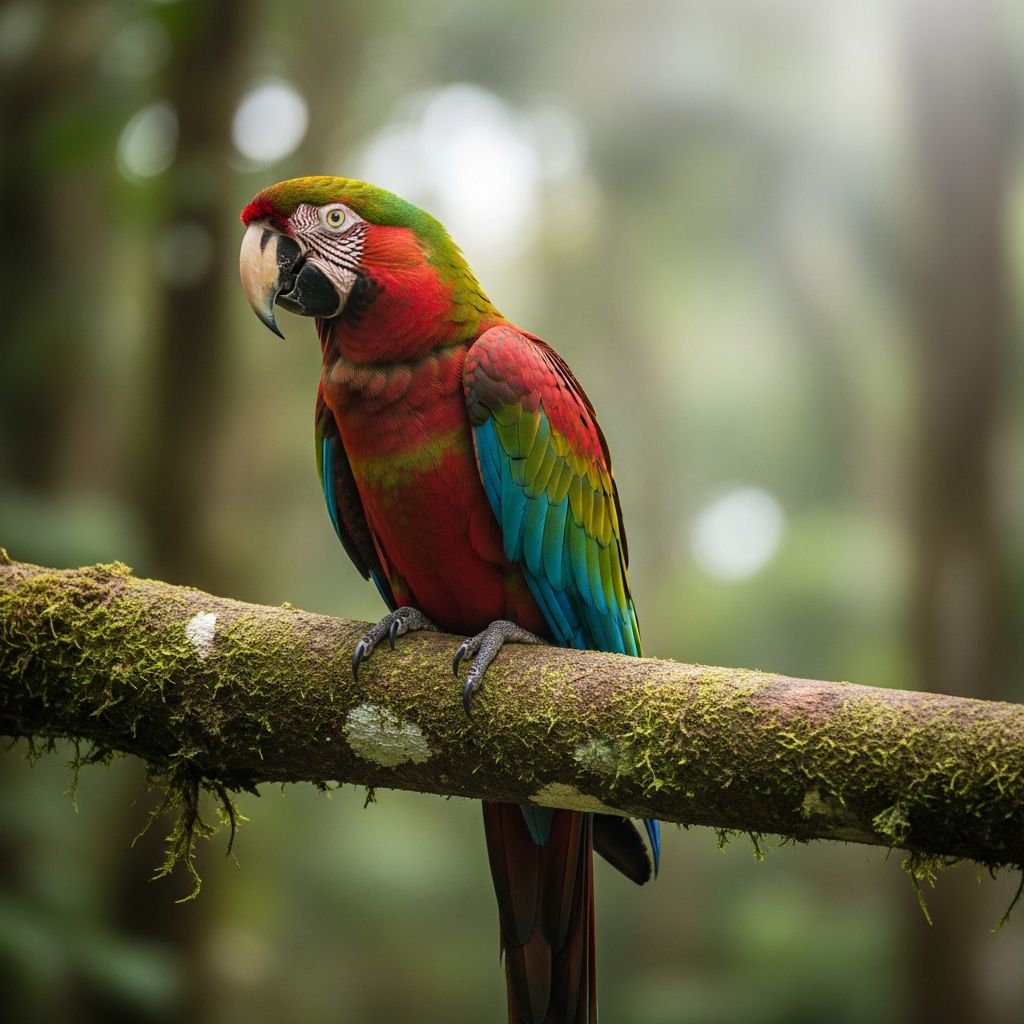
The green-winged macaw displays a striking combination of colors that makes it immediately recognizable among bird enthusiasts. These birds feature a predominantly red body covering their entire frame, from head to the extensive tail. A distinctive forest-green band adorns the center of their wings, complemented by bright turquoise coloring below and cherry-red above. The flight feathers are dark blue, while the very long tail comprises blue and red feathers blended together. The bird’s face is predominantly white, marked with characteristic red lines around the eyes formed by rows of tiny feathers on the otherwise bare white skin patches.
The beak represents one of the green-winged macaw’s most formidable features, with a black lower mandible and horn-colored upper mandible. This powerful beak can generate pressure exceeding 2000 psi, enabling the bird to crack even the most difficult nuts with ease. Gray legs and feet complete the bird’s distinctive appearance, featuring zygodactylous structure with two toes pointing forward and two pointing backward, facilitating their climbing and hanging abilities.
Distinguishing Features from Scarlet Macaws
While green-winged macaws and scarlet macaws share similar red coloration, several key differences help distinguish between these species. The most notable distinction lies in the wing feathers: the green-winged macaw displays green coloring on its upper-wing covert feathers, whereas the scarlet macaw features predominantly yellow coloring. Additionally, the green-winged macaw’s facial patch includes characteristic red lines around the eyes, a feature less prominent in scarlet macaws. When observed side by side, the green-winged macaw appears noticeably larger than its scarlet cousin. Green-winged macaws also tend to be heavier than both blue-and-gold macaws and scarlet macaws.
Size and Physical Specifications
Understanding the specific dimensions of green-winged macaws helps prospective owners prepare appropriate housing and handling considerations:
- Length: 35-36 inches from head to tail tip
- Wingspan: Approximately 4 feet
- Weight: 2.5 to 3.5 pounds
- Size Category: Large
These substantial dimensions make green-winged macaws among the second-largest parrots, rivaled only by the hyacinth macaw. Their size necessitates spacious accommodations and substantial handling capabilities from owners.
Personality and Behavior
Green-winged macaws demonstrate complex behavioral patterns that reflect their high intelligence and social nature. These birds are vocal communicators, known for their loud and raucous screaming, particularly during early morning flights to feeding grounds and evening roosting times. Their vocalizations serve important communication functions within their flocks and territories.
Social Structure
In their natural habitat, green-winged macaws travel in substantial flocks, often accompanied by loud screeching that carries great distances through the forest canopy. They maintain regular roost sites for evening rest and predictably wake to fly toward feeding grounds each morning. These birds are intensely social creatures that interact constantly with their flock members and, when kept as pets, with their human caregivers.
Monogamous Partnerships
Green-winged macaws exhibit remarkable loyalty in their relationships, typically remaining monogamous throughout their entire lives. Pairs stay together even outside breeding season, demonstrating the strong bonds these birds form. This characteristic extends to their relationships with human companions when kept as pets, as they often bond deeply with their primary caretaker.
Habitat and Geographic Distribution
Green-winged macaws inhabit diverse environments throughout their native range, demonstrating remarkable adaptability across different forest types. These birds can be found in tropical forests, swamplands, open savannahs, palm groves, and along riverbanks. Their geographic range extends throughout north and central South America, from Panama to Paraguay, eastward to the Guianas and Trinidad, and south to Argentina. This extensive range represents one of the broadest territorial distributions among macaw species.
Ecological Role
Within their ecosystem, green-winged macaws serve an important function by dispersing seeds and nuts throughout their territory. This dispersal mechanism helps maintain forest health and biodiversity, demonstrating these birds’ significant ecological importance in their native habitats.
Diet and Nutrition
Green-winged macaws are herbivorous birds with sophisticated dietary requirements. Their diet in the wild consists primarily of seeds, fruits, nuts, berries, and leaves obtained from high canopy trees. These large-beaked birds possess the capability to crack and crush hard nut shells, accessing nutritious nut meats inaccessible to other species. Additionally, they consume salts and minerals from riverbank clay deposits.
The Macaw Lick Phenomenon
A fascinating aspect of green-winged macaw behavior involves their regular visits to clay licks along riverbanks. Macaws congregate at mountains of clay known as “macaw licks,” where they consume mineral and salt-rich clay. This behavior helps neutralize toxins from certain fruits they consume, allowing access to a broader range of food sources. The clay consumption provides essential minerals and salts vital to their nutritional needs.
Dietary Recommendations for Captive Macaws
When maintaining green-winged macaws as companions, providing high-quality parrot food formulated specifically for large macaws ensures proper nutrition. Supplementing with fresh fruits, vegetables, and nuts helps replicate their natural diet while maintaining optimal health and vitality.
| Food Type | Importance | Frequency |
|---|---|---|
| Seeds and Nuts | Primary protein and fat source | Daily |
| Fresh Fruits | Vitamins and minerals | Daily |
| Vegetables | Additional nutrients and fiber | Daily |
| Leaves and Foliage | Natural enrichment | Regular |
Lifespan and Longevity
Green-winged macaws are long-lived companions, typically enjoying lifespans of 30 or more years in captivity, with some individuals living 60-80 years. This exceptional longevity means that acquiring a green-winged macaw represents a multi-decade commitment requiring consistent care, attention, and dedication throughout the bird’s life.
Breeding and Reproduction
Understanding green-winged macaw breeding patterns provides insight into their natural behaviors and development cycles. These birds breed from November through April, typically during the wet season when food availability peaks. Breeding pairs nest in tree cavities high off the ground, often positioned at least 100 feet above the forest floor, providing protection from ground-based predators.
Egg Incubation and Chick Development
Female green-winged macaws lay one to three eggs per breeding season, with an incubation period of approximately 28 days. During incubation, the male bird maintains his mate by bringing her food stored in his throat pouch, regurgitating it directly into her mouth. This parental behavior continues after chicks hatch, with both parents regurgitating food for their offspring.
Chick development follows a predictable timeline:
- First down feathers appear approximately 8 days after hatching
- Eyes open after roughly 15 days
- First feather sheaths emerge at approximately 3 weeks of age
- Chicks fledge after 90 days
- Independence achieved between 6 to 12 months of age
- Sexual maturity reached at 3 to 4 years of age
Natural Abilities and Adaptations
Green-winged macaws possess several remarkable abilities that contribute to their success in their native environment. These birds can reach speeds of up to 56 kilometers per hour (35 miles per hour) during flight, allowing rapid movement through their expansive territories. Their powerful beaks serve multiple functions beyond cracking nuts: they use their beaks as a third limb when climbing through trees, providing additional grip and stability.
Thermoregulation
Living in humid tropical forests, green-winged macaws have evolved specialized thermoregulation mechanisms. Their bare cheek pads and large, vascularized beaks play crucial roles in temperature regulation. As their internal temperature rises, blood vessels in their faces and beaks dilate, increasing blood flow close to the skin surface. This evaporative cooling process allows heat to diffuse from their bodies, helping maintain optimal body temperature in their warm, humid native environment.
Defense Mechanisms and Predators
Green-winged macaws employ multiple defense strategies to protect themselves and their flock members from threats. Their bright coloration serves as a warning signal to potential predators regarding their formidable power and defensive capabilities. Eagles represent the most likely predators of adult macaws. When one macaw detects an eagle circling overhead, it sounds an alarm cry that alerts the entire flock. Multiple macaws may rush together toward the eagle, shrieking loudly until the predator retreats. These birds defend themselves vigorously using both their powerful feet and their formidable beaks.
Conservation Status and Threats
Among the biggest threats facing wild green-winged macaws is deforestation throughout their native South American habitats. The destruction of tropical rainforests eliminates critical nesting sites, feeding grounds, and overall habitat. Prospective macaw owners can contribute to conservation efforts by purchasing recycled paper products, thereby reducing demand for virgin timber and slowing deforestation rates that threaten wild populations.
Frequently Asked Questions
Q: How do I distinguish a green-winged macaw from a scarlet macaw?
A: The most reliable distinguishing feature is the wing coloring: green-winged macaws have green upper-wing covert feathers, while scarlet macaws have yellow coloring. Green-winged macaws also display characteristic red lines around the eyes and are noticeably larger than scarlet macaws.
Q: What is the typical lifespan of a green-winged macaw?
A: Green-winged macaws typically live 30 or more years in captivity, with some individuals reaching 60-80 years of age, making them exceptionally long-lived companions requiring lifelong commitment.
Q: How loud are green-winged macaws?
A: Green-winged macaws are vocal communicators known for their raucous screaming, particularly during early morning and evening hours. They require adequate space in rural or accommodating environments.
Q: What do green-winged macaws eat?
A: These herbivorous birds eat seeds, nuts, fruits, berries, and leaves. When kept as companions, they should receive high-quality parrot food supplemented with fresh fruits, vegetables, and nuts.
Q: Are green-winged macaws monogamous?
A: Yes, green-winged macaws are monogamous birds that typically remain with one partner for their entire lives, whether in the wild or in captive settings.
Q: How powerful is a green-winged macaw’s beak?
A: Their beaks can generate pressure exceeding 2000 psi, capable of cracking the hardest nuts and even snapping a broomstick in half.
Q: What size accommodations do green-winged macaws require?
A: Given their large size (35-36 inches long with approximately 4-foot wingspan), green-winged macaws require spacious cages or aviaries with ample room for movement and exercise.
References
- Green-Winged Macaw Personality, Food & Care — Lafeber Company. Accessed 2025. https://lafeber.com/pet-birds/species/green-winged-macaw/
- Green-Winged Macaw Facts and Information — San Francisco Zoo & Gardens. Accessed 2025. https://www.sfzoo.org/green-winged-macaw/
- Green-Winged Macaw | Stone Zoo — Zoo New England. Accessed 2025. https://www.zoonewengland.org/stone-zoo/our-animals/birds/green-winged-macaw/
- Green-Winged Macaw Facts and Information — United Parks & Resorts (SeaWorld). Accessed 2025. https://seaworld.org/animals/facts/birds/green-winged-macaw/
- Green-Winged Macaw Attraction — Central Florida Zoo. Accessed 2025. https://www.centralfloridazoo.org/animals/green-winged-macaw/
- Red-and-Green Macaw — Wikipedia. Accessed 2025. https://en.wikipedia.org/wiki/Red-and-green_macaw
Similar Articles








Read full bio of Sneha Tete


