Great Pyrenees and Cats: Compatibility Guide
Learn if Great Pyrenees make suitable companions for cat owners and how to introduce them safely.
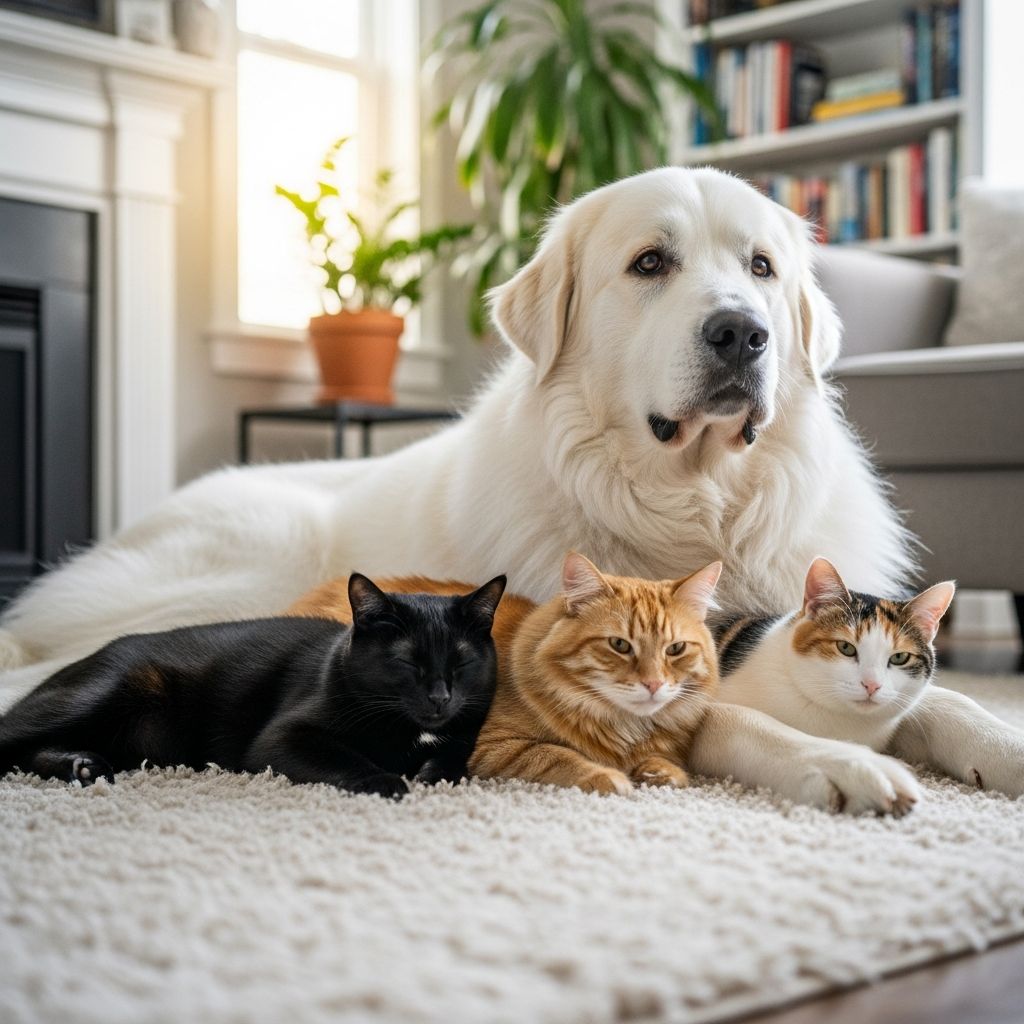
The prospect of bringing a Great Pyrenees into a household that already includes cats—or adding felines to a home with this majestic breed—raises important questions about compatibility and safety. While cats and dogs are often portrayed as natural enemies, the reality is far more nuanced. Many dog breeds can coexist peacefully with cats when proper conditions are met, and the Great Pyrenees stands out as one of the breeds better suited for multi-pet households that include felines.
Understanding the Great Pyrenees Breed Foundation
To determine whether Great Pyrenees can live harmoniously with cats, it helps to understand their original purpose and breeding history. These impressive dogs were developed centuries ago as livestock guardians, tasked with protecting flocks of sheep and other farm animals from predators in the Pyrenees Mountains. This heritage fundamentally shaped their temperament and behavior patterns in ways that remain relevant today.
Unlike hunting dog breeds that were developed to pursue and capture prey, Great Pyrenees were bred for an entirely different purpose. Their role was protective rather than predatory. They needed to be gentle with the animals they guarded while remaining vigilant against external threats. This distinction is crucial when evaluating their potential compatibility with household cats. The breed was not engineered to chase smaller animals or to view them as targets; instead, they were conditioned to see creatures within their domain as part of their responsibility to protect.
Temperament Characteristics That Support Cat Compatibility
Great Pyrenees possess several inherent qualities that make them promising candidates for homes with cats. These characteristics stem from both their breeding history and the natural disposition of the breed.
- Calm and Patient Demeanor: The breed is renowned for maintaining composure and patience with family members. This tranquil nature extends to their interactions with other animals when properly socialized.
- Low to Moderate Prey Drive: Unlike terriers or herding dogs that possess intense prey drives, Great Pyrenees generally lack the instinct to chase small, moving creatures. Their protective instincts do not translate into hunting behaviors.
- Protective Guardian Mentality: Rather than viewing cats as adversaries, Great Pyrenees often adopt a protective stance toward smaller animals in their household, potentially seeing them as part of their flock to safeguard.
- Gentle Nature: The breed is widely recognized as a gentle giant, capable of modulating their strength and behavior around more vulnerable companions.
- Independent Thinking: While this trait requires patient training, their independence means they are less likely to be driven by reactive instincts toward cats.
Individual Variation and the Role of Early Socialization
While breed tendencies provide a useful framework for understanding Great Pyrenees behavior, individual personality differences can be significant. Not every Great Pyrenees will interact identically with cats, just as not every cat will respond the same way to dogs. A dog’s early experiences, individual temperament, and exposure to cats during critical developmental periods all play substantial roles in determining compatibility.
Early socialization stands as one of the most powerful factors influencing successful cat-dog relationships. Dogs introduced to cats during puppyhood develop different neural pathways and behavioral patterns compared to those encountering cats for the first time as adults. Puppies exposed to feline playmates learn to recognize cats as companions rather than novelties or threats. Similarly, kittens raised alongside dogs develop comfort and familiarity with canine behavior patterns, reducing fear responses that might otherwise trigger defensive reactions.
For existing pets without the advantage of early joint socialization, success becomes more challenging but remains achievable with patience, gradual exposure, and consistent management. The dog’s prior contact with cats, if any, becomes relevant to predicting their response to new feline household members.
The Introduction Process: Creating Positive First Encounters
Successfully introducing a Great Pyrenees to a cat—or vice versa—requires deliberate planning and patience rather than assuming their breed compatibility guarantees immediate harmony.
Phase One: Establishing Separate Comfort Zones
The initial stage involves keeping the animals physically separated while allowing them to become aware of each other’s presence. Place the dog and cat in different areas of the home, allowing them to smell and hear each other through closed doors or gates. This period might extend from several days to weeks, depending on each animal’s temperament and any anxiety they display. Playing together during this phase, even when separated, helps build positive associations with the other’s presence.
Phase Two: Supervised Visual Contact
Once both animals show calm behavior during the separation phase, arrange controlled visual contact. Keep the dog on a leash during these encounters to maintain control and reassure both animals of safety. Allow them to observe each other from a distance initially, rewarding calm behavior with treats and praise. Gradually decrease the distance between them over multiple sessions. This phase typically spans one to three weeks but varies based on individual responses.
Phase Three: Controlled Interaction
When both animals demonstrate consistent calm behavior during visual contact, allow closer interaction while maintaining the leash. Permit them to sniff one another briefly, and be prepared for the cat to hiss or swipe if uncomfortable—this represents normal boundary-setting behavior. Immediately redirect the dog’s attention if they become too interested or begin to chase. Do not allow the interaction to escalate; keep sessions short and positive.
Phase Four: Supervised Off-Leash Time
Once the leashed interactions proceed smoothly, allow brief off-leash time in a controlled environment where the cat has escape routes and high perches. Ensure the cat can access safe spaces the dog cannot reach. Monitor all interactions closely, maintaining the ability to intervene quickly if needed. Gradually increase the duration of these supervised sessions as the relationship develops.
Potential Challenges and Practical Solutions
Even with careful introduction procedures, certain issues may emerge during the integration process. Understanding these common challenges enables proactive management.
Excessive Interest or Chasing Behavior
Some Great Pyrenees, particularly those with higher-than-typical prey drive or inadequate cat exposure, may display persistent interest in chasing cats. The dog’s large size means that even playful pursuit can terrify a cat or cause accidental injury. If chasing occurs, immediately redirect the dog’s attention using commands or toys. Engage the dog in alternative activities, and temporarily increase separation between the animals. Repeat the introduction process at a slower pace.
Fearful or Aggressive Cat Responses
Cats may respond to dogs with fear-based hissing, swatting, or hiding. While some of this behavior represents normal adjustment, persistent fear suggests the introduction pace is too rapid. Grant both animals more space and increase the time spent in the separation phases. Patience often resolves cat anxiety as they recognize the dog poses no threat.
Resource Competition
Feeding and water bowl proximity can create unnecessary tension. Place cat food and water in areas the dog cannot easily access. This prevents resource guarding behaviors and allows each animal to eat without stress. Separate feeding stations eliminate a common source of conflict.
Training Techniques That Support Coexistence
Beyond the introduction process, specific training approaches help Great Pyrenees live safely with cats:
- Recall Commands: A reliable “come” command gives owners the ability to call the dog away from the cat if needed, providing an essential safety tool.
- Leave It Command: Teaching the dog to ignore the cat on command prevents unwanted chasing or investigation during moments of excitement.
- Settle or Place Command: Training the dog to go to a specific location and remain calm helps manage excitement around the cat.
- Impulse Control: Games and exercises that build impulse control, such as waiting before meals or play sessions, translate to better self-regulation around cats.
- Positive Reinforcement Around Cats: Rewarding calm, gentle behavior in the cat’s presence strengthens desirable interactions and builds positive associations.
Long-Term Management and Supervision Requirements
Successfully introducing a Great Pyrenees to cats does not mean eliminating all supervision or management. Even bonded dog-cat pairs benefit from ongoing oversight, particularly during high-energy situations or when new elements enter the household.
During the initial weeks and months, never leave the animals unsupervised together. As their relationship stabilizes, supervised time can increase, but many households continue to separate animals at night or during extended alone periods. This practice prevents accidents and reduces stress on both animals. High-energy play sessions, mealtimes, and moments when the dog is particularly excited warrant increased attentiveness.
Environmental management—including multiple escape routes for cats, elevated resting areas, and separate resource stations—supports long-term peaceful coexistence. These environmental supports reduce friction and provide each animal with autonomous control over their interactions.
Success Rates and Real-World Outcomes
Evidence from breed rescue organizations and experienced breeders suggests that Great Pyrenees show high compatibility rates with cats when properly introduced and socialized. Rescue workers who assessed dogs for cat compatibility reported success rates exceeding 90 percent among Great Pyrenees in their care, with most dogs either peacefully coexisting with or actively protecting cats in their adoptive homes.
The small percentage of unsuccessful placements typically involved dogs with atypical prey drives for the breed or those with limited prior exposure to cats. These cases underscored the importance of individual assessment alongside breed tendencies.
Assessing Your Specific Situation
Before bringing a Great Pyrenees into a cat-containing household, honestly evaluate your specific circumstances:
- Is your cat fearful, anxious, or highly reactive to dogs? Fearful cats may require extended adjustment periods.
- Does your dog have any documented aggression toward other animals? Past behavior provides valuable predictive information.
- Can you commit to a gradual introduction process spanning weeks or months rather than days?
- Do you have the physical space to maintain temporary separation while building the relationship?
- Are you prepared for the possibility that your specific dog and cat may not become close companions, even if coexistence is peaceful?
Frequently Asked Questions
Are Great Pyrenees naturally aggressive toward cats?
No, Great Pyrenees are not naturally aggressive toward cats. Their guardian heritage means they typically see cats as creatures to protect rather than threat or prey. Individual temperament variations exist, but aggression toward cats is uncommon in the breed and more likely reflects inadequate socialization or unusual individual traits rather than breed characteristics.
What age should a Great Pyrenees be to live safely with cats?
Introducing puppies to cats is ideal, as young dogs learn to view cats as normal household members. However, adult Great Pyrenees can successfully adapt to cats through careful introduction. The animal’s prior exposure to cats matters more than absolute age.
How long does adaptation typically require?
Timeline varies considerably based on individual animals, ranging from several days for well-socialized puppies to several weeks or months for adult dogs meeting cats for the first time. Patience and consistency matter more than speed.
Can a Great Pyrenees accidentally injure a cat despite good intentions?
Yes. A Great Pyrenees’ size means that playful behavior, even when well-intentioned, can injure a much smaller cat. This underscores the importance of supervision, especially during play and the adjustment period.
Should cats and Great Pyrenees sleep together?
Initially, no. Maintain separate sleeping arrangements until the relationship is well-established and both animals show consistent calm behavior together. Many households continue separate sleeping areas long-term as a safety and comfort measure.
References
- Are Great Pyrenees Dogs Good with Cats? Vet-Verified Facts & Info — Hepper. 2024. https://articles.hepper.com/are-great-pyrenees-dogs-good-with-cats/
- Are Great Pyrenees Good With Cats? — Zoorithm. 2024. https://www.zoorithm.com/cats/are-great-pyrenees-good-with-cats
- Great Pyrenees and Cats — Colorado Great Pyrenees Rescue. 2012. http://coloradogreatpyreneesrescue.blogspot.com/2012/01/great-pyrenees-and-cats.html
- Pyrs with Cats — Great Pyrenees Club of Southern Ontario. https://www.great-pyrenees-club-of-southern-ontario.com/pyrs-with-cats.html
Similar Articles






Read full bio of Sneha Tete